
DEVELOPING CULTURAL TOURISM IN MUEANG NAN DISTRICT, NAN PROVINCE
Keywords:
Development, Cultural Tourism, Participation, Creative Culture, Mueang Nan DistrictAbstract
This study aimed to: 1) examine cultural tourism management in Mueang Nan District, Nan Province; 2) investigate the development of cultural tourism activities in Mueang Nan District, Nan Province; and 3) explore approaches to promoting and advancing cultural tourism in Mueang Nan District, Nan Province. The study employed a qualitative research design. Data were collected through structured in-depth interviews with 25 key informants and a focus group discussion involving 10 participants. The data were analyzed using content analysis.
The research findings revealed that:
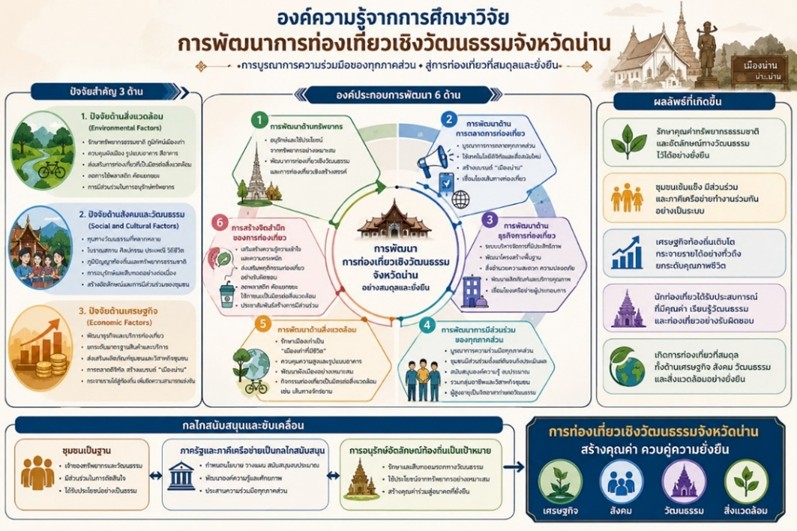
1) Mueang Nan District, Nan Province, possesses considerable potential for cultural tourism development due to its distinctive cultural capital, including its history, arts, architecture, temples, traditions, ways of life, and local wisdom. The Nan Old Town area, in particular, serves as a significant center of cultural heritage. The SWOT analysis of cultural tourism management in Mueang Nan District indicated the importance of integrating collaboration among government agencies, the private sector, local communities, and religious institutions in order to achieve a balance between cultural heritage conservation and tourism-driven economic development.
2) The development of cultural tourism activities should focus on promoting local identity through historical learning, religious tourism, local arts and crafts, community-based tourism, and creative tourism. Such activities should provide opportunities for tourists to actively participate in cultural experiences, thereby enhancing their understanding and appreciation of local cultural values.
3) Approaches to advancing cultural tourism should include the development of digital promotional media, the strengthening of collaborative networks, the enhancement of personnel capacity, and the application of technology to tourism destination management. These efforts should be grounded in community participation, cultural value conservation, and the principles of sustainable development.
References
กระทรวงการท่องเที่ยวและกีฬา. (2566). แผนพัฒนาการท่องเที่ยวแห่งชาติ ฉบับที่ 3 (พ.ศ. 2566–2570). กรุงเทพฯ: กระทรวงการท่องเที่ยวและกีฬา.
จังหวัดน่าน. (2567). แผนพัฒนาจังหวัดน่าน พ.ศ. 2566–2570 (ฉบับทบทวน). น่าน: จังหวัดน่าน.
นัสชนะ ส่างช้าง. (2567). บทบาทของชุมชนท้องถิ่นในกระบวนการพัฒนาที่ยั่งยืน. วารสารนวัตกรรมสังคมศาสตร์, 1(2), 45–55. https://so13.tci-thaijo.org/index.php/jssi/article/view/1215
พลกฤต รักจุล. (2569). การพัฒนารูปแบบเส้นทางการท่องเที่ยวเชิงวัฒนธรรมโดยใช้การวิเคราะห์องค์ประกอบเชิงยืนยัน: กรณีศึกษาอำเภอเมือง จังหวัดน่าน. วารสารวิทยาการจัดการมหาวิทยาลัยราชภัฏพิบูลสงคราม, 8(2), 205–224. https://so03.tci-thaijo.org/index.php/jmspsru/article/view/295991
พงศ์พันธ์ อนันต์วรณิชย์. (2564). การพัฒนาตัวแบบกระบวนการพัฒนาการท่องเที่ยวเชิงวัฒนธรรมและเชิงสร้างสรรค์: กรณีศึกษาจากการพัฒนาการท่องเที่ยวชุมชนเชิงวัฒนธรรมและเชิงสร้างสรรค์ 3 ชุมชน. วารสารการจัดการธุรกิจ มหาวิทยาลัยบูรพา, 10(2), 65–90.
https://so01.tci-thaijo.org/index.php/BJBM/article/view/249459
มณีรัตน์ สุขเกษม, และนุชเนตร กาฬสมุทร์. (2561). The sustainable creative tourism management: World heritage site-cultural heritage alive: A case study of Historical Town of Sukhothai and Associated Historic Towns. RMUTI Journal Humanities and Social Sciences, 5(1), 160–178.
https://so05.tci-thaijo.org/index.php/RMUTI_SS/article/view/189670
สำนักงานสภาพัฒนาการเศรษฐกิจและสังคมแห่งชาติ. (2565). แผนพัฒนาเศรษฐกิจและสังคมแห่งชาติ ฉบับที่ 13 (พ.ศ. 2566–2570). กรุงเทพมหานคร.
Bramwell, B., & Lane, B. (2011). Critical research on the governance of tourism and sustainability. Journal of Sustainable Tourism, 19(4–5), 411–421. https://doi.org/10.1080/09669582.2011.580586
Butler, R. W. (1980). The concept of a tourist area cycle of evolution: Implications for management of resources. The Canadian Geographer / Le Géographe canadien, 24(1), 5–12. https://doi.org/10.1111/j.1541-0064.1980.tb00970.x
Howkins, J. (2013). The Creative Economy: How People Make Money from Ideas (2nd ed.). Penguin.
Organisation for Economic Co-operation and Development. (2020). Culture Shock: COVID-19 and the Cultural and Creative Sectors. OECD Publishing.
Poonklat, V., Tharathuek, B., & Wongpaisanlux, S. (2023). Community-based tourism for the sustainable development. Interdisciplinary Academic and Research Journal, 3(2), 793–812. https://doi.org/10.14456/iarj.2023.106
Richards, G. (2021). Rethinking Cultural Tourism. Edward Elgar Publishing.
Richards, G. W., & Raymond, C. (2000). Creative tourism. ATLAS News, 23, 16–20. https://research.tilburguniversity.edu/en/publications/creative-tourism/
Nowacki, M. (2021). Heritage interpretation and sustainable development: A systematic literature review. Sustainability, 13(8), Article 4383. https://doi.org/10.3390/su13084383
United Nations Educational, Scientific and Cultural Organization. (2022). Culture: 2030 Indicators. Paris: UNESCO.
United Nations Educational, Scientific and Cultural Organization. (2024). UNESCO Creative Cities Network. Paris: UNESCO.
United Nations World Tourism Organization. (2004). Indicators of Sustainable Development for Tourism Destinations: A Guidebook. Madrid: UNWTO.
United Nations World Tourism Organization. (2018). Tourism and Culture Synergies. Madrid: World Tourism Organization.
United Nations. (2015). Transforming Our World: The 2030 Agenda for Sustainable Development. New York: United Nations.
Downloads
Published
How to Cite
Issue
Section
License
Copyright (c) 2026 Journal of Contemporary Buddhist Society = JCBS

This work is licensed under a Creative Commons Attribution-NonCommercial-NoDerivatives 4.0 International License.



