
BUDDHIST LEADERSHIP OF SCHOOL ADMINISTRATORS IN THE 21ST CENTURY
Keywords:
Buddhist leadership, school administrators, 21st Century, BANI World, BuddhadhammaAbstract
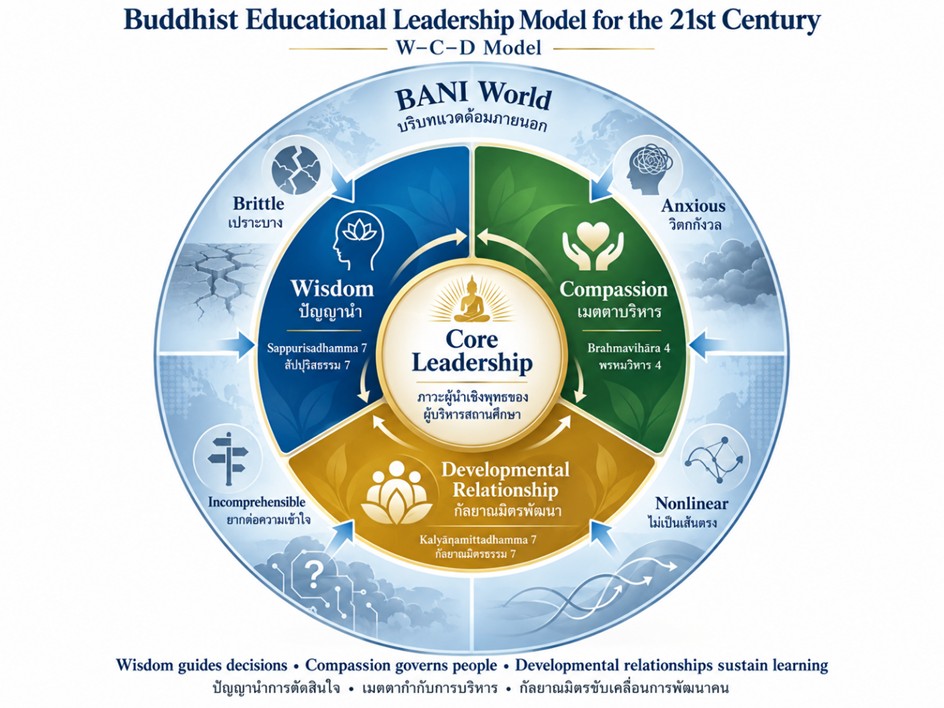
This academic article aims to analyze and synthesize the concept of Buddhist leadership for school administrators in the 21st century amid technological and social transformation and the conditions of the BANI World, characterized by brittleness, anxiety, nonlinearity, and incomprehensibility. The analysis draws on contemporary leadership concepts, educational administration literature, and three sets of Buddhist principles: the Seven Sappurisadhammas, the Four Brahmavihāras, and the Seven Kalyāṇamittadhammas. The synthesis indicates that Buddhist leadership is not merely concerned with the personal morality of administrators; rather, it represents a leadership process that integrates wisdom, ethics, relationships, and managerial competencies. The Seven Sappurisadhammas provide a foundation for wisdom, self-awareness, contextual understanding, and decision-making. The Four Brahmavihāras serve as a foundation for people management based on loving-kindness, compassion, appreciative joy, and fairness, while the Seven Kalyāṇamittadhammas support communication, coaching, mentoring, and personnel development. Based on this synthesis, the article proposes the Buddhist Educational Leadership Model for the 21st Century: W–C–D Model, comprising three dimensions: Wisdom-Based Leadership, Compassionate Management, and Developmental Relationship. The model can be applied to policy formulation, teacher management, student development, the ethical use of artificial intelligence and digital technologies, conflict management, organizational culture building, and collaboration with parents and communities. The model emphasizes that school administrators in the 21st century should lead with wisdom, manage with compassion, and develop people through constructive developmental relationships in order to enhance organizational adaptability, educational quality, ethical governance, and sustainable school development.
References
ชฎาภัทร เปี่ยมอินทร์. (2569). ผู้บริหารสถานศึกษานวัตกรรมและเทคโนโลยีการบริหารการศึกษายุคดิจิทัล. วารสารวิจยวิชาการ, 9(5), 447–466. https://so06.tci-thaijo.org/index.php/jra/article/view/292279
ชนิดา สารทอง, และธิดาวัลย์ อุ่นกอง. (2568). ภาวะผู้นำทางวิชาการของผู้บริหารสถานศึกษาในยุคดิจิทัล. วารสารบริหารการศึกษาบัวบัณฑิต. 25(1), 340-354. https://so06.tci-thaijo.org/index.php/BUAJEAD/article/view/280043
ธีระพงษ์ สมเขาใหญ่, และสุเวศ กลับศรี. (2569). การบริหารสถานศึกษาแบบมีส่วนร่วมของผู้บริหารสถานศึกษาตามหลักสังคหวัตถุ 4 ในศูนย์เครือข่ายการศึกษาที่ 10 อำเภอช้างกลาง สังกัดสำนักงานเขตพื้นที่การศึกษาประถมศึกษานครศรีธรรมราช เขต 2. วารสารศรีสุวรรณภูมิปริทรรศน์, 4(3), 244–257. https://so14.tci-thaijo.org/index.php/JSBR/article/view/3359
พระใบฎีกาสรชัย ชินวโร, พระมหาทวีศักดิ์ คุณธมฺโม, และกิตติพงษ์ ขวัญเมือง. (2568). แนวทางการบริหารสถานศึกษาแบบมีส่วนร่วมเพื่อสร้างชุมชนการเรียนรู้. วารสารสหวิทยาการนวัตกรรมปริทรรศน์, 8(2), 167–177. https://so04.tci-thaijo.org/index.php/jidir/article/view/277860
พระมหาจิรศักดิ์ คุณวํโส. (2569). การศึกษาวิเคราะห์หลักสัปปุริสธรรม 7 กับการพัฒนาภาวะผู้นำในศตวรรษที่ 21. วารสารวิชาการจินตาสิทธิ์ (Online), 4(2). https://so19.tci-thaijo.org/index.php/Chintasit/article/view/3651
พระมหาบันเจตร์ ถิรจิตฺโต (บรรเทาใจ). (2567). แนวทางการเสริมสร้างทักษะของผู้นำในการจัดการองค์กรยุค BANI World ตามหลักพละ 4. วารสารระบบนิเวศการเรียนรู้และปัญญา, 2(2), 1–11. https://so13.tci-thaijo.org/index.php/j_ecosystem_wisdom/article/view/1027
พนิดา ฐานขันแก้ว, และชิษณพงศ์ ศรจันทร์. (2569). ภาวะผู้นำที่แท้จริงของผู้บริหารสถานศึกษาที่ส่งผลต่อการปฏิบัติงานของครู สังกัดสำนักงานเขตพื้นที่การศึกษาประถมศึกษาเลย เขต 1. วารสารบัณฑิตศึกษาปริทรรศน์. https://so02.tci-thaijo.org/index.php/JGSR/article/view/286644
มหาจุฬาลงกรณราชวิทยาลัย. (2539). พระไตรปิฎกภาษาไทย ฉบับมหาจุฬาลงกรณราชวิทยาลัย. โรงพิมพ์มหาจุฬาลงกรณราชวิทยาลัย.
วาสนา ดิษฐ์ประดับ, กาญจนา บุญส่ง, และเสนาะ กลิ่นงาม. (2567). ภาวะผู้นำกับการบริหารสถานศึกษาในยุคดิจิทัล. วารสารศึกษาศาสตร์ มหาวิทยาลัยบูรพา, 35(3), 1–14. https://so02.tci-thaijo.org/index.php/edubuu/article/view/268011
สำนักงานคณะกรรมการข้าราชการครูและบุคลากรทางการศึกษา. (2567). หลักเกณฑ์และวิธีการประเมินตำแหน่งและวิทยฐานะข้าราชการครูและบุคลากรทางการศึกษา ตำแหน่งผู้บริหารสถานศึกษา และที่แก้ไขเพิ่มเติม. https://www.otepc.go.th/th/pa-download/pa-criteria/item/5170-1933-2567.html
สำนักงานคณะกรรมการข้าราชการครูและบุคลากรทางการศึกษา. (2569). สรุปภาระงานตำแหน่งผู้บริหารสถานศึกษา (ทุกสังกัด). https://otepc.go.th/en/pa-infographic/item/5996-2026-09-01-07-42-10.html
สุวรรณา มานพ, โกสุม สายใจ, และรพี ม่วงนนท์. (2568). ภาวะผู้นำดิจิทัลของผู้บริหารสถานศึกษา. วารสาร มจร สังคมศาสตร์ปริทรรศน์. https://so03.tci-thaijo.org/index.php/jssr/article/view/286761
อนุวัตร เลิศประวัติ. (2569). การประยุกต์ใช้หลักพุทธธรรมเพื่อเสริมสร้างสมรรถนะหลักของผู้บริหารสถานศึกษา: กรณีศึกษาสำนักงานเขตพื้นที่การศึกษาประถมศึกษาพระนครศรีอยุธยา เขต 2. วารสารวิรุฬห์ศาสตร์ปริทัศน์, 2(2), 12–22. https://so13.tci-thaijo.org/index.php/JWR/article/view/4169
กอบชัย เมฆดี, ธีระวัฒน์ มอนไธสง และอัจฉรา นิยมาภา. (2568). การมีส่วนร่วมของชุมชนในสถานศึกษายุคใหม่ สังกัดสำนักงานเขตพื้นที่การศึกษามัธยมศึกษา. วารสารสังคมพัฒนศาสตร์. 8(12), 249–257. https://so07.tci-thaijo.org/index.php/JSSD/article/view/9773
Boeskens, L., & Meyer, K. (2025). Policies for the digital transformation of school education: Evidence from the Policy Survey on School Education in the Digital Age. OECD Education Working Papers, 328. OECD Publishing. https://doi.org/10.1787/464dab4d-en
Global Education Monitoring Report Team. (2024). Global education monitoring report 2024/5: Leadership in education—Lead for learning. UNESCO. https://www.unesco.org/gem-report/en/publication/leadership
He, P., Guo, F., & Abazie, G. A. (2024). School principals’ instructional leadership as a predictor of teacher’s professional development. Asian-Pacific Journal of Second and Foreign Language Education, 9, Article 63. https://doi.org/10.1186/s40862-024-00290-0
Miao, F., & Holmes, W. (2023). Guidance for generative AI in education and research. UNESCO. https://unesdoc.unesco.org/ark:/48223/pf0000386693
Miao, F., Shiohira, K., & Lao, N. (2024). AI competency framework for students. UNESCO. https://unesdoc.unesco.org/ark:/48223/pf0000391105
OECD. (2025). Preparing teachers for digital education: Continuing professional learning on digital skills and pedagogies (OECD Education Policy Perspectives No. 122). OECD Publishing. https://doi.org/10.1787/af442d7a-en
Schleicher, A. (2015). Schools for 21st-century learners: Strong leaders, confident teachers, innovative approaches. OECD Publishing. https://doi.org/10.1787/9789264231191-en
Downloads
Published
How to Cite
Issue
Section
License
Copyright (c) 2026 Journal of Contemporary Buddhist Society = JCBS

This work is licensed under a Creative Commons Attribution-NonCommercial-NoDerivatives 4.0 International License.



