THE DEVELOPMENT OF HOLISTIC HEALTH OF TAI YAI ELDERLY IN WAT NIWASATHAN COMMUNITY, MAE AI SUBDISTRICT, MAE AI DISTRICT, CHIANG MAI PROVINCE THROUGH THE "KARN KAM SIN NON JONG" CULTURE
Keywords:
Holistic Health, Tai Yai Elderly, Karn Kam Sin Non Jong, Cultural Capital, Bowon 4-Sook ModelAbstract
This study aimed to: 1) examine the well-being of Tai Yai older adults in the Wat Niwasathan community, Mae Ai Subdistrict, Mae Ai District, Chiang Mai Province; 2) develop health-promoting activities based on the cultural practice of “Kan Kam Sin Non Chong”; and 3) transfer and evaluate activities for empowering the well-being of Tai Yai older adults. This study employed a qualitative participatory approach based on Participatory Action Research (PAR). A total of 44 key informants were purposively selected, including Tai Yai older adults, Buddhist monks, community leaders and ritual knowledge holders, village health volunteers, and family members. Data were collected through in-depth interviews, focus group discussions, participant observation, and field notes, and were analyzed using content analysis and inductive synthesis.
The findings revealed that:
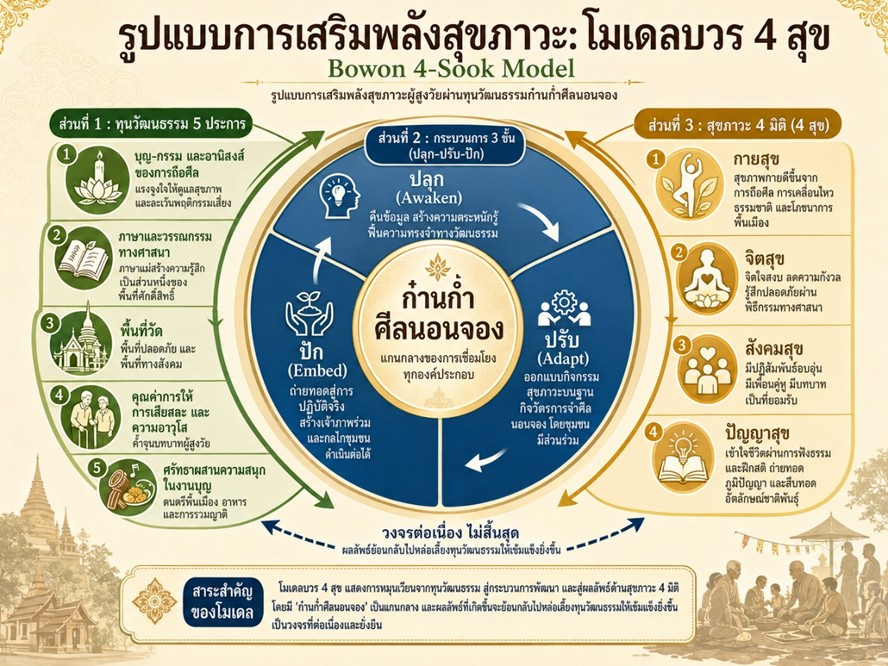
1) the well-being of Tai Yai older adults was interconnected across physical, mental, social, and wisdom/spiritual dimensions. Vulnerabilities were associated with chronic illnesses, social isolation, and declining social roles, while Buddhism, the temple, local wisdom, and the cultural practice of Kan Kam Sin Non Chong served as important resources for strengthening mental and wisdom/spiritual well-being; 2) the participatory development process resulted in a set of five activities entitled Chong Dee, Lee Mee Sook, integrating physical, mental, social, and wisdom/spiritual well-being into the community’s traditional practices of observing Buddhist precepts and religious activities; and 3) reflection and evaluation of the activities led to the development of the Bowon 4-Sook Model, comprising five forms of cultural capital, a three-stage process—Awaken, Adapt, and Embed—and four dimensions of well-being: Physical Well-being, Mental Well-being, Social Well-being, and Wisdom/Spiritual Well-being, with Kan Kam Sin Non Chong serving as the core that connects all components. The study demonstrates that health promotion for older adults in ethnic communities should be grounded in existing religious and cultural capital and community participation so that interventions are consistent with local ways of life and cultural identity.
References
กรมสุขภาพจิต. (2564). แบบประเมินโรคซึมเศร้าด้วย 9 คำถาม (9Q). กระทรวงสาธารณสุข.
จักรแก้ว นามเมือง. (2560). โรงเรียนผู้สูงอายุ: ต้นแบบการจัดการสุขภาวะและสวัสดิการผู้สูงอายุ [รายงานการวิจัย]. มหาวิทยาลัยมหาจุฬาลงกรณราชวิทยาลัย วิทยาเขตพะเยา.
จิตติยา สมบัติบูรณ์, นุชนาถ ประกาศ, และบุศริน เอี่ยวสีหยก. (2562). ความสุขของผู้สูงอายุไทยในยุค Thailand 4.0. วารสารวิทยาลัยพยาบาลพระปกเกล้า จันทบุรี, 30(2), 219–228.
ดวงเดือน รัตนะมงคลกุล, สมสมัย สังขมณี, สุธีร์ รัตนะมงคลกุล, วิมลวรรณ เลิศวงศ์เผ่าพันธุ์, และสิร์ดาภัทร สุขฉวี. (2558). ภาพสุขภาวะของผู้สูงอายุผ่านมุมมองพฤฒพลังในชุมชนจังหวัดนครนายก. Journal of Medicine and Health Sciences, 22(2), 48–60.
พระครูประภากรสิริธรรม (เกษม สุวณฺโณ). (2560). การศึกษาสุขภาวะของผู้สูงอายุในเขตชุมชนท่าอิฐ วัดแสงสิริธรรม ตำบลท่าอิฐ อำเภอปากเกร็ด จังหวัดนนทบุรี [วิทยานิพนธ์พุทธศาสตรมหาบัณฑิต, มหาวิทยาลัยมหาจุฬาลงกรณราชวิทยาลัย].
พระครูวินัยธรจิรภัทรส์ จิตฺตโสภโณ (มีทองแสน), และพระมหาโกมล กมโล. (2568). กระบวนการส่งเสริมสุขภาวะผู้สูงอายุด้วยหลักวิปัสสนากรรมฐาน. วารสาร มจร บาฬีศึกษาพุทธโฆสปริทรรศน์, 11(3), 1080–1093.
พระพรหมคุณาภรณ์ (ป. อ. ปยุตฺโต). (2549). สุขภาวะองค์รวมแนวพุทธ (พิมพ์ครั้งที่ 11). สหธรรมิก.
พรทิพย์ สุขอดิศัย, จันทร์ชลี มาพุทธ, และรุ่งฟ้า กิติญาณุสันต์. (2557). วิถีชีวิตและแนวทางการมีสุขภาวะของผู้สูงอายุในภาคตะวันออก. วารสารการศึกษาและการพัฒนาสังคม, 10(1), 90–102.
รศรินทร์ เกรย์, อุมาภรณ์ ภัทรวาณิชย์, เฉลิมพล แจ่มจันทร์, และเรวดี สุวรรณนพเก้า. (2556). มโนทัศน์ใหม่ของนิยามผู้สูงอายุ: มุมมองเชิงจิตวิทยาสังคมและสุขภาพ. สถาบันวิจัยประชากรและสังคม มหาวิทยาลัยมหิดล.
อธิเทพ ผาทา, พระธรรมวชิรปัญญาจารย์, พระเมธีวรญาณ, พระครูสิริรัตนบัณฑิต, พระครูภาวนาวัฒนบัณฑิต วิ., และพระมหายงยุทธ ธีรธมฺโม. (2568). พุทธนวัตกรรมการส่งเสริมสุขภาวะผู้สูงอายุตามแนวพระวินัยปิฎกในจังหวัดพระนครศรีอยุธยา. วารสารชัยภูมิปริทรรศน์, 8(2), 191–205.
อัญชลี ศรีกลชาญ, พิมพ์ตะวัน จันทัน, ปวินญาพัฒน์ วรพันธ์, และอชิระ อุตมาน. (2568). การศึกษาผลการพัฒนากิจกรรมส่งเสริมสุขภาวะผู้สูงอายุในจังหวัดนครนายก. วารสารสังคมศาสตร์ปัญญาพัฒน์, 7(4), 1–18.
Adams, T., Bezner, J., & Steinhardt, M. (1997). The conceptualization and measurement of perceived wellness: Integrating balance across and within dimensions. American Journal of Health Promotion, 11(3), 208–218. https://doi.org/10.4278/0890-1171-11.3.208
Miles, M. B., & Huberman, A. M. (1994). Qualitative data analysis: An expanded sourcebook (2nd ed.). Sage Publications.
Downloads
Published
How to Cite
Issue
Section
License
Copyright (c) 2026 Journal of Contemporary Buddhist Society = JCBS

This work is licensed under a Creative Commons Attribution-NonCommercial-NoDerivatives 4.0 International License.



