CREATIVE HOSTEL MANAGEMENT BASED ON LOCAL FOOD WISDOM IN THE CHAO PHRAYA RIVER OLD TOWN AREA
Keywords:
Creative Management, Hostel Business, Local Food Wisdom, Cultural Intermediary, Chao Phraya River Old TownAbstract
This research aims to1) examine the context, identity, and value of local food wisdom in the Old Town area along the Chao Phraya River 2) investigate current creative management practices in hostels integrating food wisdom and 3) propose guidelines for developing creative hostel management based on local food wisdom. Applying a qualitative research methodology, the study focused on two strategic zones in the Phra Nakhon district Tha Tien and Phra Athit Road. Data were collected through purposive sampling of 15 key informants, including hostel entrepreneurs, culinary experts, and international tourists, until data saturation was reached. Data collection instruments comprised semi-structured in-depth interviews, participant observations, and document analysis. Data were analyzed using inductive content analysis and validated through data triangulation.
The findings reveal that
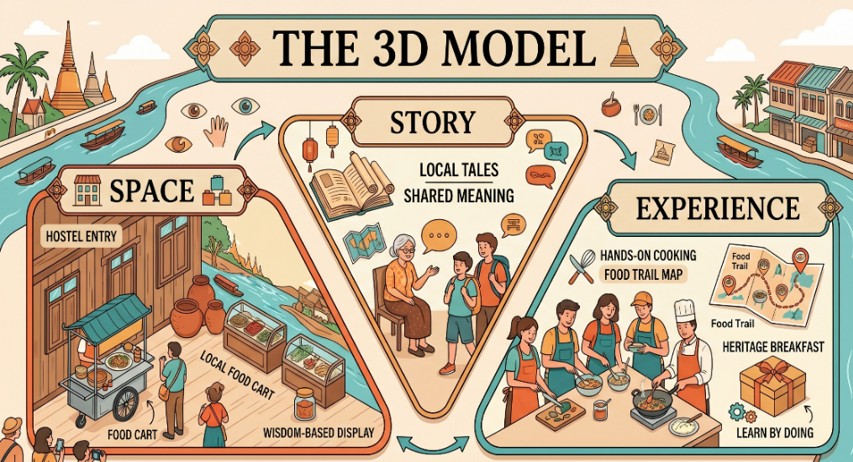
The local food identity functions as Living Heritage. Tha Tien is characterized by refined Royal Thai cuisine adapted into contemporary riverside cafes, whereas Phra Athit Road is defined by historic Muslim street food and multicultural fusion cuisine. In terms of creative management, leading hostels act as Cultural Intermediaries by deploying spatial design, narrative storytelling, and community collaboration to transform cultural capital into business value. The study synthesizes a strategic 3D Management Model (Space-Story-Experience): 1) Space: physical design and visual symbolization; 2) Story: building shared meaning through local historical narratives; and 3) Experience: co-creating participatory activities and integrating community ecosystems. This model provides actionable guidelines for hostel entrepreneurs to foster distinctive brand identity and sustainable competitiveness.
References
กรมการท่องเที่ยว. (2565). รายงานสถานการณ์การท่องเที่ยวเชิงวัฒนธรรมในเขตเมืองเก่ากรุงเทพมหานคร. กระทรวงการท่องเที่ยวและกีฬา.
กรมส่งเสริมวัฒนธรรม. (2561). อาหารไทย: มรดกภูมิปัญญาทางวัฒนธรรมของชาติ. กระทรวงวัฒนธรรม.
นภชนก ตลับเงิน. (2023). การพัฒนากิจกรรมการท่องเที่ยวเชิงสร้างสรรค์ชุมชนย่านเมืองเก่าภูเก็ต. วารสารวิชาการการจัดการภาครัฐและเอกชน, 5(2), 136–148.
พรรณี สวนเพลง. (2561). การพัฒนาเส้นทางการท่องเที่ยววิถีไทยเพื่อเรียนรู้เกี่ยวกับภูมิปัญญาอาหารท้องถิ่นในกลุ่มเมืองมรดกโลกทางวัฒนธรรม (สุโขทัย
ศรีสัชนาลัยและกำแพงเพชร พระนครศรีอยุธยา) (รายงานการวิจัย). มหาวิทยาลัยสวนดุสิต.ภูริ ชุณห์ขจร, พงศ์สุระ ธัญญเจริญอนุกูล, ธีราพัทธ์ ชมชื่นจิตต์สิน, นิลุบล ประเคนภัทรา และปุณยนุช ลีฬหะสุวรรณ. (2025). การส่งเสริมแนวทางการท่องเที่ยวเชิงอาหารจังหวัดนนทบุรี. วารสารคหกรรมศาสตร์และวัฒนธรรมอย่างยั่งยืน, 7(1), 88–99.สริตา พันธ์เทียน, ทรงคุณ จันทจร, และ มาริสา โกเศยะโยธิน. (2560). รูปแบบการจัดการท่องเที่ยวเชิงอาหารไทยโดยใช้แนวคิดเศรษฐกิจสร้างสรรค์ในเขตจังหวัดลุ่มแม่น้ำภาคกลาง. วารสารวิจัยและพัฒนา มหาวิทยาลัยราชภัฏสวนสุนันทา, 9(3), 190-198.
องค์การบริหารการพัฒนาพื้นที่พิเศษเพื่อการท่องเที่ยวอย่างยั่งยืน (องค์การมหาชน). (2562). แนวทางการพัฒนาการท่องเที่ยวเชิงสร้างสรรค์. อพท.
Creative Economy Agency. (n.d.). Charoenkrung. Creative City Development. https://creativecity.cea.or.th/th/districts/charoenkrung/about
Creative Economy Agency. (2022). Made in Charoenkrung ปีที่ 1. Creative City Development. https://creativecity.cea.or.th/th/district-projects/made-in-charoenkrung-year-1
Creative Economy Agency. (2025). Eat-Along: อีท-อะ-ลอง. Creative City Development. https://creativecity.cea.or.th/th/district-projects/eat-along
Creative Economy Agency. (2025). Thailand’s creative industries movement report 2024–2025. https://www.cea.or.th/en/single-industries/Thailand-Creative-Industries-Movement-Report-2024-2025
Mehmetoglu, M., & Engen, M. (2011). Pine and Gilmore’s concept of experience economy and its dimensions: An empirical examination in tourism. Journal of Quality Assurance in Hospitality & Tourism, 12(4), 237–255. https://doi.org/10.1080/1528008X.2011.541847
Pine, B. J., & Gilmore, J. H. (2011). The experience economy. Harvard Business Review Press.
Richards, G. (2020). Designing creative tourism experiences: Space, story, and experience. Annals of Tourism Research, 85, 103-118.
Sims, R. (2009). Food, place and authenticity: Local food and the sustainable tourism experience. Journal of Sustainable Tourism, 17(3), 321–336. https://doi.org/10.1080/09669580802359293
Tourism Authority of Thailand. (2026). Thailand tourism update at TTM+ 2026 reinforces quality-led growth direction. TAT Newsroom.
Veríssimo, M., & Costa, C. (2018). Do hostels play a role in pleasing Millennial travellers? The Portuguese case. Journal of Tourism Futures, 4(1), 57–68. https://doi.org/10.1108/JTF-12-2017-0054
World Tourism Organization. (2016). Presentation of the 2nd UNWTO Global Conference on Gastronomy Tourism. UN Tourism.
Downloads
Published
How to Cite
Issue
Section
License
Copyright (c) 2026 Journal of Contemporary Buddhist Society = JCBS

This work is licensed under a Creative Commons Attribution-NonCommercial-NoDerivatives 4.0 International License.



