
THE BUDDHIST PSYCHOLOGICAL PRACTICE MODEL AFFECTING THE HOLISTIC WELL-BEING OF PRIVATE SECTOR PERSONNEL
Keywords:
Anapanasati, Bhavana 4, Buddhist psychology, Holistic well-being, Private-sector personnelAbstract
This research aimed to: 1) investigate the components and processes of Buddhist psychological practice that contribute to the holistic well-being of personnel in private-sector organizations; and 2) synthesize and propose a Buddhist psychological practice model for enhancing the holistic well-being of personnel in private-sector organizations. This qualitative research employed documentary research based on the Tipiṭaka, commentaries, Buddhist psychology literature, and related research, together with in-depth interviews with 20 key informants from four groups: Buddhist scholars, psychology experts, organizational executives, and employee representatives. The research instrument was a semi-structured interview protocol, which was validated for content validity by five experts. The data were analyzed using content analysis and verified through data triangulation.
The findings revealed that:
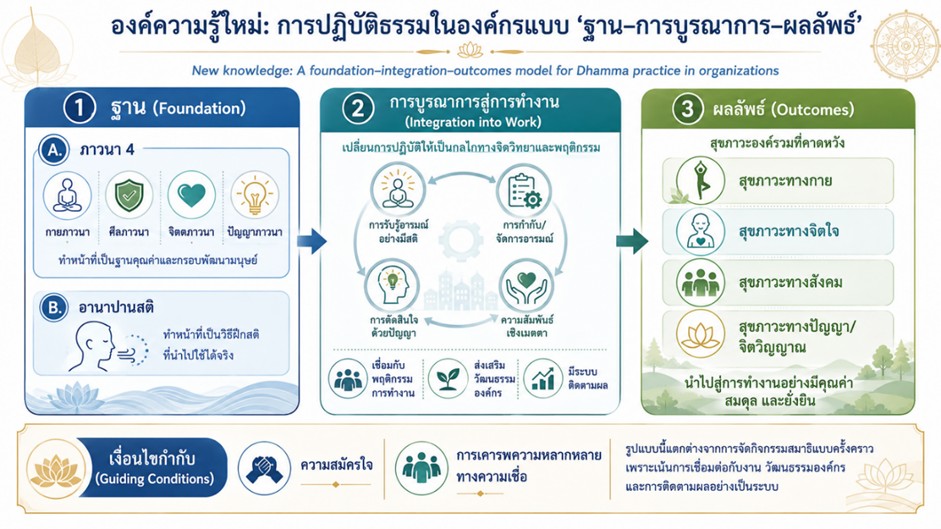
1) the fundamental basis of the practice consisted of the Four Bhāvanā and Ānāpānasati (mindfulness of breathing) based on the approach of Venerable Ajahn Mun Bhuridatta. These practices were connected to four Buddhist psychological mechanisms: mindful awareness of emotions, appropriate emotional regulation, wisdom-based decision-making, and the cultivation of compassionate relationships. These mechanisms contributed to physical, psychological, social, and intellectual/spiritual well-being. 2) The BIMH model consists of B: Bhāvanā 4, I: Integration into Work, M: Mindfulness through Ānāpānasati, and H: Holistic Well-being. The model is implemented through planning, application, personnel development and organizational culture building, as well as monitoring and evaluation. The model should be implemented on a voluntary basis, respect diversity in beliefs, and avoid making causal interpretations that extend beyond the evidence supported by qualitative research.
References
กาญจนา หาญศรีวรพงศ์ และพระมหามิตร ฐิตปญฺโญ. (2562). สมาธิกับการพัฒนาคุณภาพชีวิตมนุษย์. วารสารวิชาการธรรมทรรศน์, 19(1), 287–296.
https://so06.tci-thaijo.org/index.php/dhammathas/article/view/108189
เจือจันท์ วังทะพันธ์, โสวิทย์ บำรุงภักดิ์, และพระครูสุธีคัมภีรญาณ ประมวล. (2563). การพัฒนาความฉลาดทางอารมณ์ด้วยการปฏิบัติสมาธิของนักศึกษาครูสมาธิ สถาบันพลังจิตตานุภาพ. วารสารสันติศึกษาปริทรรศน์ มจร, 8(4), 1308–1321. https://so03.tci-thaijo.org/index.php/journal-peace/article/view/236980
ชิสา กันยาวิริยะ และเมธา หริมเทพาธิป. (2565). การศึกษาเชิงวิเคราะห์หลักภาวนา 4 ตามหลักพุทธปรัชญาเถรวาท. พุทธมัคค์, 7(2), 229–235.
https://so01.tci-thaijo.org/index.php/bdm/article/view/259186
พระมหาเขมานันท์ ปิยสีโล. (2562). อานาปานสติกรรมฐานสายพระอาจารย์มั่น ภูริทัตโต ในประเทศไทย. วารสารบัณฑิตศึกษาปริทรรศน์, 15(3), 167–182.
https://so02.tci-thaijo.org/index.php/JGSR/article/view/208391
วรัญญา กาญจนเนตร, สิริวัฒน์ ศรีเครือดง, และกมลาศ ภูวชนาธิพงศ์. (2567). ผลของการฝึกสมาธิที่มีต่อความเข้มแข็งทางจิตใจตามแนวพุทธจิตวิทยาของกลุ่มผู้ปฏิบัติธรรมวัยผู้ใหญ่. วารสาร มจร อุบลปริทรรศน์, 9(2), 1747–1756. https://so06.tci-thaijo.org/index.php/mcjou/article/view/274869
สานุ มหัทธนาดุลย์ และสริตา มหัทธนาดุลย์. (2562). การเสริมสร้างสุขภาวะองค์รวมเพื่อวิถีชีวิตที่สมดุลตามแนวพุทธจิตวิทยา. วารสารมหาจุฬานาครทรรศน์, 6(3), 1161–1172. https://so03.tci-thaijo.org/index.php/JMND/article/view/184621
อุ่นเอื้อ สิงห์คำ. (2554). กระบวนการและผลกระทบของการสร้างเสริมสุขภาวะองค์รวมวิถีพุทธ [วิทยานิพนธ์บริหารศาสตรมหาบัณฑิต, มหาวิทยาลัยอุบลราชธานี].
Benson, H. (1975). The relaxation response. William Morrow.
Creswell, J. D. (2017). Mindfulness interventions. Annual Review of Psychology, 68, 491–516. https://doi.org/10.1146/annurev-psych-042716-051139
Davidson, R. J., Kabat-Zinn, J., Schumacher, J., Rosenkranz, M., Muller, D., Santorelli, S. F., Urbanowski, F., Harrington, A., Bonus, K., &
Sheridan, J. F. (2003). Alterations in brain and immune function produced by mindfulness meditation. Psychosomatic Medicine, 65(4), 564–570. https://doi.org/10.1097/01.PSY.0000077505.67574.E3
Maslow, A. H. (1954). Motivation and personality. Harper & Row.
Wallace, B. A., & Shapiro, S. L. (2006). Mental balance and well-being: Building bridges between Buddhism and Western psychology. American Psychologist, 61(7), 690–701. https://doi.org/10.1037/0003-066X.61.7.690
World Health Organization. (2022). World mental health report: Transforming mental health for all. World Health Organization.
Downloads
Published
How to Cite
Issue
Section
License
Copyright (c) 2026 Journal of Contemporary Buddhist Society = JCBS

This work is licensed under a Creative Commons Attribution-NonCommercial-NoDerivatives 4.0 International License.



