
INTEGRATING THE PRINCIPLE OF KINDNESS TO CREATE SAFE FOOD FOR FARMERS IN THE NONG SUEA TEMPLE COMMUNITY, KRAB YAI UBDISTRICT, BAN PONG DISTRICT, RATCHABURI PROVINCE
Keywords:
Metta, Food Safety, Sustainable Agriculture, Participatory LearningAbstract
This study aimed to: (1) examine the integration of the principle of loving-kindness (Metta) into safe food production among farmers in Wat Nong Suea Community, Krap Yai Subdistrict, Ban Pong District, Ratchaburi Province; (2) organize activities to promote the application of the principle of loving-kindness in safe food production among the community farmers; and (3) propose a model for integrating the principle of loving-kindness into safe food production in Wat Nong Suea Community. This study employed a qualitative research approach using participatory action research (PAR). Key informants included community farmers, Buddhist monks, and other community stakeholders. The research instruments consisted of in-depth interviews, participant observation, focus group discussions, and collaborative learning activities. Data were analyzed through content analysis and descriptive synthesis.
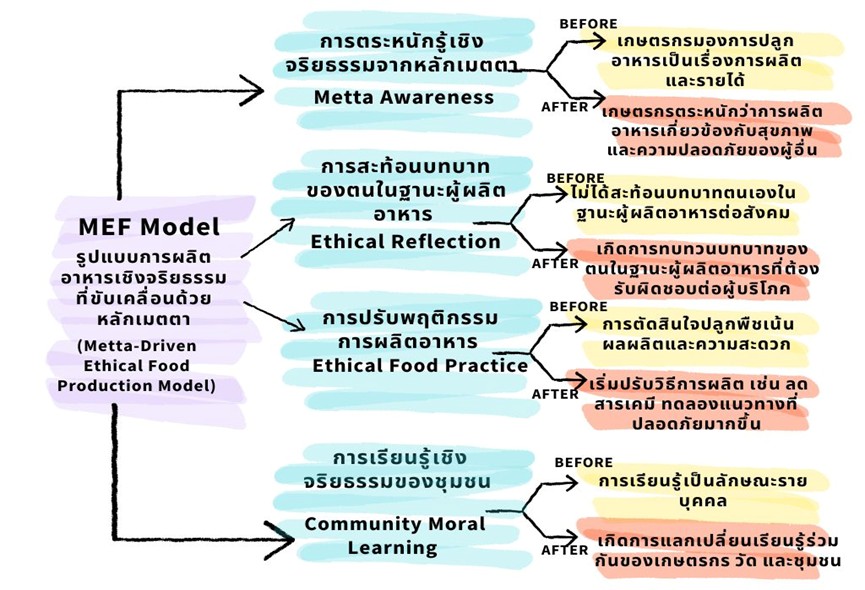
The findings revealed that: (1) the integration of the principle of loving-kindness into safe food production among farmers in Wat Nong Suea Community was reflected in their awareness of the impacts of food production on consumers, the environment, their own health, and the community. This awareness encouraged farmers to modify their agricultural practices by reducing the use of chemical substances, adopting organic fertilizers, and preserving agricultural ecosystems. (2) Activities promoting the integration of loving-kindness into safe food production were implemented through participatory community learning processes, including dialogue, experience sharing, experiential learning, and collective reflection. These activities enhanced farmers’ understanding and enabled them to apply the principle of loving-kindness to food production in a practical and tangible manner. (3) The synthesis of the research findings led to the development of a model for integrating the principle of loving-kindness into safe food production. The model consists of four key dimensions: loving-kindness toward consumers, the environment, oneself, and the community. The resulting new body of knowledge was conceptualized as the Metta-Driven Ethical Food Production Model (MEF Model), which explains the process of developing ethical food production within communities through four stages: awareness of loving-kindness, reflection on the role of food producers, transformation of food production practices, and collaborative community learning.
References
กนกพร ตันวัฒนะ, & คณิต เขียววิชัย. (2562). รูปแบบชุมชนอาหารปลอดภัยของระบบการเกษตรที่สนับสนุนโดยชุมชนในพื้นที่ภาคกลาง. วารสารเศรษฐศาสตร์การเมืองบูรพา, 7(2), 85–99.
กาสัก เต๊ะขันหมาก และคณะ. (2566). รูปแบบการเสริมสร้างความมั่นคงและความปลอดภัยด้านอาหารระดับครัวเรือนและชุมชนในจังหวัดลพบุรี. วารสารรัชต์ภาคย์, 17(50), 311–324.
คณะกรรมการภาคีความร่วมมือจังหวัดชัยภูมิ. (2557). โครงการผลิตอาหารปลอดภัยตามแนวทางเศรษฐกิจพอเพียงจังหวัดชัยภูมิ (รายงานวิจัย). สำนักงานกองทุนสนับสนุนการวิจัย.
จินดา หวังวรวงศ์ และคณะ. (2561). แนวทางพุทธวิธีอาหารปลอดภัยที่ยั่งยืนด้วยสัมมาอาชีวะสำหรับสังคมไทย. วารสารบัณฑิตศึกษาปริทรรศน์, 14(1), 26–38.
สำนักงานคณะกรรมการอาหารและยา. (2544). แนวทางการผลิตอาหารตามหลักเกณฑ์วิธีการที่ดี (GMP). สำนักงานคณะกรรมการอาหารและยา.
สถาบันมาตรวิทยาแห่งชาติ. (2568). NQI กับตัวอย่างห่วงโซ่การผลิตอาหารปลอดภัย จากฟาร์มจนถึงผู้บริโภค (Safe Food for Customers from Farm to Fork). https://mx.nimt.or.th/?p=15803
SDG Move. (2021, June 10). WHO ออกคู่มือวัดภาระโรคที่เกิดจากอาหารในระดับประเทศ เพื่อระบุความท้าทายและโอกาสในการพัฒนาระบบอาหารปลอดภัย. https://www.sdgmove.com/2021/06/10/who-handbook-estimating-the-burden-of-foodborne-diseases/
Khuesai, T., Panthong, K., & Ratanakom, N. (2019). Let's move beyond the limit to food security. Institute of Health Systems Management, Prince of Songkla University.
Plungsricharoensuk, P., Pathumcharoenwattana, W., & Nantananate, C. (2017). Community learning process to enhance food security: A case study of Ban Yang Dang, Khu Yai Mi Sub-district, Sanam Chai Khet District, Chachoengsao Province. Veridian E-Journal, Silpakorn University, 10(2), 2758–2774.
Sitthisuntikul, K., Satienperakul, K., & Jolanun, B. (2019). Approaches to develop food security in the organic communities of Luang Neua Sub-district, Doi Saket District, Chiang Mai. Journal of Agricultural Research and Extension, 35(3), 63–72.
Songklang, S., Namyotha, C., Mahaweerawat, U., Homjhampa, P., & Yangyuen, S. (2018). Community food security pattern and food safety management of Lad-Pattana Subdistrict, Mueang District, Mahasarakham Province. In Proceedings of the 14th Mahasarakham University Research Conference (pp. 266–272).
Songsrirote, N. (2015). Food security and household management capacity of farmers under the Agricultural Land Reform Office in Mahasarakham Province. NIDA Development Journal, 55(1), 1–25.
Downloads
Published
How to Cite
Issue
Section
License
Copyright (c) 2026 Journal of Contemporary Buddhist Society = JCBS

This work is licensed under a Creative Commons Attribution-NonCommercial-NoDerivatives 4.0 International License.



