
THE IMPLEMENTATION OF NEW PUBLIC MANAGEMENY TOWARD SUSTAINABLE DEVELOPMENT IN SAMUT SAKHON PROVINCIAL ADMINISTRATIVE ORGANIZATION
Keywords:
New Public Management, Sustainable Development, Provincial Administrative Organization, Public Participation, Good GovernanceAbstract
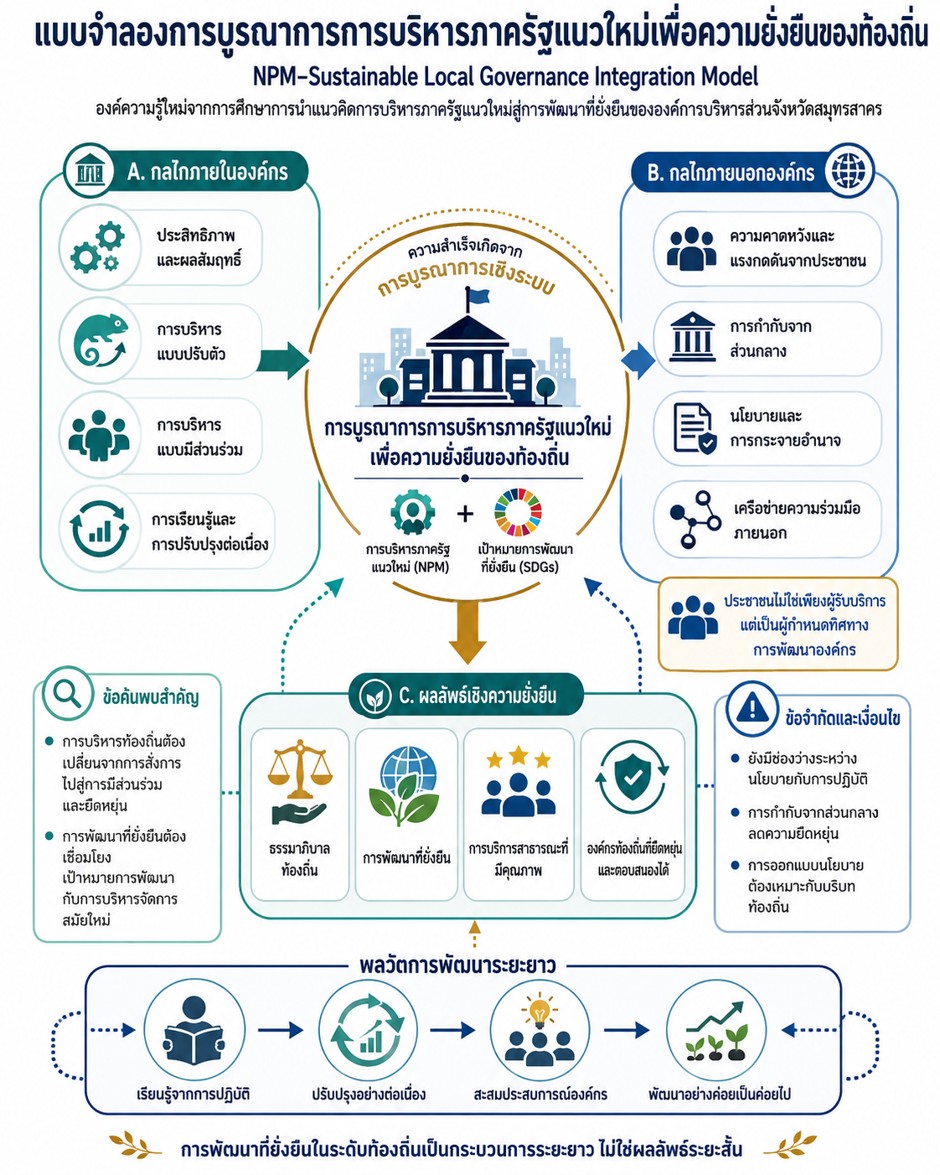
This research aimed to (1) investigate the processes of implementing NPM in line with sustainable development goals, (2) explore the challenges encountered during this implementation and (3) examine strategies for developing New Public Management (NPM) to achieve sustainable development. A qualitative research approach was utilized, with data collected through in-depth interviews with 20 key informants and analyzed via content analysis.
The findings revealed that (1) the implementation process was integrated and participatory, requiring collaboration among all sectors, aligning policies and plans with local contexts, and emphasizing ongoing monitoring and evaluation. This comprehensive approach supports sustainable development, (2) significant challenges include budget and human resource limitations, inconsistent centrally driven policies, inadequate public participation, and pressures from public expectations. Both internal and external factors play a crucial role in determining implementation success, (3) NPM implementation aligns with sustainable development by emphasizing results-based management, public participation, decentralization, technology use, human resource development, and transparency. These practices foster balanced growth across economic, social, and environmental dimensions.
The sustainable development of local administrative organizations could be effectively achieved when the principles of modern public administration were integrated into the local context through flexible, participatory, and responsive management mechanisms that appropriately address external pressures. This knowledge could be applied as a framework for developing other local administrative organizations with similar contexts.
References
กีรติกาญจน์ เจตน์ธนานันท์, ธีรพงษ์ บุญรักษา และ รษิกา เอี่ยมเกิด. (2567). การพัฒนาทักษะภายในของผู้นำองค์กร: สู่ภาวะผู้นำที่สร้างผลกระทบให้เกิดการพัฒนาที่ยั่งยืนของโลกได้อย่างแท้จริง. วารสารมหาวิทยาลัยคริสเตียน, 30(4), 137-153.
ชนากานต์ วิจิตร. (2567). SDG Localization: ท้องถิ่นเข้มแข็งสู่รากฐานการพัฒนาอย่างยั่งยืน. https://image.mfa.go.th/mfa/0/OznAy3tii2/นักศึกษา/SDG_Localization_ท้องถิ่นเข้มแข็งสู่รากฐานการพัฒนา.pdf
นิรุต หัตถะผะสุ. (2564). กลไกการขับเคลื่อนการดำเนินงานขององค์การภาครัฐเพื่อบรรลุเป้าหมายการพัฒนา
ที่ยั่งยืน กรณีศึกษา กระทรวงมหาดไทย. [สารนิพนธ์ปริญญามหาบัณฑิต]. จุฬาลงกรณ์
มหาวิทยาลัย.
พัชราวลัย ศุภภะ. (2562). นโยบายสาธารณะและการวางแผนเพื่อจัดการองค์กรภาครัฐ. พระนครศรีอยุธยา
: สำนักพิมพ์มหาวิทยาลัยมหาจุฬาลงกรรราชวิทยาลัย.
Denhardt, R. B., & Denhardt, J. V. (2000). The new public service: Serving rather than steering. Public Administration Review, 60(6), 549–559.
Hood, C. (1991). A public management for all seasons?. Public Administration, 69(1), 3-19.
M. Nilsson, D. Griggs and M. Visbeck (2016). Map the interactions between Sustainable
Development Goals. Comment in Nature, 53(7607), 320-322.
Osborne, D., & Gaebler, T. (1992). Reinventing Government: How the Entrepreneurial Spirit is
Transforming the Public Sector. Addison-Wesley.
Pollitt, C., & Bouckaert, G. (2011). Public management reform: A comparative analysis: New
public management, governance, and the neo-Weberian state (3rd ed.). Oxford
University Press.
Downloads
Published
How to Cite
Issue
Section
License
Copyright (c) 2026 Journal of Contemporary Buddhist Society = JCBS

This work is licensed under a Creative Commons Attribution-NonCommercial-NoDerivatives 4.0 International License.



