
MODEL FOR THE DEVELOPMENT OF MUKDAHAN PROVINCE AS A SPECIAL ECONOMIC ZONE AND GATEWAY TO INDOCHINA
Keywords:
Special Economic Zone, Mukdahan Province, Gateway to Indochina, Development Pattern, Four Sangahavatthu (Sangahavatthu 4)Abstract
This research aimed to study: 1) geographical and logistical factors, 2) economic factors, and 3) policy factors affecting the development pattern of the Mukdahan Special Economic Zone, the Gateway to Indochina; and 4) to propose a development pattern for the Mukdahan Special Economic Zone, the Gateway to Indochina. The study employed a qualitative research methodology, applying Grounded Theory as the research approach. Key informants, totaling 22 individuals, were purposively selected from four sectors, namely the public sector, the private business sector, the political sector, and the citizen sector. Data were collected through semi-structured in-depth interviews together with non-participant observation, and data credibility was verified using the Triangulation Technique. Data were analyzed through content analysis and presented descriptively.
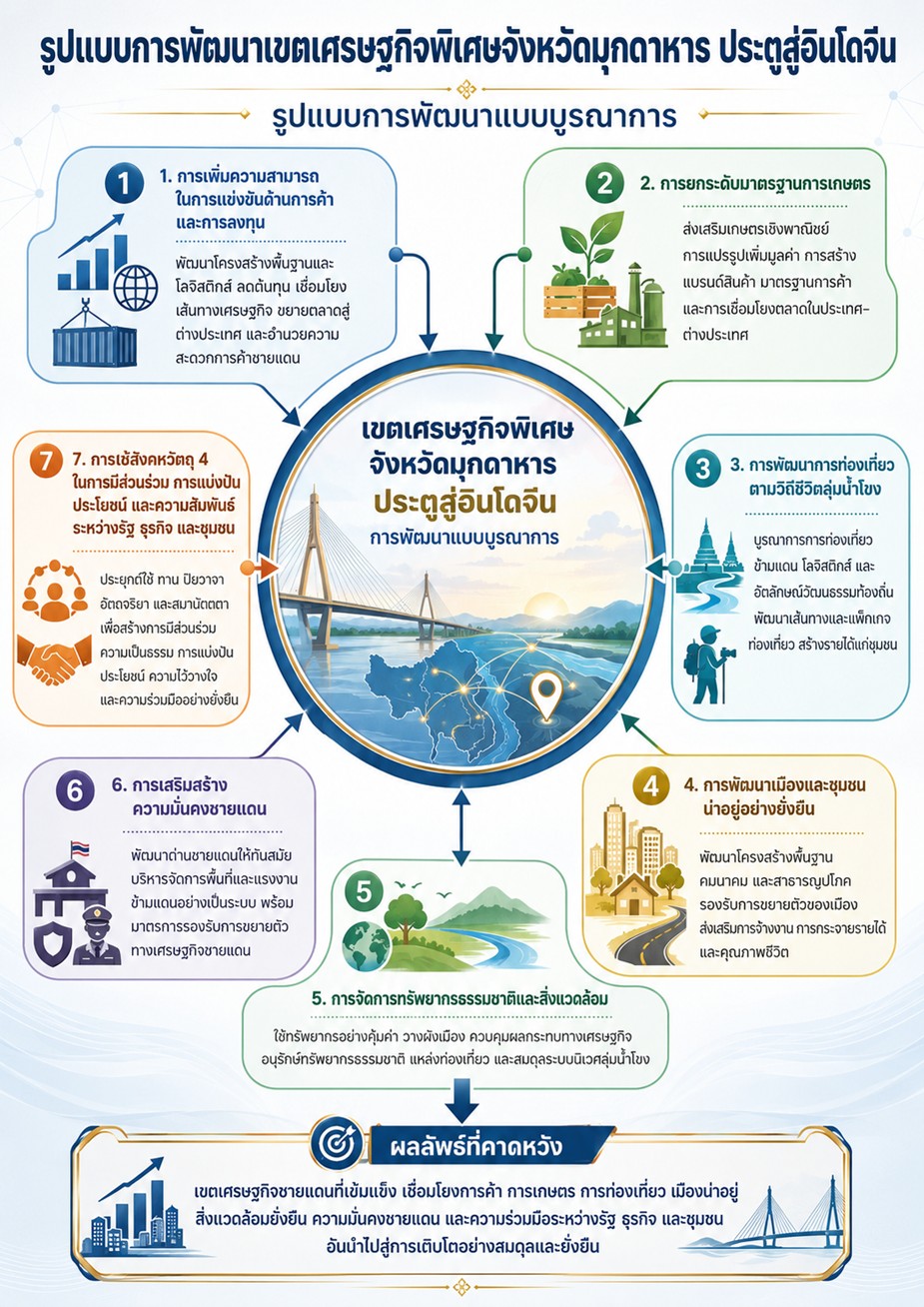
The research findings revealed that: 1) Geographical and logistical factors affecting the development pattern included the province's location along the East–West Economic Corridor, transportation linkages with neighboring countries, the abundance of natural resources, which were conducive to trade, investment, and the province's role as a regional logistics hub. 2) Economic factors included the province's economic structure encompassing trade, services, agriculture, and industry; investment from both the public and private sectors; the volume of exports and imports within the area. 3) Policy factors included tax incentives, government policies related to border special economic zones, and support from government agencies and local administrative organizations. 4) The development pattern for the Mukdahan Special Economic Zone was an integrated development model comprising seven core components: 4.1) enhancing trade and investment competitiveness for international connectivity, serving as the core driver 4.2) upgrading agricultural standards 4.3) developing tourism based on the Mekong River way of life, serving as a value enhancer 4.4) developing sustainable livable cities and communities, serving as a foundation for development 4.5) managing natural resources and the environment serving as a sustainability condition 4.6) strengthening border security serving as a stability builder and 4.7) applying the Four Sangahavatthu principles to enhance participation benefit-sharing and relationships among the government business sector and community serving as a relationship-connecting mechanism encompassing joint conceptualization planning implementation benefit-sharing monitoring and evaluation in order to achieve balanced fair and sustainable development.
References
กิตติพงษ์ โคตรจันทึก, พระศิวกร ปญฺญาวุฑฺโฒ และ พระสมุห์บัว ทีปธมฺโม. (2563). เศรษฐศาสตร์การเมือง
อาเซียน: ความสัมพันธ์ระหว่างประชาคมอาเซียน ตามหลักเศรษฐศาสตร์แบบพึ่งพา. วารสาร มจร สังคมศาสตร์ปริทรรศน์, 9(2), 288–303.
บรรจง กาญจนานิล. (2560). บทบาทของรัฐในการพัฒนาเขตเศรษฐกิจพิเศษ:กรณีศึกษาเขตเศรษฐกิจพิเศษ
ตราด. วารสารรัชต์ภาคย์, 12(26), 78-79.
วิภาดา มุกดา. (2561). ปัญหาจากการรับรู้และความคาดหวังในการเตรียมความพร้อมเข้าสู่ประชาคม
เศรษฐกิจอาเซียนของ ผู้ประกอบการในเขตเศรษฐกิจพิเศษ. มหาวิทยาลัยสวนดุสิต. วารสาร
วิทยาลัยดุสิตธานี, 12(1), 199-216.
วันชัย รัตนวงษ์, วรินทร์ วงษ์มณี และวรารัตน์ ธีระศักดิ์. (2559). โครงการศึกษาแนวทางการเพิ่มศักยภาพของระบบโลจิสติกส์และโซ่อุปทาน การค้าชายแดนเพื่อรองรับการเข้าสู่ประชาคมเศรษฐกิจอาเซียน และนำเสนอ แบบจำลองทางธุรกิจเพื่อส่งเสริมการดำเนินการของเอกชนบริเวณจุดผ่านแดนและเขตอุตสาหกรรมส่งออก. https://elibrary.tsri.or.th/fullP /RDG5750065/RDG 5750065V01/RDG 5750065V01_full.pdf
สมพงษ์ ศิริโสภณศิลป์, จักรกฤษณ์ ดวงพัสตรา, วิรัช หิรัญ, ศักดิ์สุริยา ไตรยราช และ ประภาวี วงษ์บุตรศรี.
(2560). การพัฒนาเขตเศรษฐกิจพิเศษในจังหวัดหนองคาย จังหวัดนครพนม. วารสารการขนส่งและโลจิสติกส์, 10(1), 25-40.
สำนักงานคณะกรรมการนโยบายเขตพัฒนาเศรษฐกิจพิเศษ. (2560). รายงานประจำปี 2560. กรุงเทพฯ:
อนุรักษ์ ตั้งปณิธานนท์. (2563). แนวทางการขับเคลื่อนการบริหารการพัฒนาพื้นที่เขตเศรษฐกิจพิเศษ
มุกดาหาร. วารสารวิทยาการจัดการ มหาวิทยาลัยราชภัฏนครปฐม, 7(2), 14-24.
Asian Development Bank. (2016). Greater Mekong Subregion economic cooperation
program: Strategic framework 2012–2022. Manila: ADB.
Durongkaveroj, W. (2023). The economic impact of special economic zones: Evidence from
Thailand. Kasetsart Journal of Social Sciences, 44(3), 377–386.
UNCTAD (United Nations Conference on Trade and Development) (2019). Trade and
Development Report 2019. https://unctad.org/system/files /official-document/tdr 2019_en.pdf
Downloads
Published
How to Cite
Issue
Section
License
Copyright (c) 2026 Journal of Contemporary Buddhist Society = JCBS

This work is licensed under a Creative Commons Attribution-NonCommercial-NoDerivatives 4.0 International License.



