
GUIDELINES FOR MIGRANT LABOR MANAGEMENT IN CHANTHABURI PROVINCE
Keywords:
Management Guidelines, Migrant Labor, Chanthaburi ProvinceAbstract
The objectives of this research were to: 1) examine the management of migrant labor in Chanthaburi Province, 2) analyze the management process in Chanthaburi Province, and 3) identify the problems and obstacles in migrant labor management in Chanthaburi Province. A qualitative in character. 15 key informants comprised. They included the following persons: Senior executives, heads of government agencies, operational-level officers, and employers of migrant workers in the local area. The collected data were analyzed by using the content analysis.
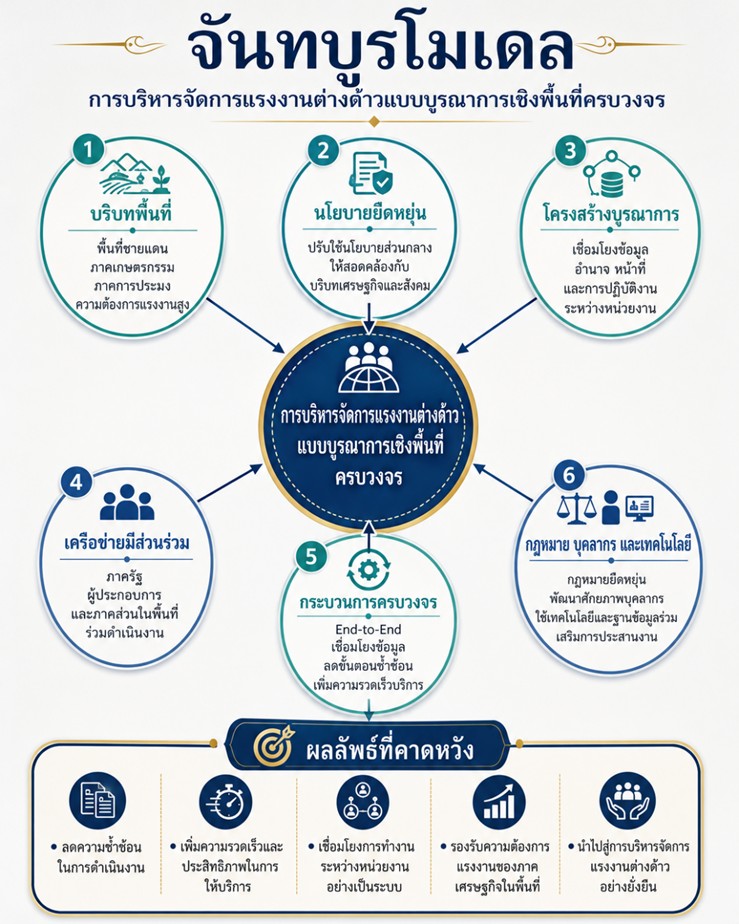
The results revealed that: 1) That management operated through an integrated system among key agencies (Provincial Employment, Office, Provincial Administration, Immigration Office, and Public Health Office). The administrative structure model combining centralization and decentralization, which promoted both policy unity and operational flexibility at the local level, while public-private cooperation helped improving operational practices. 2)The management process was complex due to the involvement of multiple agencies and procedures. The lack of integrated information systems caused redundant procedures, delays, and to contact several agencies. 3) Major problems and obstacles included inflexible legal regulations, fragmented databases, limitations in human resources, and ineffective both inter-agency coordination, which reduced operational efficiency and responsiveness to labor demands.
Therefore, the study recommends improving regulatory flexibility, developing a one-stop service system, integrating inter-agency databases, and strengthening human resource capacity to improve efficiency, transparency, and sustainability in migrant labor management.
References
ประภัสสร์ เทพชาตรี. (2557). ไทยกับการเป็นศูนย์กลางประชาคมอาเซียน. นนทบุรี: ศูนย์อาเซียนศึกษา มหาวิทยาลัยธรรมศาสตร์.
พิมพ์ธาดา วรรัฐธนพัชร์. (2566). การปฏิบัติตามนโยบายการบริหารจัดการแรงงานประเทศไทยไปทำงานที่สาธารณรัฐเกาหลี ภายใต้ระบบการจ้างแรงงานต่างชาติ. วารสารรัฐประศาสนศาสตร์ มหาวิทยาลัยราชภัฏสวนสุนันทา, 6(2), 307–320.
แพรวพรรณ ศิริเลิศ. (2569, มกราคม, 20). SDG Updates | สำรวจกระแสการเคลื่อนย้ายของแรงงานข้ามชาติ – เมื่อไทยอาจเผชิญปัญหา ‘ขาดแคลนแรงงาน. https://www.sdgmove.com/ 2023/09/21/sdg-updates-survey-migrant-workers-in-thailand/
ภูการ สมาทา และ ศรุดา สมพอง. (2562). การบริหารการเปลี่ยนแปลงระบบแรงงานในช่วงสถานการณ์พิเศษ (คสช). วารสารวิชาการธรรมทรรศน์, 19(4), 49-62.
สาริน จารุชาติ. (2569, มกราคม, 20). อุตสาหกรรมไทย : อยู่ตรงไหนและจะแข่งขันอย่างไรในเวทีโลก. https://www. krungsri.com/th/research/research-intelligence/ thailand-sectoral-potential-2021
สำนักนโยบายและยุทธศาสตร์การค้า. (2569, มกราคม, 20). ภาวะการค้าระหว่างประเทศของไทยประจำเดือนมีนาคม 2568. https://uploads.tpso.go.th/
อรรถสิทธิ์ วารีศรี. (2563). การนำนโยบายแรงงานต่างด้าวไปการปฏิบัติในพื้นที่ภาคใต้. วารสารการวิจัยการบริหารพัฒนา, 10(1), 65-74.
ThaiPublica. (2568). สถาพัฒน์แถลง GDP ไตรมาส 1/68 โต 3.1% หั่นเฉลี่ยทั้งปี 1.8%. https://thaipublica.org/2025/05/thai-nesdc-q1-68-gdp-growth-3-1-annual-outlook-reduced-to-1-8/
Downloads
Published
How to Cite
Issue
Section
License
Copyright (c) 2026 Journal of Contemporary Buddhist Society = JCBS

This work is licensed under a Creative Commons Attribution-NonCommercial-NoDerivatives 4.0 International License.



