
SUCCESS IN IMPLEMENTING THE ONE MILLION PEOPLE HEALTH SCREENING POLICY IN BANGKOK METROPOLITAN AREA
Keywords:
Policy Implementation, Success Factors, Transformational Leadership, Health Screening Policy, Bangkok Metropolitan AreaAbstract
This research aimed to: (1) examine the factors influencing the successful implementation of the “One Million Health Check-up Policy” in the Bangkok Metropolitan Area; and (2) propose appropriate guidelines and recommendations to enhance its effectiveness and efficiency. This qualitative study employed in-depth interviews and document analysis. Data were collected through in-depth interviews and document analysis. Key informants consisted of policymakers and senior public health administrators, frontline practitioners, and service recipients.
The findings revealed that:
(1) the success of policy implementation was influenced by policy-related, mediating, and contextual factors. Policy-related factors included the policy’s problem-solving capacity and policy structure. Although the policy had clearly defined objectives and quantitative targets, limitations were found in policy communication, role clarification, and resource adequacy at the operational level. Transformational leadership played a crucial role in motivating personnel and fostering collaboration. Policy communication functioned as a key mediating mechanism linking these factors to successful implementation by promoting shared understanding among stakeholders. In addition, contextual factors-such as complex population structures, diverse health insurance schemes, fragmented healthcare systems, and health behaviors-significantly affected service accessibility and data integration. In terms of outcomes, participants perceived that proactive and digitally supported services facilitated access to healthcare services through digital technologies, proactive service delivery, and multi-sectoral collaboration, leading to greater operational effectiveness and high levels of service satisfaction. However, limitations in population coverage remained. (2) The study recommends strengthening integrated health information systems, enhancing policy communication, ensuring adequate resource allocation at the operational level, and promoting effective leadership to achieve sustainable and inclusive policy implementation.
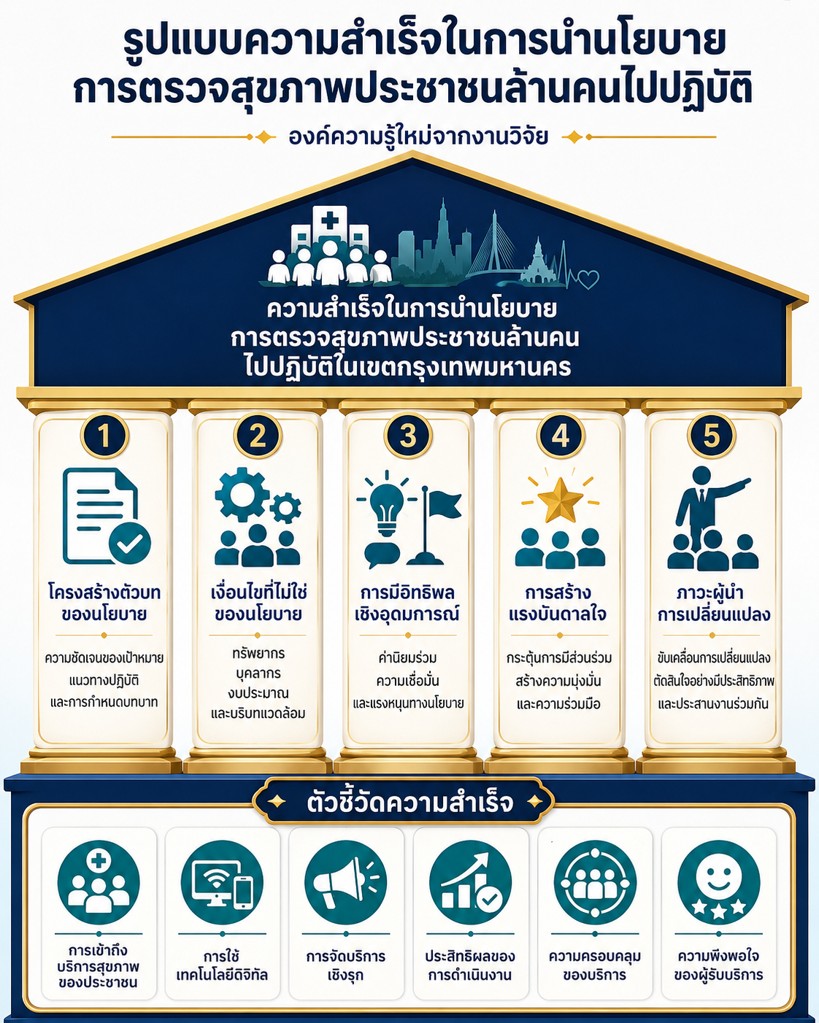
The policy implementation mechanisms, comprising 1) the textual structure of the policy, 2) non-policy conditions, 3) ideological influence, 4) motivation, and 5) transformational leadership, are all crucial factors contributing to the successful implementation of the one-million-person health checkup policy. Indicators of success include public access to healthcare, the use of digital technology, proactive service delivery, operational effectiveness, service coverage, and service-user satisfaction.
References
เริงฤดี ปธานวนิช, (2568). การสำรวจสุขภาพประชาชนไทยโดยการตรวจร่างกาย ครั้งที่ 7 พ.ศ.2567-2568.
https://kb.hsri.or.th/dspace/handle/11228/6360?show=full
อัญชนา แก้วไธสง. (2560). ปัจจัยที่มีความสัมพันธ์กับพฤติกรรมการตรวจสุขภาพของผู้สัมผัสอาหารในเขต
เทศบาลตำบลเมืองศรีไคอำเภอวารินชําราบ จังหวัดอุบลราชธานี. วารสารราชธานีนวัตกรรมทาง
วิทยาศาสตร์สุขภาพ, 1(1), 64-80.
Avolio, Bruce J., B. J., & Bass, B. M. (2004). Multifactor leadership questionnaire: Manual
and sampler set (3rd ed.). Mind Garden.
Frederick Herzberg. (1959). The motivation to work. New York. NY: John Wiley & Sons.
Mazmanian, D. A., & Sabatier, P. A. (1983). Implementation and public policy. Glenview, IL:
Scott, Foresman and Company.
Pressman, J. L., & Wildavsky, A. (1973). Implementation: How Great Expectations in
Washington are Dashed in Oakland. University of California Press.
Sabatier, P. A., & Mazmanian, D. A. (1980). The Implementation of Public Policy: A Framework
of Analysis. Policy Studies Journal, 8(4): 538–560.
Van Meter, D. S., & Van Horn, C. E. (1975). The policy implementation process: A conceptual
framework. Administration & Society, 6(4), 445–488.
World Health Organization. (2008). Integrated health services: What and why? Geneva:
World Health Organization.
World Health Organization. (2019). WHO guideline: Recommendations on digital interventions for health system strengthening. Geneva: World Health Organization.
Yukl, G. (2012). Leadership in organizations (8thed.). Boston, MA: Pearson Education.
Downloads
Published
How to Cite
Issue
Section
License
Copyright (c) 2026 Journal of Contemporary Buddhist Society = JCBS

This work is licensed under a Creative Commons Attribution-NonCommercial-NoDerivatives 4.0 International License.



