
LEADERSHIP AND ORGANIZATIONAL MANAGEMENT IN THE DIGITAL ERA
Keywords:
Leadership, Organizational Management, Organizational Success, Digital EraAbstract
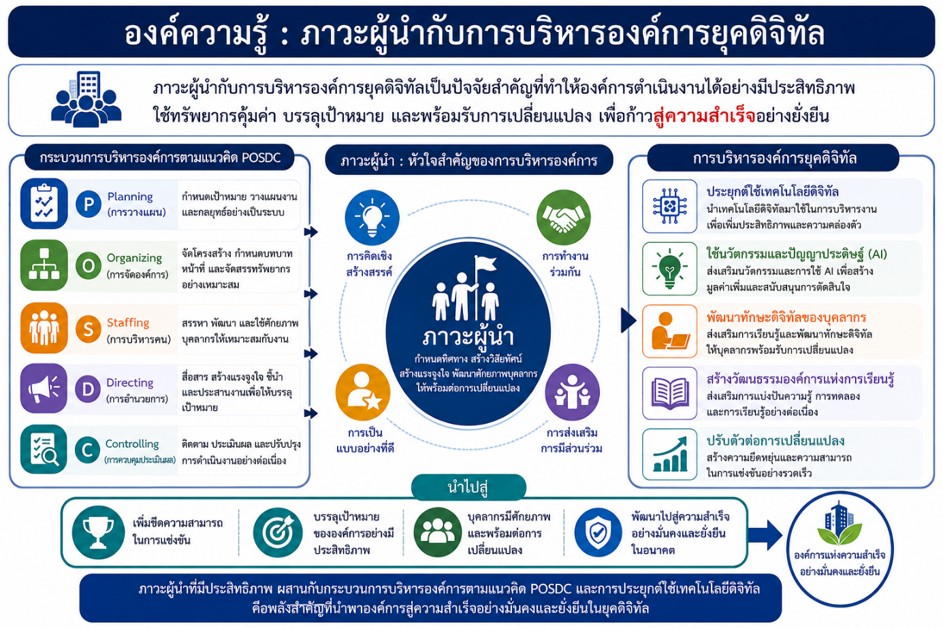
This academic article aims to examine the concepts of leadership and organizational management in the contemporary era, as well as to analyze the role of leadership in driving organizational success amid rapid economic, social, and technological changes. The study found that organizational management is a crucial process that enables organizations to operate effectively and achieve their goals through key management functions, including planning, organizing, staffing, directing, and controlling. Leadership is a significant factor influencing organizational success, as leaders are responsible for setting directions, creating a shared vision, developing human potential, motivating employees, and fostering collaboration within the organization. Furthermore, leaders in the digital era must possess the capability to effectively apply technology and integrate the principles of the Dutiyapāpaṇika Sutta in Buddhist philosophy to promote innovation and cultivating a learning culture to respond effectively to continuous changes. These competencies enhance organizational competitiveness and contribute to sustainable development. Therefore, leadership and organizational management serve as essential mechanisms that enable organizations to adapt to change, optimize resource utilization, and achieve long-term success in the digital era.
References
ธรรมนิติ. (2569). ผู้นำในยุคดิจิทัล Economy. สืบค้นข้อมูลจาก https://www.dharmniti.co.th/
นฤมล เพ็ญสิริวรรณ. (2561). ภาวะผู้นำกับการพัฒนาองค์กรให้มีประสิทธิภาพสูงสุด. วารสาร มจร มนุษยศาสตร์ปริทรรศน์, 4(2), 117–125.
นันทวัฒน์ บรมานันท์. (2560). หลักกฎหมายปกครองเกี่ยวกับบริการสาธารณะ (พิมพ์ครั้งที่ 5). กรุงเทพมหานคร: วิญญูชน.
เนตร์พัณณา ยาวิราช. (2556). การจัดการสมัยใหม่ (พิมพ์ครั้งที่ 8). กรุงเทพมหานคร: บริษัท ทริปเพิ้ล กรุ๊ป จำกัด.
ปกิตน์ สันตินิยม (2563). ภาวะผู้นำของผู้บริหารองค์กรภายใต้ยุคการเปลี่ยนแปลงทางเทคโนโลยี. วารสารวิชาการรัฐศาสตร์และรัฐประศาสนศาสตร์, 2(2), 10 – 19.
มหาจุฬาลงกรณราชวิทยาลัย. (2539). พระไตรปิฎกภาษาไทย ฉบับมหาจุฬาลงกรณราชวิทยาลัย. กรุงเทพมหานคร : โรงพิมพ์มหาจุฬาลงกรณราชวิทยาลัย.
พระธรรมโกศาจารย์ (ประยูร ธมฺมจิตฺโต). (2549). พุทธวิธีในการบริหาร (พิมพ์ครั้งที่ 4). กรุงเทพมหานคร: โรงพิมพ์มหาจุฬาลงกรณราชวิทยาลัย.
วิโรจน์ สารรัตนะ, พระครูสุธีจริยวัฒน์, พระครูธรรมาภิสมัย, พระมหาศุภชัย สุภกิจฺโจ, พระณัฐวุฒิ สัพโส และวิทูล ทาชา. (2561). ภาวะผู้นําสำหรับศตวรรษที่ 21. วารสารศึกษาศาสตร์ มหาวิทยาลัยนเรศวร, 20(1), 261-271.
วีระพงศ์ เกียรติไพรยศ และพระปลัดสถิตย์ โพธิญาโณ. (2565). ภาวะผู้นํากับการบริหารองค์การในยุคนิวนอร์มัล. วารสารพุทธสังคมวิทยาปริทรรศน์, 7(1), 123-134.
ลักษณา ศิริวรรณ. (2566). ภาวะผู้นำกับความสำเร็จของการวางแผนยุทธศาสตร์และการนำไปสู่การปฏิบัติ. วารสาร มจร พุทธปัญญาปริทรรศน์, 8(6), 27.
สมเด็จพระพุทธโฆษาจารย์ (ป.อ.ปยุตฺโต). (2564). พจนานุกรม ฉบับประมวลธรรม. (พิมพ์ครั้งที่ 43). ม.ป.ท.
สุรพล สุยะพรหม และคณะ. (2555). ทฤษฎีองค์การและการจัดการเชิงพุทธ. พระนครศรีอยุธยา: มหาวิทยาลัยมหาจุฬาลงกรณราชวิทยาลัย.
Kotter, J. P. (1996). Leading Change. Boston: Harvard Business School Press.
Northouse, Peter G. (2018). Leadership: Theory and Practice. (8th ed.). SAGE Publications.
Downloads
Published
How to Cite
Issue
Section
License
Copyright (c) 2026 Journal of Contemporary Buddhist Society = JCBS

This work is licensed under a Creative Commons Attribution-NonCommercial-NoDerivatives 4.0 International License.



