
COMMUNITY INNOVATION AND THE CREATION OF SOCIAL, ECONOMIC, AND ENVIRONMENTAL BALANCE FOR SUSTAINABILITY
Keywords:
Community Innovation, Creation of Social Economic and Environmental Balance, SustainabilityAbstract
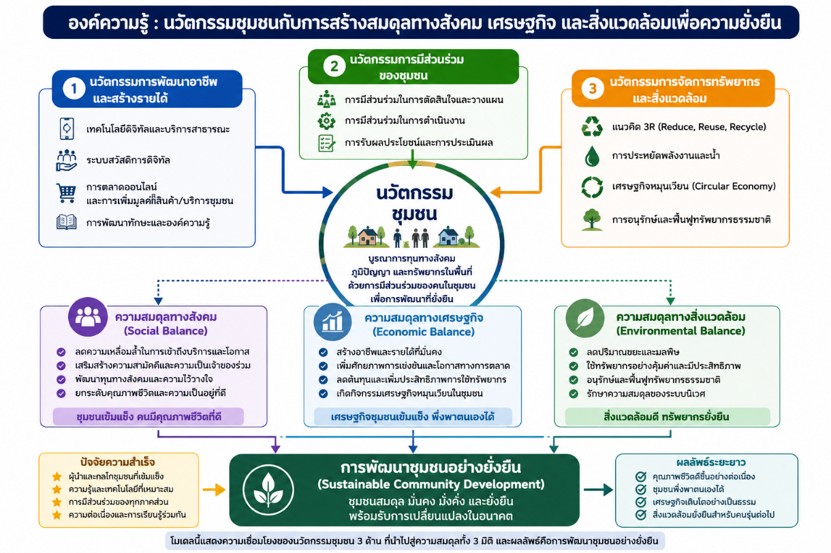
This academic article aims to explain the concept of sustainable community development, focusing on the integration of community innovation, community participation, and efficient resource use within the context of current economic and social changes. Despite improvements in quality of life through education and technology, there remains an imbalance between economic growth and the strength of communities and the environment, leading to external dependence and a diminishing role of local wisdom. Therefore, the concept of sustainable development has been adopted as a key framework for guiding development directions. It is observed that community career development today requires innovation and technology to increase economic opportunities, reduce inequality, and enhance the quality of life for citizens. At the same time, community participation is a crucial mechanism that ensures development aligns with local contexts, covering everything from planning and decision-making to implementation and evaluation. Additionally, the efficient use of resources, particularly through the 3R concept and circular economy, along with energy and water conservation, helps reduce resource loss, minimize waste, and promote systematic environmental management.
This academic article is expected to generate integrated knowledge and understanding of sustainable community development approaches that align with the current context of Thai society. It can be used as a conceptual framework for government agencies, the private sector, local administrative organizations, educational institutions, and community leaders in formulating policies, planning, and designing community development activities that focus on participation, innovation, and efficient resource management. Additionally, it can be applied as a guideline for promoting careers, strengthening the grassroots economy, reducing inequality, and enhancing the quality of life for the people, alongside the conservation of natural resources and the environment. This will lead to community self-reliance, social stability, and long-term sustainable development.
References
เกษม ศรีพงษ์. (ม.ป.ป.). ชีววิทยาแผนใหม่ Modern Biology ม.4 เล่ม 1 ว441. กรุงเทพฯ: ภูมิบัณฑิตการพิมพ์.
ถวิลวดี บุรีกุล. (2548). การมีส่วนร่วม: แนวคิด ทฤษฎี และกระบวนการ. กรุงเทพฯ: พาณิชพระนคร.
ธัชพล ยรรยงค์. (2560). การเสริมสร้างกระบวนการมีส่วนร่วมของประชาชนต่อการอนุรักษ์และฟื้นฟูป่าต้นน้ำ จังหวัดน่าน (รายงานการวิจัย). มหาวิทยาลัยมหาจุฬาลงกรณราชวิทยาลัย วิทยาลัยสงฆ์นครน่าน.
ปรีชา สุวรรณพินิจ, และนงลักษณ์ สุวรรณพินิจ. (2556). High school biology ชีววิทยา ม.4–6 เล่ม 5 (รายวิชาเพิ่มเติม). กรุงเทพฯ: ไฮเอ็ดพับลิชชิ่ง.
มหาวิทยาลัยศรีนครินทรวิโรฒ. (2569, 29 พฤษภาคม). กรอบแผนยุทธศาสตร์มหาวิทยาลัย 20 ปี. https://www.swu.ac.th/information/plan/strategy20.pdf
มูลนิธิชัยพัฒนา. (2569, 29 พฤษภาคม). องค์ประกอบของเศรษฐกิจ http://www.chaipat.or.th/ site_content/34-13/3579-2010-10-08-05-24-39.html
สถาบันส่งเสริมการสอนวิทยาศาสตร์และเทคโนโลยี. (2554). หนังสือเรียนรายวิชาเพิ่มเติม ชีววิทยา เล่ม 5 ชั้นมัธยมศึกษาปีที่ 4–6. กรุงเทพฯ: สกสค. ลาดพร้าว.
สำนักงานเลขาธิการสภาการศึกษา. (2569, 29 พฤษภาคม). แผนการปฏิรูประบบการศึกษาและการเรียนรู้ของประเทศ (National reform plan: Education). https://lamphuncity.go.th/wp-content/ uploads/2020/05/แผนปฏิรูปประเทศด้านการศึกษา.pdf
สำนักงานคณะกรรมการเศรษฐกิจและสังคมแห่งชาติ. (2558). คณะอนุกรรมการขับเคลื่อนเศรษฐกิจพอเพียง เศรษฐกิจพอเพียงคืออะไร. สำนักงานคณะกรรมการเศรษฐกิจและสังคมแห่งชาติ
สำนักงานคณะกรรมการเศรษฐกิจและสังคมแห่งชาติ. (2565). แผนพัฒนาเศรษฐกิจและสังคมแห่งชาติ ฉบับที่ 13 (พ.ศ. 2566–2570). สำนักงานสภาพัฒนาการเศรษฐกิจและสังคมแห่งชาติ สำนักนายกรัฐมนตรี.
สำนักงานอาคารเฉลิมพระเกียรติสมเด็จพระเทพรัตนราชสุดา (2569, 29 พฤษภาคม). การลดขยะ ด้วยแนวคิด 3Rs. https://researchex.mju.ac.th/goffice/index.php/content1/17-3rs
อรทัย ก๊กผล และคณะ. (2556). การบริหารปกครองสาธารณะ: การบริหารรัฐกิจในศตวรรษที่ 21. กรุงเทพฯ: คณะรัฐศาสตร์ มหาวิทยาลัยธรรมศาสตร์.
SPC THAI EDUCATIONL VILLAGE (2569, 29 พฤษภาคม). 9 วิธีอนุรักษ์สิ่งแวดล้อมและทรัพยากรแบบง่าย ๆ ที่คุณเองก็ทำได้. https://www.spcvedu.com/global-citizenship/laudato-si-15-12-2021/
Elkington, J. (1997). Cannibals with Forks: The Triple Bottom Line of 21st Century. Business. Capstone.
Elms, D., & Low, J. (2016). Technology-driven business innovation in small enterprises. Journal of Small Business Management, 54(4), 345-360.
Ghosh, S., & Stiglitz, J. E. (2014). Technology and public services: How to bridge the digital divide. Journal of Public Economics, 118.
Hunziker, A., & von Groote, P. (2019). Social welfare innovation: Approaches to poverty reduction and income redistribution. Social Policy & Administration, 53(5).
Kregel, J. (2018). Supporting small businesses in urban economies. Urban Studies, 55(7).
Sachs, J. D. (2015). The Age of Sustainable Development. Columbia University Press.
Downloads
Published
How to Cite
Issue
Section
License
Copyright (c) 2026 Journal of Contemporary Buddhist Society = JCBS

This work is licensed under a Creative Commons Attribution-NonCommercial-NoDerivatives 4.0 International License.



