
GUIDELINES FOR INDUSTRIAL TOURISM MANAGEMENT IN THE EASTERN ECONOMIC CORRIDOR, RAYONG PROVINCE
Keywords:
industrial tourism, Industrial Tourism; Tourism Management; Eastern Economic Corridor (EEC); Rayong Province, 4C's marketing mix, Buddhist ethicsAbstract
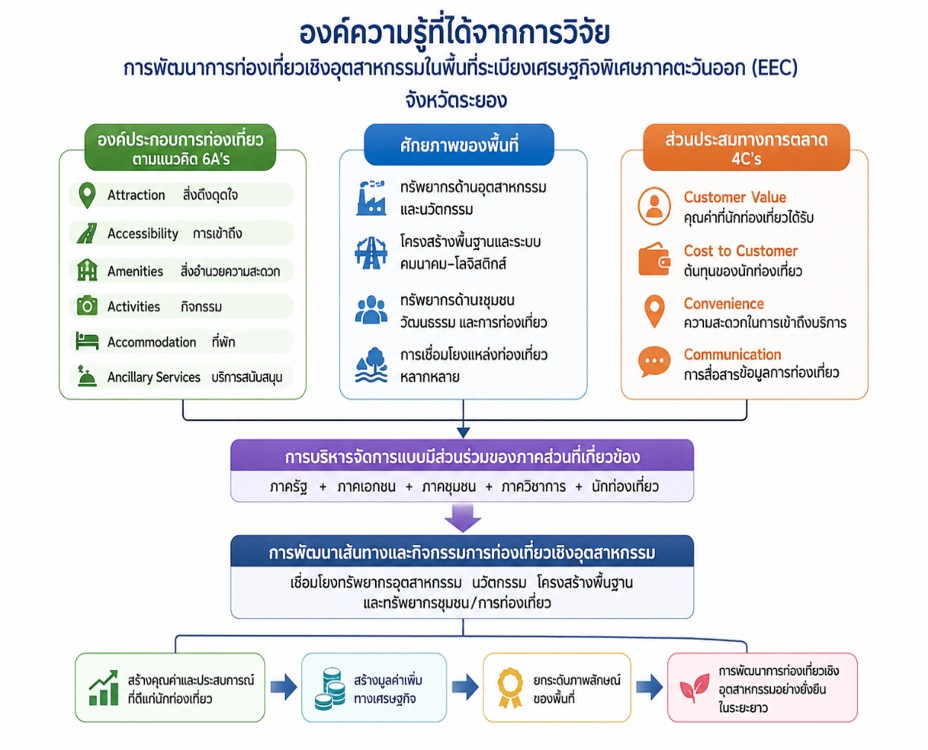
This research aimed to 1) examine the components and potential of industrial tourism in the Eastern Economic Corridor (EEC), Rayong Province; 2) analyze the 4C's marketing mix in the management of industrial tourism in the EEC, Rayong Province; and 3) propose management guidelines for industrial tourism in the EEC, Rayong Province. This study employed a qualitative research design, collecting data through semi-structured in-depth interviews with 30 key informants, including representatives from the public sector, private sector, local community, academia, and tourists, selected through purposive sampling of stakeholders involved in industrial tourism in the area. Data were analyzed using content analysis.
The findings revealed that:
1) The components of industrial tourism in the EEC, Rayong Province, conform to the 6A's framework comprising Attractions, Accessibility, Amenities, Activities, Accommodation, and Ancillary Services. Rayong Province possesses tourism potential and industrial readiness, supported by transportation and logistics infrastructure, as well as connectivity with natural and cultural tourist attractions in the area.
2) The 4C's marketing mix consists of Consumer Needs and Value, Cost to the Consumer, Convenience of Access, and Communication.
3) Guidelines for managing industrial tourism in the EEC area of Rayong Province include integrating cooperation among various sectors, developing industrial tourism routes, developing green industry, developing digital communication and marketing systems, formulating a strategic plan for industrial tourism in the EEC area, and applying Buddhist ethics—namely the Middle Way (Majjhima Patipada), the Four Sangahavatthu (bases of social solidarity), and the Threefold Training (Trisikkha) as a guiding framework to ensure that economic development, community participation, and environmental responsibility proceed in a balanced and sustainable manner.
References
กรมการท่องเที่ยว. (2567). ข้อมูลนักท่องเที่ยว. https://www.dot.go.th
สำนักงานคณะกรรมการนโยบายเขตพัฒนาพิเศษภาคตะวันออก. (2565). รายงานเศรษฐกิจรายไตรมาส 2564. https://www.eeco.or.th/th/quarterly-economic-report/1808
สำนักงานคณะกรรมการส่งเสริมการลงทุน. (2564). ภาวะการส่งเสริมการลงทุน. https://www.boi.go.th/index.php?page=index&language=th
Auksondee, N., & Darawong, C. (2024). Factors towards tourist satisfaction and behavioral intention of community based tourism in Thailand. Ph.D. in Social Sciences Journal, 14(2), 563–576. https://doi.org/10.14456/phdssj.2024.40
Badia, F., Galeone, G., & Shini, M. (2024). Sustainable strategies of industrial tourism in the agri-food business: an exploratory approach. British Food Journal, 126(1), 327-346. https://doi.org/10.1108/BFJ-11-2022-1031
Chiponde, D., Gledson, B., & Greenwood, D. (2022). Organisational learning from failure and the needs-based hierarchy of project-based organisations. Frontiers in Engineering and Built Environment, 2(2), 121–132. https://doi.org/10.1108/FEBE-10-2021-0051
Eastern Economic Corridor Office of Thailand (EECO). (2024). Development and promotion of tourism within EEC. https://www.eeco.or.th/en/development-and-promotion-of-tourism-within-eec/
Jiricka-Pürrer, A., Brandenburg, C., & Pröbstl-Haider, U. (2020). City tourism pre- and post-covid-19 pandemic: Messages to take home for climate change adaptation and mitigation? Journal of Outdoor Recreation and Tourism, 31, 100329. https://doi.org/10.1016/j.jort.2020.100329
Jujia, S., Somwang, C., & Sulaim, S. (2025). Enhancing the potential of creative community-based tourism to develop the area based on the local identity of the Si Ayutthaya group. Humanities, Arts and Social Sciences Studies, 25(1), 102–113. https://doi.org/10.69598/hasss.25.1.266080
Kádár, B., & Gede, M. (2021). Tourism flows in large-scale destination systems. Annals of Tourism Research, 87, 103113. https://doi.org/10.1016/j.annals.2020.103113
Kotler, P., Kartajaya, H., & Setiawan, I. (2017). Marketing 4.0: Moving from traditional to digital. Wiley. ISBN 9781119341208. https://books.google.com/books?id=FnlnDwAAQBAJ
Lee, C.-F. (2015). Tourist satisfaction with factory tour experience. International Journal of Culture, Tourism and Hospitality Research, 9(3), 261–277. https://doi.org/10.1108/IJCTHR-02-2015-0005
Li, H., Meng, F., & Pan, B. (2020). How does review disconfirmation influence customer online review behavior? A mixed-method investigation. International Journal of Contemporary Hospitality Management, 32(11), 3685–3703. https://doi.org/10.1108/IJCHM-03-2020-0234
Mada, Y. P. (2024). The evolution and revolution of marketing mix from 4P to 4C to 4E to e-marketing mix: A literature overview. International Journal of Innovations in Engineering Research and Technology, 11(8), 37–47. https://doi.org/10.26662/ijiert.v11i8.pp37-47
Nguyen, C. T., Yuen, K. F., Kim, T. Y., & Wang, X. (2024). An empirical research on the determinants of driver-partners’ participative behaviour in crowd logistics: From a motivation theory perspective. The International Journal of Logistics Management, 35(2), 601–622. https://doi.org/10.1108/IJLM-12-2022-0496
Omar, S. I., Othman, A. G., & Mohamed, B. (2014). The tourism life cycle: An overview of Langkawi Island, Malaysia. International Journal of Culture, Tourism and Hospitality Research, 8(3), 272–289. https://doi.org/10.1108/IJCTHR-09-2013-0069
Rhama, B. (2022). The halal tourism – alternative or mass tourism? Indications of traditional mass tourism on CrescentRating guidelines on halal tourism. Journal of Islamic Marketing, 13(7), 1492–1514. https://doi.org/10.1108/JIMA-07-2020-0199
Saghafi, F., Jalilvand, M. R., Ahmadiyeh, E., & Vosta, L. N. (2023). Analysis of an industrial tourism business network using social network approach: The case of Isfahan, Iran. Journal of Islamic Marketing, 14(12), 3113–3132. https://doi.org/10.1108/JIMA-06-2022-0164
Slack, N., Singh, G., & Sharma, S. (2020). Impact of perceived value on the satisfaction of supermarket customers: Developing country perspective. International Journal of Retail & Distribution Management, 48(11), 1235–1254. https://doi.org/10.1108/IJRDM-03-2019-0099
Somrak, T. (2025). The community-based tourism management effect on tourists’ perceptions and expectations. Journal of Thai Hospitality and Tourism, 20(1), 95–109. https://so04.tci-thaijo.org/index.php/tourismtaat/article/view/265097
Trinh, H. N., Tran, H. H., & Vuong, D. H. Q. (2020). Determinants of consumers’ intention to use credit card: A perspective of multifaceted perceived risk. Asian Journal of Economics and Banking, 4(3), 105–120. https://doi.org/10.1108/AJEB-06-2020-0018
Yuan, H. (2024). Research of the influence of tourists' experience on tourists' revisit intention. Journal of Modern Learning Development, 9(7), 140–152. https://so06.tci-thaijo.org/index.php/jomld/article/view/275846
Zoller, Y. J., & Muldoon, J. (2019). Illuminating the principles of social exchange theory with Hawthorne studies. Journal of Management History, 25(1), 47–66. https://doi.org/10.1108/JMH-05-2018-0026
Downloads
Published
How to Cite
Issue
Section
License
Copyright (c) 2026 Journal of Contemporary Buddhist Society = JCBS

This work is licensed under a Creative Commons Attribution-NonCommercial-NoDerivatives 4.0 International License.



