
THE PROMOTION OF MENTAL HEALTH AMONG HILL TRIBE ELDERLY THROUGH BUDDHIST PSYCHOLOGICAL PRINCIPLES
Keywords:
Mental Health Promotion, Hill Tribe Elderly, Buddhist PsychologyAbstract
This research aimed to 1) study the mental health problems of elderly hill tribe people and 2) explore guidelines for promoting the mental health of elderly hill tribe people according to Buddhist psychological principles. This study employed a qualitative research design and was conducted in two main stages. The first stage involved a documentary study of primary sources, including the Tipiṭaka and its commentaries, and secondary sources, such as related academic documents and research studies. The second stage consisted of in-depth interviews with 25 key informants, including monks and laypersons, experts in Buddhism, experts in psychology and Buddhist psychology, public health professionals, community leaders, and representatives of the elderly population. Data were analyzed using Content Analysis based on the 6Cs technique, Matrix Analysis, and Triangulation.
The research findings revealed that:
1) Mental health problems among Karen (Pgaz K'nyau) highland communities: The findings indicate that the mental health problems among the Karen (Pgaz K'nyau) highland communities comprise five interrelated dimensions: (1) feelings of worthlessness and hopelessness, (2) low self-worth and identity confusion, (3) loneliness and social isolation, (4) insufficient psychological and emotional support, and (5) powerlessness accompanied by reduced psychological coping capacity. These dimensions are closely interconnected and collectively contribute to adverse outcomes, including impaired immune functioning, feelings of abandonment, diminished self-esteem, and maladaptive emotional expression.
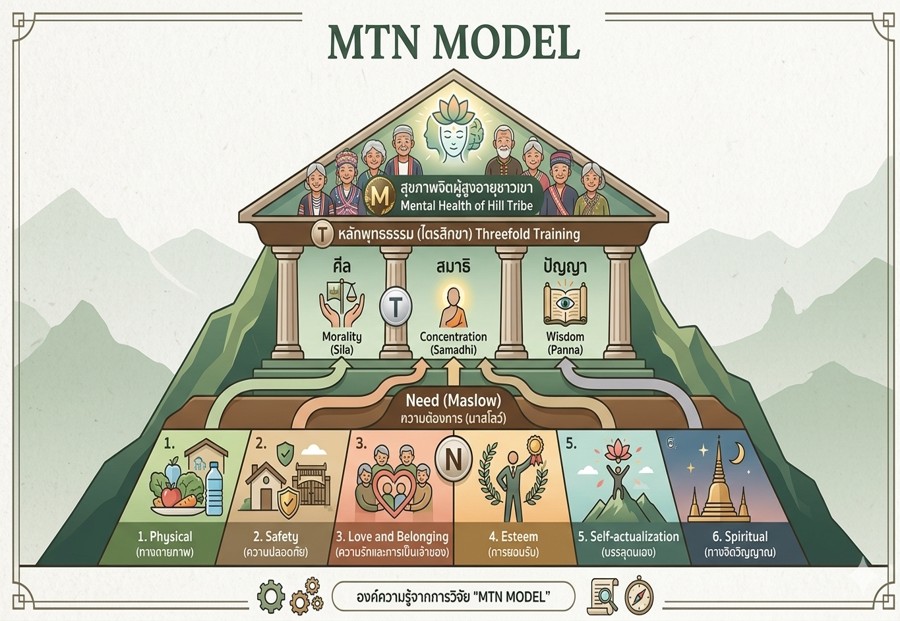
2) Guidelines for promoting the mental health of elderly hill tribe people should be implemented through participatory approaches involving families, communities, and relevant organizations, while grounding interventions in cultural contexts and religious principles. 1.These guidelines consist of six key components 2.promoting physical health as a foundation for mental health 3.fostering psychological security and emotional safety 4.encouraging love, social bonding, and community participation 5.enhancing self-worth and self-acceptance and 6.promoting self-development and a sense of meaning in life; and strengthening spiritual mental health based on the Buddhist principle of the Threefold Training (Trisikkhā) These approaches contribute to improved mental health, enhanced self-esteem, and the ability of elderly individuals to live happily within their communities.
References
กรมกิจการผู้สูงอายุ. (2567). สถานการณ์ผู้สูงอายุไทย พ.ศ. 2567. กรุงเทพมหานคร: กระทรวงการพัฒนาสังคมและความมั่นคงของมนุษย์
กระทรวงการพัฒนาสังคมและความมั่นคงของมนุษย์. (2566). แผนผู้สูงอายุแห่งชาติ ฉบับที่ 3 (พ.ศ. 2566–2580). กรุงเทพมหานคร
ธีรยุทธ ขาวสะอาด. (2566). ความเชื่อมโยงระหว่างกิจกรรมทางกายทางวัฒนธรรมกับสุขภาวะทางจิตของกลุ่มผู้สูงอายุชาติพันธุ์ปกาเกอะญอ. วารสารวิทยาศาสตร์การกีฬาและสุขภาพ, 24(1), 102–118.
นารีรัตน์ ประสิทธิ์ศิริกุล. (2566). ปัจจัยเชิงเหตุผลของความภาคภูมิใจในตนเองของวัยรุ่นและผู้สูงอายุชาติพันธุ์ปกาเกอะญอ: กรณีศึกษาชุมชนในเขตภาคเหนือตอนบน. วารสารจิตวิทยาคลินิกและสุขภาพจิต, 15(1), 112–128.
พรทิพย์ แก้ววิจิตร. (2566). ความขัดแย้งทางอัตลักษณ์และภาวะหมดคุณค่าในตนเองของวัยรุ่นปกาเกอะญอที่ย้ายถิ่นเข้าสู่แรงงานในเมือง. วารสารมานุษยวิทยาประยุกต์, 9(1), 110–128.
พุทธจิตวิทยา. (2565). แนวคิดการประยุกต์หลักไตรสิกขาเพื่อส่งเสริมสุขภาพจิตผู้สูงอายุ. กรุงเทพมหานคร: มหาวิทยาลัยมหาจุฬาลงกรณราชวิทยาลัยตรมหาบัณฑิต, บัณฑิตวิทยาลัยมหาวิทยาลัยมหาสารคาม, ๒๕๖๓), บทคัดย่อ.
สมชาย วงศ์คำเกล้า. (2565). การสร้างเสริมความภาคภูมิใจในอัตลักษณ์ทางวัฒนธรรมเพื่อการพัฒนาที่ยั่งยืนของกลุ่มชาติพันธุ์ปกาเกอะญอ. วารสารสังคมพัฒนาและมานุษยวิทยา, 10(2), 45–62.
สำนักงานการวิจัยแห่งชาติ. (2566). ยุทธศาสตร์การวิจัยด้านผู้สูงอายุและสังคมสูงวัยของประเทศไทย. กรุงเทพมหานคร
สำนักงานสถิติแห่งชาติ. (2567). สถิติประชากรและดัชนีการสูงวัยของประเทศไทย. กรุงเทพมหานคร: กระทรวงดิจิทัลเพื่อเศรษฐกิจและสังคม
สำนักงานสาธารณสุขจังหวัดเชียงใหม่. (2567). รายงานการสำรวจสุขภาวะและอนามัยสิ่งแวดล้อมของชาวกะเหรี่ยงในจังหวัดเชียงใหม่ พ.ศ. 2565–2567. เชียงใหม่.
สิริพร ทาชาติ. (2563). การดูแลผู้สูงอายุวิถีพุทธ: กรณีศึกษาสถานสงเคราะห์ผู้สูงอายุวัดป่าหนองแซง จังหวัดอุดรธานี วิทยานิพนธ์ศิลปศาสตรมหาบัณฑิต. มหาวิทยาลัยมหาสารคาม.
สุรศักดิ์ ใจดี. (2565). ภาวะความสิ้นหวังและปัจจัยที่เกี่ยวข้องในผู้สูงอายุชาติพันธุ์ปกาเกอะญอ: กรณีศึกษาชุมชนที่ได้รับผลกระทบจากการประกาศเขตอุทยาน. วารสารสุขภาพจิตและจิตเวชศาสตร์, 14(2), 55–72.
อัครเดช ศรีวิชัย. (2566). ภาวะความไร้อำนาจและการเผชิญปัญหาทางจิตสังคมของกลุ่มชาติพันธุ์ปกาเกอะญอในพื้นที่ทับซ้อนเขตป่าอนุรักษ์. วารสารรัฐศาสตร์และมานุษยวิทยา, 12(1), 145–163.
Downloads
Published
How to Cite
Issue
Section
License
Copyright (c) 2026 Journal of Contemporary Buddhist Society = JCBS

This work is licensed under a Creative Commons Attribution-NonCommercial-NoDerivatives 4.0 International License.



