
THE ENHANCING HOLISTIC WELL-BEING BASED ON BUDDHIST PSYCHOLOGY FOR FAMILIES AND COMMUNITIES IN MAE USU SUBDISTRICT, THA SONG YANG DISTRICT, TAK PROVINCE
Keywords:
Holistic well-being, Buddhist psychology, Pgaz K'Nyau (Karen) Hill-Tribe Society, The Four BhavanaAbstract
This research aimed to: 1) study the problems of enhancing holistic well-being based on Buddhist psychology among hill-tribe families and society; 2) study the supportive factors contributing to the enhancement of holistic well-being based on Buddhist psychology among hill-tribe families and society; and 3) propose guidelines for developing Buddhist psychology together with local wisdom to enhance the holistic well-being of hill-tribe families and society in Mae Usu Subdistrict, Tha Song Yang District, Tak Province. This is a qualitative research study, conducted through documentary research of primary sources (the Tipitaka and commentaries) and secondary sources, together with in-depth interviews with 20 key informants from 6 sample groups. Data were analyzed using the 6 Cs Content Analysis technique, Matrix Analysis, and Triangulation.
The findings revealed that:
1) Enhancing holistic well-being requires a participatory development approach focusing on "individuals, families, and communities" simultaneously across four dimensions—physical, mental, social, and spiritual. Key underlying causes include socio-economic change, health problems and risk behaviors among youth, the risk of losing cultural identity, and the community's need for stability.
2) The supportive factors for enhancing holistic well-being comprise three categories: family factors, social factors, and Buddhist psychological factors, reflecting a blending of traditional Pgaz K'Nyau (Karen) beliefs such as beliefs in ancestral spirits, respect for elders, and community solidarity with Buddhist principles.
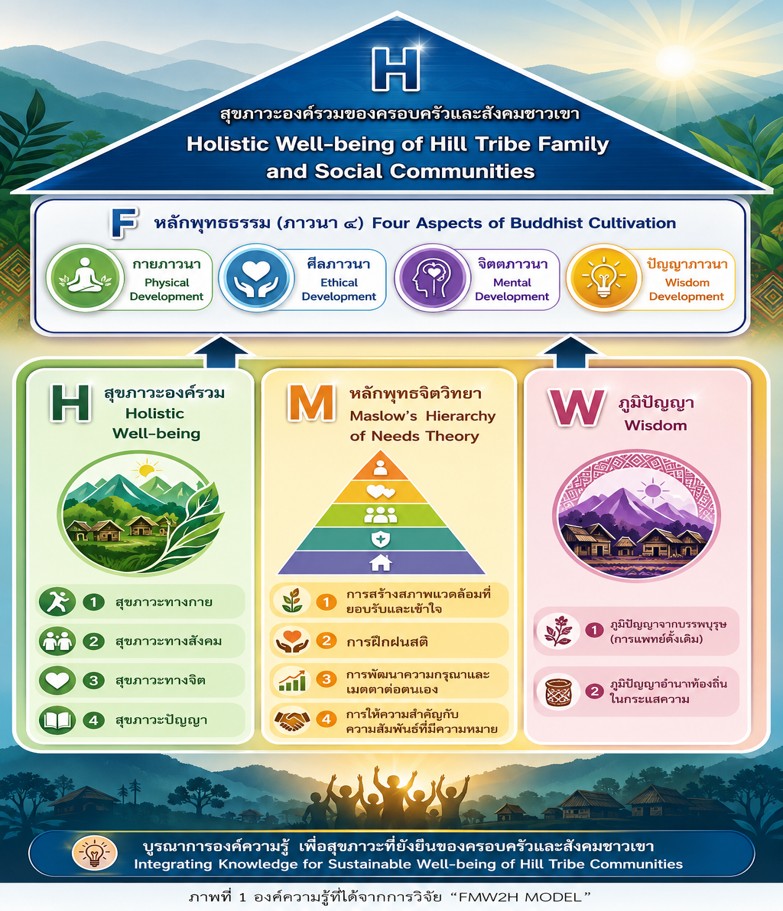
3) Guidelines for developing Buddhist psychology in conjunction with local wisdom yielded six practical approaches, synthesized into the FMW2H Model, which integrates Buddhist principles (the Four Bhāvanā), Buddhist psychology (linked to Maslow's Hierarchy of Needs), and Pgaz K'Nyau local wisdom. The model emphasizes participatory processes, respect for nature, and the application of wisdom in managing problems at the family and community levels, thereby fostering community resilience and sustainable well-being.
References
พระครูสิริรัตนานุวัตนานุวัตร และ ประยูร สุยะใจ. (2561). ยุทธศาสตร์ การสร้างรูปแบบการเสริมสร้างสุขภาวะองค์รวมของครอบครัวและสังคมตามแนวพุทธจิตวิทยาบูรณาการ (รายงานวิจัย), บัณฑิตวิทยาลัย: มหาวิทยาลัยมหาจุฬาลงกรณราชวิทยาลัย.
เพ็ญนภา ทรัพย์เจริญ และคณะ.(2566). บทบาทสถานภาพและทิศทางการพัฒนาองค์ความรู้และพื้นบ้านชาวไทยภูเขา, นนทบุรี: สถาบันการแพทย์แผนไทย กรมการแพทย์ กระทรวงสาธารณสุข.
สำนักงานสภาพัฒนาการเศรษฐกิจและสังคมแห่งชาติ. (2566). แผนพัฒนาเศรษฐกิจและสังคมแห่งชาติ ฉบับที่ 13 (พ.ศ. 2566–2570). กรุงเทพมหานคร: สำนักงานสภาพัฒนาการเศรษฐกิจและสังคมแห่งชาติ.
สุวิจักขณ์ ภานุสรณ์ฐากูร. (2563). กระบวนการพัฒนาจิตเพื่อเสริมสร้างสุขภาวะองค์รวมตามแนวพุทธ จิตวิทยาและการปฏิบัติตามกฎแห่งแรงดึงดูด [ดุษฎีบัณฑิตพุทธศาสตรดุษฎีบัณฑิต, มหาวิทยาลัยมหาจุฬาลงกรณราชวิทยาลัย].
Bronfenbrenner, U. (1979). The ecology of human development: Experiments by nature and design. Harvard University Press.
Mahatthanadull, S. (2006). Mental balance and well-being: Building bridges between Buddhism and Western psychology. Mahidol University.
Mahatthanadull, S., & Mahatthanadull, S. (2020). Holistic well-beings promotion for balanced way of life according to Buddhist psychology. Journal of MCU Buddhasocial Review, 5(2), 1–15.
Maslow, A. H. (1943). A theory of human motivation. Psychological Review, 50(4), 370–396.
Nature Portfolio. (2025). Defining bhāvanā through the PAL framework: Grounded theory insights from long-term IAM®-35 practitioners. Humanities and Social Sciences Communications, 12, Article 1234. https://doi.org/10.1057/s41599-025-05783-y
Phra Brahmagunabhorn (P. A. Payutto). (2016). Buddhist economics: A middle way for the marketplace. Buddhadhamma Foundation.
Phatthanaphraiwan, S., et al. (2025). Reciprocal relations in the Karen highlands of northern Thailand. People and Nature, 7(2), 1–18. https://doi.org/10.1002/pan3.70011
Santasombat, Y. (2003). Space of resistance and place of local knowledge in Karen ecological movement of northern Thailand: The case of Pgaz K'Nyau villages in Mae Lan Kham River Basin. Chiang Mai University.
Suansunandha Philosophy Center. (2025). Linking the Inner Development Goals (IDG) to Bhāvanā 4 (ภาวนา 4) in Buddhism: A conceptual integration. Suan Sunandha Rajabhat University.
Wallace, B. A., & Shapiro, S. L. (2006). Mental balance and well-being: Building bridges between Buddhism and Western psychology. American Psychologist, 61(7), 690–701.
World Health Organization. (2021). Constitution of the World Health Organization: Basic documents (49th ed.). WHO Press.
Downloads
Published
How to Cite
Issue
Section
License
Copyright (c) 2026 Journal of Contemporary Buddhist Society = JCBS

This work is licensed under a Creative Commons Attribution-NonCommercial-NoDerivatives 4.0 International License.



