
THE INTERNAL QUALITY ASSURANCE MODEL FOR BUDDHIST MONASTIC SCHOOLS, GENERAL EDUCATION SECTION
Keywords:
Internal Educational Quality Assurance, Enhancement, Brahmavihāra DhammaAbstract
This research article aimed to: 1. study the conditions promoting internal educational quality assurance in Phrapariyattidhamma Schools, General Education Division; 2. develop a model for internal educational quality assurance in Phrapariyattidhamma Schools, General Education Division; and 3. evaluate the model for internal educational quality assurance in Phrapariyattidhamma Schools, General Education Division. This study employed a multi-phase mixed-methods research design combining quantitative and qualitative approaches. The quantitative research utilized samples consisting of administrators and teachers from Phrapariyattidhamma Schools, General Education Division. The statistics used in the study included frequency, percentage, mean, standard deviation, and qualitative descriptive analysis.
The research findings revealed that:
- The study of the conditions promoting internal educational quality assurance in Phrapariyattidhamma Schools, General Education Division, showed that the overall level was high (4.01). Considering each aspect, it was found that implementation according to the plan had the highest mean score at a high level (4.09), followed by applying evaluation results for improvement at a high level (4.03), while monitoring and evaluation had the lowest mean score (3.93).
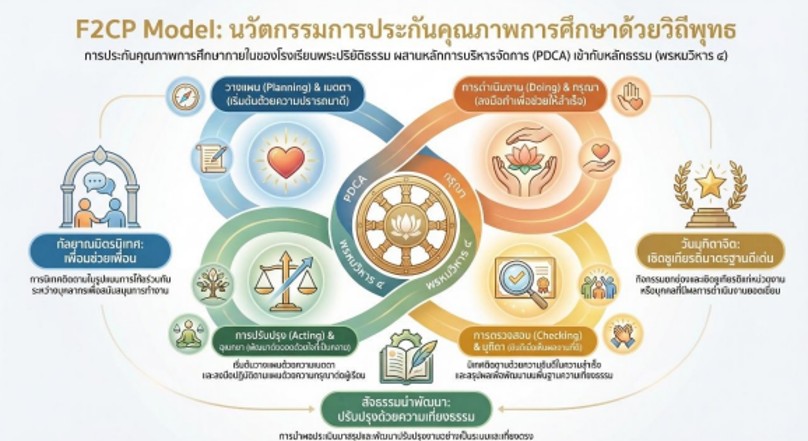
- The development of the internal educational quality assurance model for Phrapariyattidhamma Schools, General Education Division, revealed that the body of knowledge derived from the research led to the creation of a textual model consisting of six components: Principles Objectives Integration Development through four activities Evaluation guidelines Conditions for success under the LICR Model.
- The evaluation results of the internal educational quality assurance model for Phrapariyattidhamma Schools, General Education Division, indicated that the model’s suitability, feasibility, and usefulness were overall at a high level, based on the mean and standard deviation values. When considering each aspect in descending order, feasibility ranked first, followed by suitability and usefulness respectively, which was consistent with the F2CP Model
References
กระทรวงศึกษาธิการ. (2546). คู่มือการประกันคุณภาพการศึกษาในสถานศึกษา ระดับการศึกษาขั้นพื้นฐาน. กรุงเทพฯ: สำนักงานคณะกรรมการการศึกษาแห่งชาติ.
เฉลิมพร กุมภา. (2564). รูปแบบการบริหารงานการประกันคุณภาพการศึกษา ของโรงเรียนขนาดเล็ก. วารสารสังคมศาสตร์และมานุษยวิทยาเชิงพุทธ. 6(2), 67-76.
ชาญชัย อาจินสมาจาร. (2550). ทักษะภาวะผู้นำ. กรุงเทพฯ: มัลติอินฟอร์เมชันเทคโนโลยี.
นิพนธ์ กินาวงศ์. (2543). หลักการบริหารการศึกษา (พิมพ์ครั้งที่ 2). พิษณุโลก: ตระกูลไทย.
ศิริวรรณ จั่นทับ. (2566). ปัจจัยที่ส่งผลต่อการดำเนินงานประกันคุณภาพการศึกษาภายในสถานศึกษา สังกัดสำนักงานเขตพื้นที่การศึกษามัธยมศึกษานครสวรรค์. วารสารคณะครุศาสตร์ราชภัฎนครสวรรค์. 6(2), 109-207.
สมพล ทุ่งหว้า. (2560). การพัฒนาระบบการประกันคุณภาพภายในสำหรับการจัดการศึกษา หลักสูตรบริหารธุรกิจ มหาบัณฑิต (ดุษฎีนิพนธ์ปรัชญาดุษฎีบัณฑิต สาขาวิชาวิจัย วัดผลและสถิติการศึกษา). คณะศึกษาศาสตร์: มหาวิทยาลัยบูรพา.
สิทธิกร อ้วนศิริ. (2555). การพัฒนาโมเดลเชิงสาเหตุของปัจจัยที่ส่งผลต่อผลการประเมินคุณภาพภายนอก ของโรงเรียนพระปริยัติธรรม แผนกสามัญศึกษา. เลย: สำนักงานพระพุทธศาสนา จังหวัดเลย.
สุพล เครือมโนรมย์. (2565). การศึกษาการบริหารงานบุคลากร ตามหลักพรหมวิหาร 4 โรงเรียนประถมศึกษา เขตบางกอก ใหญ่กรุงเทพมหานค. วารสาร มจร อุบลปริทรรศน์. 7(2), 2023-2034.
Downloads
Published
How to Cite
Issue
Section
License
Copyright (c) 2026 Journal of Contemporary Buddhist Society = JCBS

This work is licensed under a Creative Commons Attribution-NonCommercial-NoDerivatives 4.0 International License.



