
THE APPLICATION OF PSYCHIC WILLPOWER TO SOLVE INSOMNIA IN PRACTITIONERS FOLLOWING TO THE TEACHINGS OF LUANG POR WIRIYANGK
Keywords:
Power of Mind (Cittānubhāva), Insomnia, Luang Por Viriyang, Meditation Practice, Buddho RecitationAbstract
This research aimed to: 1) study the power of mind (Cittānubhāva) for solving insomnia according to the approach of Luang Por Viriyang; 2) study the perspectives of meditation practitioners regarding the solution to insomnia according to the approach of Luang Por Viriyang; and 3) apply the power of mind to solve insomnia among meditation practitioners according to the approach of Luang Por Viriyang. This study employed a qualitative methodology. The key informants were 17 meditation practitioners (monastics and/or laypersons) who had experienced insomnia and had practiced meditation according to the approach of Luang Por Viriyang. In-depth interviews served as the primary instrument for data collection, and the data were analyzed using content analysis.
The research findings revealed that:
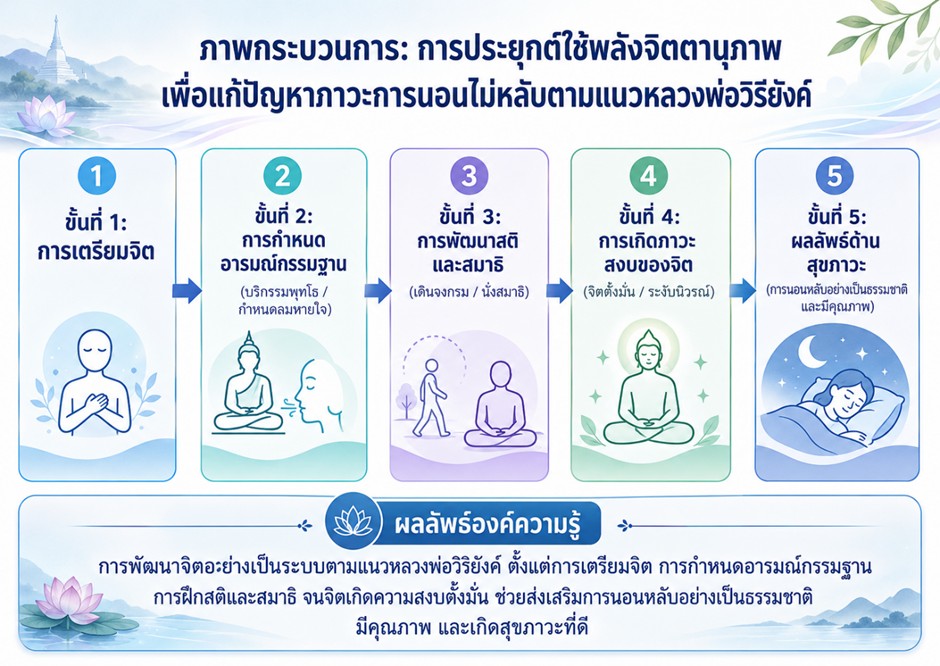
1) The power of mind according to the approach of Luang Por Viriyang arises from meditation practice involving the recitation of "Buddho" in conjunction with consistent sitting meditation and walking meditation, until the mind becomes firmly established, capable of suppressing the hindrances (nīvaraṇa) and entering a state of tranquility. This power of mind is not merely a relaxation technique but a systematic process of mental development that addresses the root cause of insomnia: the restlessness of the mind. 2) The perspectives of the meditation practitioners reflected that the causes of insomnia stem from mental distraction, accumulated stress, and an insufficient ability to regulate one's own thoughts and emotions. Through continuous practice of meditation according to this approach, mental distraction diminishes, stability is established, and sleep occurs naturally and with improved quality. The practitioners viewed the power of mind as a tool for both mental development and self-care, used in conjunction with one another. 3) The application of the power of mind to solve insomnia among meditation practitioners according to the approach of Luang Por Viriyang involves implementing the mental training process into daily life. When the mind has been trained to suppress the hindrances and achieve balance, sleep occurs effectively and sustainably. This constitutes a body of knowledge connecting Buddhist principles with the care of mental well-being within the context of contemporary society.
References
พระพรหมมงคลญาณ (พระอาจารย์วิริยังค์ สิรินฺธโร). (2562). หลักสูตรครูสมาธิ เล่ม 1. บริษัท ประชาชนจำกัด.
ภาควิชาจิตเวชศาสตร์ คณะแพทยศาสตร์ศิริราชพยาบาล. (2561). บทความผิดปกติการนอน. ใน จิตเวชศาสตร์ (หน้า 563–571). ภาควิชาจิตเวชศาสตร์ คณะแพทยศาสตร์ศิริราชพยาบาล.
สมเด็จพระญาณวชิโรดม (วิริยังค์ สิรินฺธโร). (2550). วิธีทำสมาธิ. ธรรมมงคล.
สมาคมจิตแพทย์แห่งประเทศไทย. (2558). คู่มือการวินิจฉัยและสถิติสำหรับความผิดปกติทางจิต DSM-5 ฉบับภาษาไทย. สมาคมจิตแพทย์แห่งประเทศไทย.
สมาคมโรคจากการหลับแห่งประเทศไทย และ กรมอนามัย กระทรวงสาธารณสุข. (2559). สารพันปัญหาการนอนหลับ. บริษัท โอ-วิทย์ (ประเทศไทย) จำกัด.
Benson, H. (2000). The relaxation response. HarperCollins.
Black, D. S., O'Reilly, G. A., Olmstead, R., Breen, E. C., & Irwin, M. R. (2015). Mindfulness meditation and improvement in sleep quality and daytime impairment among older adults with sleep disturbances: A randomized clinical trial. JAMA Internal Medicine, 175(4), 494–501. https://doi.org/10.1001/jamainternmed.2014.8081
Kalmbach, D. A., Anderson, J. R., & Drake, C. L. (2018). The impact of stress on sleep: Pathogenic sleep reactivity as a vulnerability to insomnia and circadian disorders. Journal of Sleep Research, 27(6), e12710. https://doi.org/10.1111/jsr.12710
Morin, C. M., Drake, C. L., Harvey, A. G., Krystal, A. D., Manber, R., Riemann, D., & Spiegelhalder, K. (2015). Insomnia disorder. Nature Reviews Disease Primers, 1, 15026. https://doi.org/10.1038/nrdp.2015.26
Ong, J. C., Shapiro, S. L., & Manber, R. (2008). Combining mindfulness meditation with cognitive-behavior therapy for insomnia: A treatment-development study.
Behavior Therapy, 39(2), 171–182. https://doi.org/10.1016/j.beth.2007.07.002
Rusch, H. L., Rosario, M., Levison, L. M., Olivera, A., Livingston, W. S., Wu, T., & Gill, J. M. (2019). The effect of mindfulness meditation on sleep quality: A systematic review and meta-analysis of randomized controlled trials. Annals of the New York Academy of Sciences, 1445(1), 5–16. https://doi.org/10.1111/nyas.13996
Shapiro, S. L., Carlson, L. E., Astin, J. A., & Freedman, B. (2006). Mechanisms of mindfulness. Journal of Clinical Psychology, 62(3), 373–386. https://doi.org/10.1002/jclp.20237
World Health Organization. (n.d.). Sleep problems prevalence and health impact. WHO. Retrieved 2026.
Downloads
Published
How to Cite
Issue
Section
License
Copyright (c) 2026 Journal of Contemporary Buddhist Society = JCBS

This work is licensed under a Creative Commons Attribution-NonCommercial-NoDerivatives 4.0 International License.



