
DYNAMIC BUDDHIST INTEGRATION: COUPLING IDDHIPĀDA IV AND THE FOUR NOBLE TRUTHS FOR SUSTAINABLE WORK EFFICIENCY
Keywords:
Buddhist Integration, Work Efficiency, Four Noble Truths, Iddhipada IVAbstract
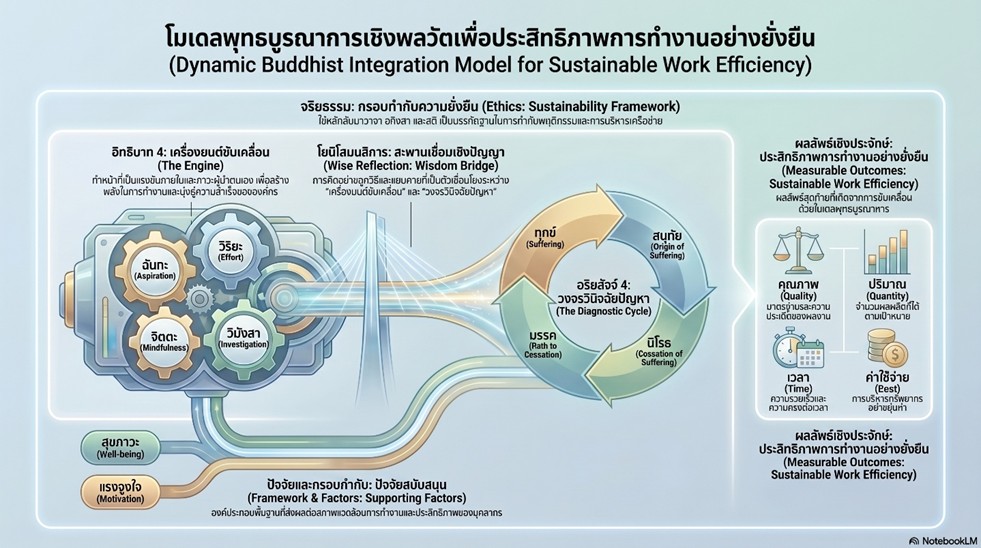
This academic article aims to propose a Buddhist Integration framework for sustainable work efficiency, employing the Four Paths to Success (Iddhipāda IV) as the principal axis of intrinsic drive and the Four Noble Truths (Ariyasacca) as a systematic process for analysing and resolving problems. Within contemporary work settings in which personnel face stress, work overload and burnout, the study finds that Maslow’s hierarchy of needs and motivation theories adequately address structural needs and extrinsic drives but do not encompass the dimensions of recognising craving (taṇhā), managing suffering (dukkha) and working without becoming enslaved to outcomes. The article therefore proposes a clear conceptual ordering in which work efficiency is treated as the outcome, well-being and motivation as factors, and ethics as the governing framework. The integration proceeds along three dimensions: (1) strategy and cognitive systems, using the Four Noble Truths and Yonisomanasikāra to analyse root causes; (2) human development, using the Threefold Training and the Fourfold Development to balance body and mind, reinforced by Buddhist organisational ethics through Right Speech, non-violence and mindfulness; and (3) achievement, using Iddhipāda IV as the foundation of self-leadership integrated with collaborative networking. The new knowledge derived is a “Dynamic Buddhist Integration Model” coupling the intrinsic drive of Iddhipāda IV with the diagnostic cycle of the Four Noble Truths to enhance efficiency in quality, quantity, time and cost, together with virtue and inner well-being. In conclusion, Buddhist Integration does not aim solely at increasing output but at balancing efficiency, virtue, well-being and organisational relationships for a sustainable, well-governed ecosystem of work.
References
กฤษดา ทองทับ. (2569, 10 เมษายน). วันนี้คุณมี “แรงจูงใจในการทำงาน” กันหรือยัง. https://www.manarom.com/blog/motivate_yourself_to_work.html
คุณาทัย อ่อนน้อม. (2564). คนที่เก่งขึ้นทุกวัน เขาทำงานด้วย MINDSET แบบนี้. อมรินทร์ บุ๊ค เซ็นเตอร์.
ชูศักดิ์ เจนประโคน. (2557). เทคนิคการจูงใจ Motivation technique. สำนักพิมพ์มหาวิทยาลัยรามคำแหง.
พระครูปลัดสุวัฒนวิสุทธิสารคุณ (พระมหามฆวินทร์ ปุริสุตฺตโม, ผศ.ดร.). (2568). อริยสัจ 4 เพื่อการพัฒนาองค์กร. วารสารสถาบันพอดี, 2(1), 1–13.
https://so16.tci-thaijo.org/index.php/IS-J/article/view/1343
พระพรหมคุณาภรณ์ (ป.อ. ปยุตฺโต). (2558). การศึกษาเพื่อสร้างบัณฑิตหรือการศึกษาเพื่อเพิ่มผลผลิต (พิมพ์ครั้งที่ 5). มูลนิธิพุทธธรรม.
พระพรหมคุณาภรณ์ (ป.อ. ปยุตฺโต). (2559). พุทธธรรม ฉบับปรับขยาย (พิมพ์ครั้งที่ 47). โรงพิมพ์มหาจุฬาลงกรณราชวิทยาลัย.
ภัทราพร จันตะนี, บุญทัน ดอกไธสง และสุรินทร์ นิยมางกูร. (2566). การบูรณาการหลักพุทธธรรมเพื่อพัฒนาประสิทธิภาพการปฏิบัติงานของบุคลากรมหาวิทยาลัยราชภัฏกลุ่มศรีอยุธยา. วารสารพุทธนวัตกรรมและการจัดการ, 6(4), 49–60.
https://so06.tci-thaijo.org/index.php/bim/article/view/259655
ภูรีภัทร ห้วยหงษ์ทอง. (2561). การบูรณาการหลักพุทธธรรมเพื่อส่งเสริมการพัฒนาคุณภาพชีวิตในการทำงาน. วารสารวิจัยวิชาการ, 1(3), 123–135.
https://so06.tci-thaijo.org/index.php/jra/article/view/178151
วรินทร จินดาวงศ์. (2566). การบูรณาการหลักพุทธธรรมเพื่อส่งเสริมประสิทธิภาพการปฏิบัติงานของบุคลากรในสังกัดสำนักงานศึกษาธิการจังหวัดศรีสะเกษ [วิทยานิพนธ์ปริญญาดุษฎีบัณฑิต, มหาวิทยาลัยมหาจุฬาลงกรณราชวิทยาลัย].
สมเด็จพระพุทธโฆษาจารย์ (ป.อ. ปยุตฺโต). (2564). พจนานุกรมพุทธศาสน์ ฉบับประมวลธรรม (พิมพ์ครั้งที่ 43). โรงพิมพ์มหาจุฬาลงกรณราชวิทยาลัย.
สุวิทย์ เมษแก้ว. (2565). การจัดการเชิงพุทธ (พิมพ์ครั้งที่ 3). สำนักพิมพ์เซเว่น บุ๊คส์.
อธิพัฒน์ วรนิธิภาคย์. (2566). ปรัชญาทางสังคมศาสตร์และการวิเคราะห์ทฤษฎีลำดับขั้นของความต้องการของอับราฮัม ฮาโรลด์ มาสโลว์. วารสารวิชาการไทยวิจัยและการจัดการ, 4(3), 65–66.
https://so05.tci-thaijo.org/index.php/TRDMJOPOlSU/article/view/268840
Deci, E. L., & Ryan, R. M. (2000). The “what” and “why” of goal pursuits: Human needs and the self-determination of behavior. Psychological Inquiry, 11(4), 227–268.
doi.org/10.1207/S15327965PLI1104_01
Gethin, R. (1998). The foundations of Buddhism. Oxford University Press.
Harvey, P. (2000). An introduction to Buddhist ethics: Foundations, values and issues. Cambridge University Press.
Herzberg, F. (1968). One more time: How do you motivate employees? Harvard Business Review, 46(1), 53–62.
https://hbr.org/2003/01/one-more-time-how-do-you-motivate-employees
Keown, D. (2005). Buddhist ethics: A very short introduction. Oxford University Press.
Maslach, C., & Leiter, M. P. (2016). Understanding the burnout experience: Recent research and its implications for psychiatry. World Psychiatry, 15(2), 103–111.
https://doi.org/10.1002/wps.20311
Maslow, A. H. (1943). A theory of human motivation. Psychological Review, 50(4), 370–396. https://doi.org/10.1037/h0054346
Urbinner. (2569, 10 เมษายน). ทฤษฎีลำดับขั้นความต้องการของมาสโลว์ (Maslow’s Hierarchy of Needs). https://www.urbinner.com/post/maslow-hierarchy-of-needs
Downloads
Published
How to Cite
Issue
Section
License
Copyright (c) 2026 Journal of Contemporary Buddhist Society = JCBS

This work is licensed under a Creative Commons Attribution-NonCommercial-NoDerivatives 4.0 International License.



