
INTEGRATION OF NEW NORMAL LEADERSHIP AND GOOD GOVERNANCE FOR MANAGEMENT IN THE DIGITAL ERA
Keywords:
New Normal Leadership, Digital Leadership, Good Governance, Educational Organizational Reform, DGEM ModelAbstract
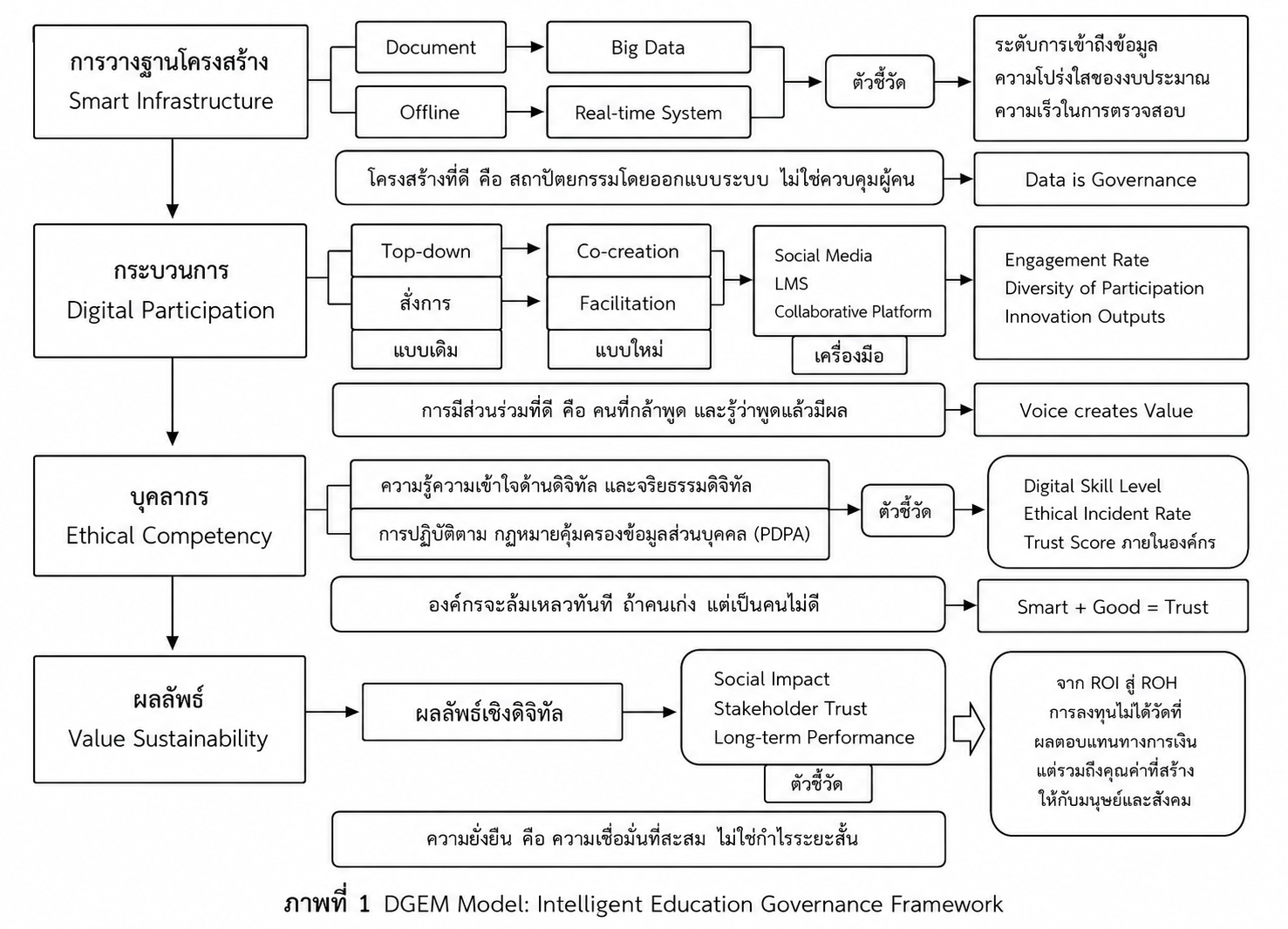
This academic article aims to present guidelines for educational organizational reform by integrating New Normal Leadership and Good Governance in the digital era. Global crises and technological dynamics have compelled educational institutions to transition to full online systems. The study indicates that digital leadership is a critical variable that encompassing not only technical expertise but also innovative vision and the creation of flexible organizational cultures. The six principles of Good Governance—Rule of Law, Ethics, Transparency, Participation, Accountability, and Value for Money—serve as oversight mechanisms to ensure the ethical and fair use of power and technology. Furthermore, a new body of knowledge has been synthesized into the DGEM Model (Intelligent Education Governance Framework), consisting of four key steps: 1) Establishing a smart digital infrastructure foundation with real-time monitoring; 2) Building a participatory ecosystem that shifts the leader's role to a facilitator to create innovation consensus; 3) Enhancing personnel competency alongside digital ethics to foster a culture of responsibility; and 4) Integrating for sustainability focusing on efficiency and social value. This model introduces the synergy of innovative intelligence and systemic integrity to bridge the digital divide and build public trust, ultimately leading to a quality, equitable, and sustainable reform of Thai education amidst future global uncertainties.
References
กรมการปกครอง. (2545). ระเบียบสำนักนายกรัฐมนตรีว่าด้วยการสร้างระบบบริหารกิจการบ้านเมืองและสังคมที่ดี พ.ศ. 2542. กรุงเทพมหานคร: โรงพิมพ์อาสารักษาดินแดน.
จันทนา แสนสุข. (2559). ภาวะผู้นำ Leadership. พิมพ์ครั้งที่ 3. กรุงเทพมหานคร: บริษัท ทริปเพิ้ล กรุ๊ป.
จิรพล สังข์โพธิ์ และคณะ. (2569). ภาวะผู้นำในการบริหารองค์กรยุคดิจิทัล กรณีศึกษา: องค์กรไอทีและองค์กรที่เกี่ยวข้องกับไอทีในเขตกรุงเทพมหานคร และปริมณฑล. [ออนไลน์]. แหล่งที่มา: https://sites.google.com/view/plans-ud4 [22 มีนาคม 2569].
ชรินรัตน์ แผงดี. (2550). “การนำเสนอรูปแบบการบริหารด้วยหลักธรรมาภิบาลของผู้บริหารกลุ่มเครือข่ายโรงเรียนบึงพิมพาสามัคคี สำนักงานเขตพื้นที่การศึกษานครสวรรค์ เขต 2”. วิทยานิพนธ์ศึกษาศาสตรมหาบัณฑิต สาขาวิชาการบริหารการศึกษา. บัณฑิตวิทยาลัย: มหาวิทยาลัยราชภัฏนครสวรรค์.
ชูชาติ พุทธลา. (2561). “องค์ประกอบภาวะผู้นำทางดิจิทัลของผู้บริหารโรงเรียนสังกัดสำนักงานเขตพื้นที่การศึกษาประถมศึกษาจังหวัดหนองบัวลำภู”. วิทยานิพนธ์การศึกษามหาบัณฑิต สาขาวิชาการบริหารการศึกษา. บัณฑิตวิทยาลัย: มหาวิทยาลัยขอนแก่น.
ณิรดา เวชญาลักษณ์. (2560). ภาวะผู้นำทางการบริหาร. กรุงเทพมหานคร: สำนักพิมพ์แห่งจุฬาลงกรณ์มหาวิทยาลัย.
ณัฐนันท์ ศิริเจริญ. (2568). “ภาวะผู้นำแบบปรับตัวและธรรมาภิบาลในยุคดิจิทัล: กรณีศึกษาหน่วยงานรัฐในกรุงเทพมหานครและเขตปริมณฑล”. วารสารรัฐศาสตร์และรัฐประศาสนศาสตร์. ปีที่ 16 ฉบับที่ 2: 123-158.
ดาวรุวรรณ ถวิลการ. (2564). ภาวะผู้นำดิจิทัล Digital Leadership. ขอนแก่น: มหาวิทยาลัยขอนแก่น.
ถวิลวดี บุรีกุล และคณะ. (2545). โครงการศึกษาเพื่อพัฒนาดัชนีวัดผลการพัฒนาระบบบริหารจัดการที่ดี. นนทบุรี: สถาบันพระปกเกล้า.
ภานุมาศ จันทร์ศรี. (2562). “โมเดลการพัฒนาภาวะผู้นำเชิงดิจิทัลของผู้บริหารโรงเรียนขยายโอกาสทางการศึกษา: การวิจัยแบบผสมผสานวิธี”. วิทยานิพนธ์ศึกษาศาสตรมหาบัณฑิต สาขาวิชาการบริหารการศึกษา. บัณฑิตวิทยาลัย: มหาวิทยาลัยขอนแก่น.
วัฒนชัย ศิริญาณ และคณะ. (2560). “องค์กรแห่งนวัตกรรม: ทางเลือกใหม่สำหรับการพัฒนาในศตวรรษที่ 21 (The Innovation Organization: The New Alternative for 21st Century Development)”. วารสารอินฟอร์เมชั่น Information. ปีที่ 24 ฉบับที่ 2: 80-92.
สถาบันพระปกเกล้า. (2558). ดุลอำนาจในการเมืองการปกครองไทย. กรุงเทพมหานคร: เอ.พี. กราฟิค ดีไซน์และการพิมพ์.
สุกัญญา แช่มช้อย. (2558). “ภาวะผู้นำทางเทคโนโลยี: การนำเทคโนโลยีเข้าสู่ห้องเรียนและโรงเรียนในศตวรรษที่ 21”. วารสารศึกษาศาสตร์ มหาวิทยาลัยนเรศวร. ปีที่ 17 ฉบับที่ 4: 216-224.
สำนักนโยบายและยุทธศาสตร์ สำนักงานปลัดกระทรวงศึกษาธิการ. (2563). แผนยุทธศาสตร์กระทรวงศึกษาธิการ. กรุงเทพมหานคร: กระทรวงศึกษาธิการ.
American Library Association. (2022). Digital literacy, libraries, and public policy. [Online]. Source: https://www.districtdispatch.org/wp-content/uploads/2013/01/2012OITPdigilitreport1_22_13.pdf [March 25, 2026].
Blake, R. R., & Mouton, J. S. (1964). The Managerial Grid. Houston: Gulf Publishing.
Digital Marketing Institute. (2026). The Most In-Demand Skills in Digital Leadership. [Online]. Source: https://www.digitalmarketinginstitute.com/blog/03-04-18the-most-in-demand-skills-in-digital-leadership [March 25, 2026].
Gorton, C. and Gorton, B. (2022). 6 Characteristics of Digital Leadership. [Online]. Source: https://digileaders.com/6-characteristics-digital-leadership [March 25, 2026].
Koontz, H. and Weihrich, H. (1988). Management. New York: McGraw–Hill.
Krishnanunthi, L. (2017). “Indicators of Digital Leadership in the context of K-12 Education”. Journal of Educational Technology Development and Exchange (JETDE). Vol. 10 No. 1: 27-40.
Martin, A., & Gtudziecki, E. (2006). “Dig Eulit: Concepts and Tools for Digital Literacy Development”. ITALICS: Innovations in Teaching & Learning in Information & Computer Sciences. Vol. 5 No. 4: 246-264.
Mitchel, T. R. and Larson, J. R., Jr. (1987). People in Organization. Singapore: McGraw-Hill International.
Stogdill, R. M. (1974). Studies in Naval Leadership. Pitsburgh: Canegie Press.
Sullivan, L. (2026). Skills Every Digital Leader Needs. [Online]. Source: https://www.cmswire.com/digital-workplace/8-skills-every-digital-leader-needs [March 25, 2026].
Downloads
Published
How to Cite
Issue
Section
License
Copyright (c) 2026 Journal of Contemporary Buddhist Society = JCBS

This work is licensed under a Creative Commons Attribution-NonCommercial-NoDerivatives 4.0 International License.



