
MEDITATION 4: DEVELOPMENT OF A CURRICULUM TO ENHANCE DEVELOPMENT AND PREVENT CHILDREN FROM USING SMARTPHONES AS A NANNY IN THE TAK OK SUBDISTRICT ADMINISTRATIVE ORGANIZATION'S CHILD DEVELOPMENT CENTER, BAN TAK DISTRICT, TAK PROVINCE
Keywords:
Bovorn Network, Early Childhood Development, Fourfold Meditation, Smartphones as Babysitters, Child Development CenterAbstract
This research aims to 1) study the Bhavana 4 model and its impact on physical, emotional-mental, social, and intellectual learning development; 2) develop learning activities for early childhood development centers; and 3) promote the strengthening of the “Bovorn” (Home, Temple, School) network in preventing children from using smartphones as nannies. This is a mixed-method research study, comprising quantitative research. The research employed questionnaires administered to a population of 100 individuals and qualitative research through in-depth interviews with 10 key informants. Data was analyzed using percentages, means (), standard deviations (S.D.), and content analysis
The research findings revealed
- Overall, opinions regarding curriculum development were at a high level. The aspects with the highest means in each area were: development of play equipment and skill-enhancing devices (= 4.45), educational games to stimulate analytical thinking (= 4.30), and children's curiosity and willingness to ask questions ( = 4.21), respectively.
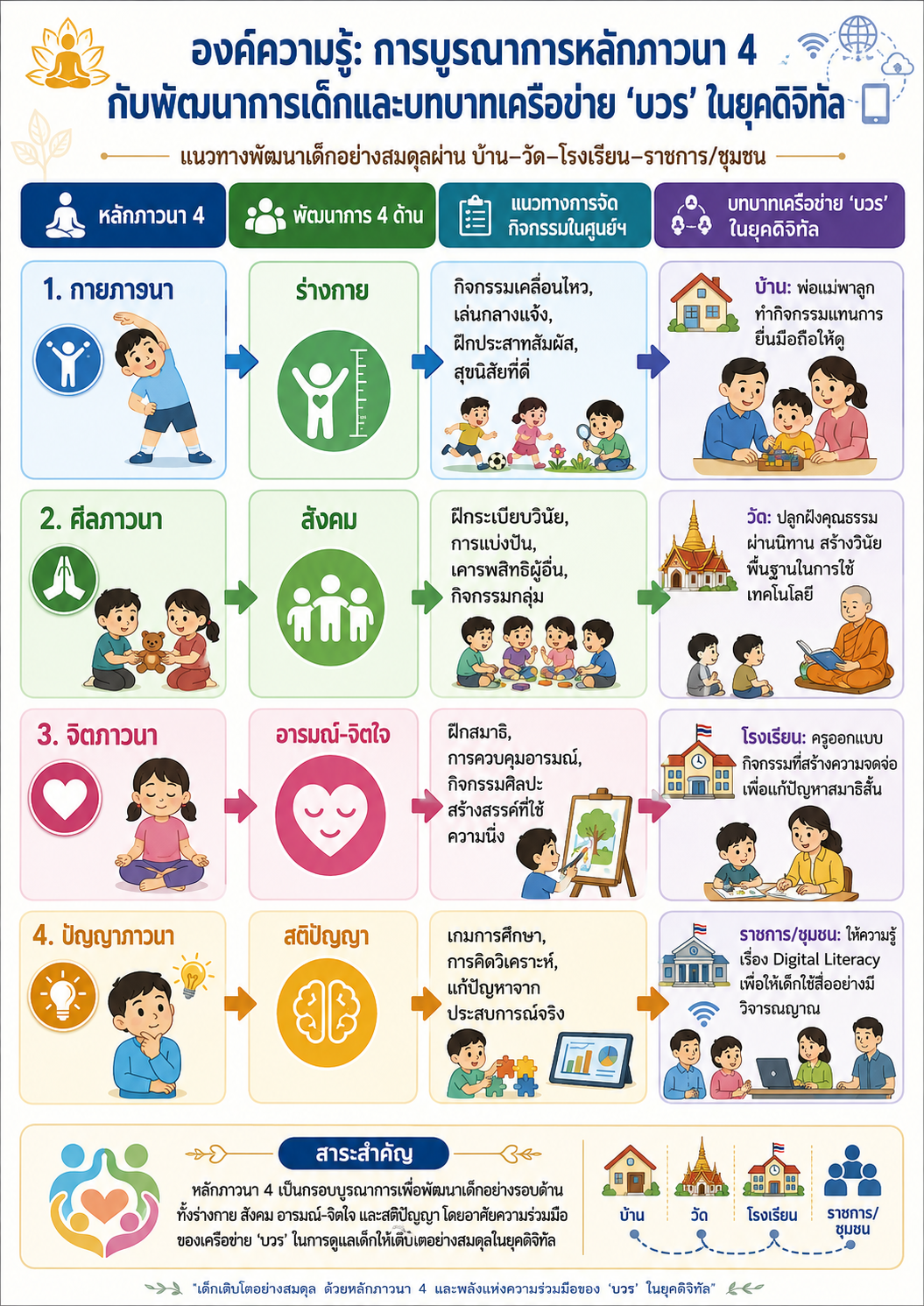
- Regarding the Fourfold Meditation model and learning, the Fourfold Meditation (body, morality, mind, wisdom) directly aligned with early childhood development. Body meditation helps develop motor skills and health; morality meditation fosters discipline and social interaction; mind meditation enhances concentration and emotional control; and wisdom meditation promotes analytical thinking and problem-solving, serving as an important safeguard to reduce reliance on smartphone screens.
- Regarding learning activities... The Early Childhood Development Center has integrated the 2017 Early Childhood Education Curriculum with Executive Function (EF) skills through six core activities, emphasizing the creation of "play spaces" instead of "screens," focusing on enabling children to be self-reliant and interact with their real environment.
4. Regarding the "Bovorn" network, the most effective prevention of smartphone addiction in children stems from the collaborative efforts of the home (parents as role models in reducing media use), the temple (a center for volunteer activities and meditation), and the school/early childhood development center (a source for disseminating media literacy skills). The temple serves as a central hub for providing alternative activities that draw children away from the virtual world into the real world.
References
กรมสุขภาพจิต กระทรวงสาธารณสุข. (ม.ป.ป.). คู่มือส่งเสริมพัฒนาการเด็กอายุ 0–5 ปี สำหรับผู้ปกครอง (น. 18–20). ม.พ.ป.
กิ่งแก้ว อมรวงศ์, และคณะ. (2567). การพัฒนารูปแบบการป้องกันการติดสื่อดิจิทัลในเด็กวัยก่อนเรียน. วารสารกองการพยาบาล, 51(1), 12–25.
คณะกรรมการสิทธิเด็ก. (ม.ป.ป.). อนุสัญญาว่าด้วยสิทธิเด็กแห่งสหประชาชาติ (ฉบับเป็นมิตรกับเด็ก) (น. 3–4). ม.พ.ป.
จินตนา มณีรัตน์. (2566). บทบาทของผู้ดูแลเด็กในศูนย์พัฒนาเด็กเล็กในการจัดการปัญหาการติดสื่อดิจิทัลในเด็ก. วารสารวิจัยการศึกษาปฐมวัย, 7(1), 42–58.
ชัยชนะ เอี่ยมมงคลชัย. (2566). ปัจจัยเสี่ยง ผลกระทบ และแนวทางการจัดการการใช้สื่อหน้าจอในเด็กวัยก่อนเรียน. วารสารสุขภาพจิตแห่งประเทศไทย, 31(2), 145–158.
ดวงกมล อุปการ, และ อรพินท์ ญาณชัย. (2561). ควรเลือกใช้หลักการใดในการเสริมสร้างพัฒนาการเรียนรู้ของเด็กวัยก่อนเรียน: "Brain-Based Learning" หรือ "Executive Function"?. วารสารวิชาการ Veridian E-Journal, Silpakorn University (Humanities, Social Sciences, and Arts), 11(1), 1635–1651.
พรพรรณ นนทพันธ์. (2561). ปัจจัยที่เกี่ยวข้องกับพฤติกรรมการส่งเสริมพัฒนาการของผู้ดูแลเด็กวัยก่อนเรียนในจังหวัดสงขลา. วารสารวิทยาลัยพยาบาลพระจอมเกล้า จังหวัดเพชรบุรี, 1(3), 10–24.
รสริน นภาภรณ์พิพาท, และคณะ. (2565). มุมมอง “บ้าน วัด โรงเรียน (บวร)” เพื่อความมั่นคง. วารสารความมั่นคงและยุทธศาสตร์ศึกษา, 3(1), 45–60.
วราภรณ์ จันทบุตร, วรรณวิไล ยูสุข, และ วุฒิชัย เสมรัมย์. (2561). การพัฒนาแนวทางส่งเสริมพัฒนาการเด็กวัยก่อนเรียนในศูนย์พัฒนาเด็กเล็ก เทศบาลตำบลสี
วิเชียร อำเภอน้ำยืน จังหวัดอุบลราชธานี. วารสารวิจัยทางการศึกษา คณะศึกษาศาสตร์ มหาวิทยาลัยศรีนครินทรวิโรฒ, 15(1), 208–219.
วราภรณ์ สังสกุล, และคณะ. (2564). สถานการณ์และแนวทางส่งเสริมพัฒนาการเด็กวัยก่อนเรียนตามผลลัพธ์ที่พึงประสงค์. วารสารการศึกษาทางสาธารณสุขและพยาบาล, 27(1), 193–205.
วิไล สุขีวัฒน์. (2564). ปัจจัยที่เกี่ยวข้องกับพฤติกรรมการใช้สมาร์ทโฟนของเด็กวัยก่อนเรียนตามการรับรู้ของผู้ปกครอง. วารสารวิทยาศาสตร์การพยาบาลและสุขภาพ, 44(1), 92–104.
United Nations. (1989). Convention on the Rights of the Child. https://www.ohchr.org/en/ instruments-mechanisms/instruments/convention-rights-child
Downloads
Published
How to Cite
Issue
Section
License
Copyright (c) 2026 Journal of Contemporary Buddhist Society = JCBS

This work is licensed under a Creative Commons Attribution-NonCommercial-NoDerivatives 4.0 International License.



