THE CRISIS OF YOUTH DEPRESSION: WHEN FAMILY PRESSURE HARMS MENTAL HEALTH
Keywords:
youth depression, family pressure, academic stress, Vietnamese adolescents, mental health literacyAbstract
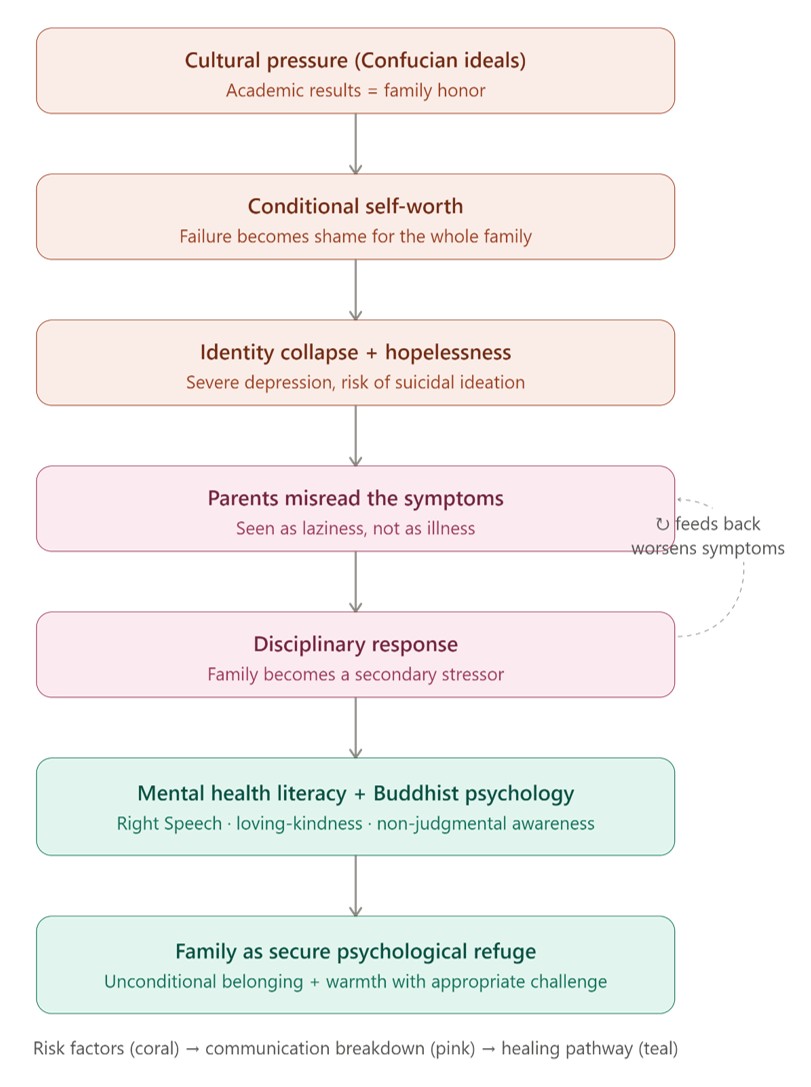
Adolescent depression has escalated into a severe and increasingly urgent public health crisis, particularly in rapidly urbanizing environments such as Ho Chi Minh City, Vietnam. While multiple biopsychosocial factors contribute to this phenomenon, intense family pressure and culturally rooted academic expectations remain among the most significant and consistent drivers of psychological distress among young people. This article examines how deeply embedded Confucian and collectivist family dynamics, which tightly link a youth's self-worth and family honor to academic performance, create chronic environments of Performance-based correlation and psychological strain. When adolescents internalize the belief that their value as persons depends entirely upon educational achievement, the experience of failure becomes not merely disappointing but existentially devastating, triggering identity collapse, profound hopelessness, and severe depression.
The crisis is further compounded by critical intergenerational communication gaps. Depressed youths rarely present with overt sadness; instead, they exhibit emotional numbness, chronic fatigue, social withdrawal, and somatic complaints that parents frequently misinterpret as laziness, disobedience, or poor attitude. This misinterpretation typically provokes disciplinary responses rather than empathetic support, transforming the family from a protective sanctuary into an active source of secondary stress that deepens adolescent isolation, shame, and self-blame.
By examining the current epidemiological landscape, cultural risk factors, and familial dynamics, this article highlights the urgent need for a paradigm shift in family relationships and mental health literacy. Drawing upon contemporary psychological literature and culturally resonant approaches including the Buddhist psychology model of problem-solving this article proposes that families must consciously move away from performance-based validation toward compassionate, mindful communication. Enhancing parental mental health literacy, integrating Buddhist-informed communication practices, and rebuilding the family as a secure psychological refuge are identified as essential strategies for fostering sustainable resilience and well-being among vulnerable Vietnamese adolescents.
References
Beck, A. T., Rush, A. J., Shaw, B. F., & Emery, G. (1979). Cognitive therapy of depression. Guilford Press.
Beck, A. T., & Steer, R. A. (1988). Manual for the Beck Hopelessness Scale. Psychological Corporation.
Bernal, G., & Domenech Rodriguez, M. (2012). Cultural adaptations: Tools for evidence-based practice with diverse populations. American Psychological Association.
Cao, L. X., Le, C. M., Tran, D. T. T., Nguyen, V. H. A., & Tran-Chi, V. L. (2024). Prevalence and factors associated with depression among high school students in Ho Chi Minh City, Vietnam. National Journal of Community Medicine, 15(7), 526–532.
Crocker, J., & Park, L. E. (2004). The costly pursuit of self-esteem. Psychological Bulletin, 130(3), 392–414.
Doan, H., Phan, T., & Vu, L. (2023). Psychological impacts of COVID-19 on Vietnamese adolescents. National University Press.
Gureje, O., Simon, G. E., Ustun, T. B., & Goldberg, D. P. (1997). Somatization in cross-cultural perspective: A World Health Organization study in primary care. American Journal of Psychiatry, 154(7), 989–995.
Harvey, P. (2013). An introduction to Buddhism: Teachings, history and practices (2nd ed.). Cambridge University Press.
Ho, T. T. Q., Nguyen, B. T. N., & Ngoc, N. P. H. (2022). Academic stress and depression among Vietnamese adolescents: A moderated mediation model of life satisfaction and resilience. Current Psychology, 42, 1–11.
Jorm, A. F. (2012). Mental health literacy: Empowering the community to take action for better mental health. American Psychologist, 67(3), 231–243.
Kelley, L. C. (2017). Confucianism in Vietnamese education. Institute of Southeast Asian Studies.
Le, T., & Hoang, P. (2024). School mental health survey in HCMC. Department of Education Publishing.
Le, V. T. (2026). Buddhist psychology model of problem-solving for depression among youths in Ho Chi Minh City, Viet Nam [Doctoral dissertation]. Mahachulalongkorn rajavidyalaya University.
Neff, K. D., & Faso, D. J. (2015). Self-compassion and well-being in parents of children with autism. Mindfulness, 6(4), 938–947.
Nguyen, T. T., Tran, M. D., & Le, T. H. (2022). Cultural expressions of depression among Vietnamese adolescents. Asian Journal of Psychiatry, 68, 102–115.
OECD. (2018). PISA country report: Vietnam. OECD Publishing.
Pham, T. T. (2022). Help-seeking behavior among Vietnamese adolescents. Youth Psychology Center.
Rogers, C. R. (1980). A way of being. Houghton Mifflin.
Segal, Z. V., Williams, J. M. G., & Teasdale, J. D. (2013). Mindfulness-based cognitive therapy for depression (2nd ed.). Guilford Press.
Steinberg, L. (2016). Adolescence (11th ed.). McGraw-Hill.
Tran, M. Q., Vo, K., & Nguyen, D. (2021). Adolescent psychological health in Ho Chi Minh City. University of Education Press.
Vu, N. H., & Doan, T. T. H. (2019). Family structures in contemporary Vietnam. Social Sciences Publishing House.
Wong, D. F. K. (2016). Systematic review of mental health literacy interventions in Asian populations. Asian Journal of Psychiatry, 22, 76–84.
Downloads
Published
How to Cite
Issue
Section
License
Copyright (c) 2026 Journal of Contemporary Buddhist Society = JCBS

This work is licensed under a Creative Commons Attribution-NonCommercial-NoDerivatives 4.0 International License.



