
SUSTAINING COMMUNITY DEVELOPMENT UNDER PROTRACTED CONFLICT IN MYANMAR: A DOCUMENTARY SYNTHESIS OF RECURRING COMMUNITY DEVELOPMENT MECHANISMS
Keywords:
Community Development, Community Resilience, Myanmar, Prolonged Challenges, Buddhist Peace EthicsAbstract
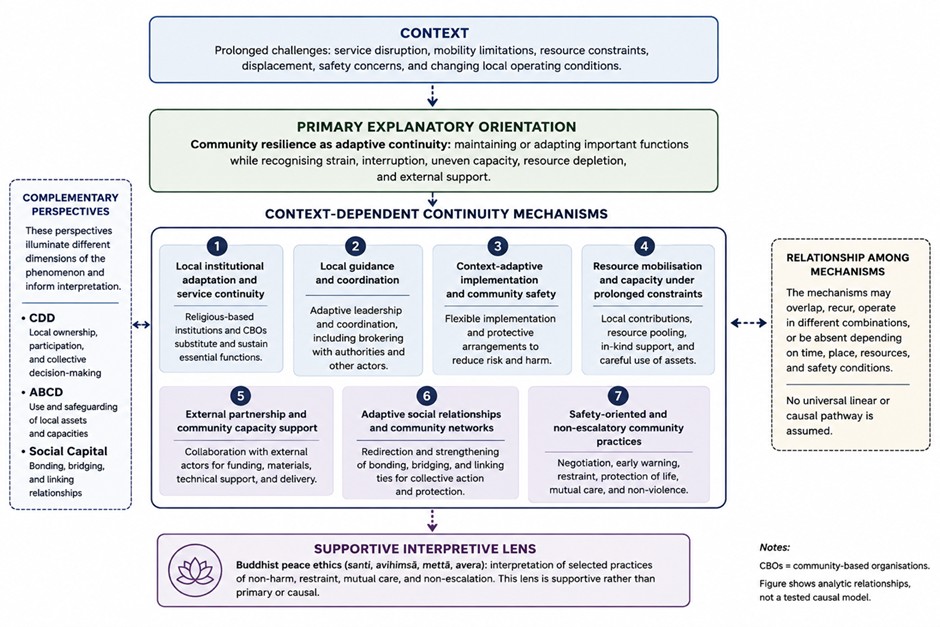
This study examines how communities in Myanmar sustain community development under prolonged challenges. It uses a qualitative, interpretivist documentary synthesis of nineteen publicly available documents published from 2021 to July 2026. The Framework Method combined twelve study-specific analytical domains, developed to operationalise the research objectives and sensitised by the literature, with inductive sub-coding of 118 page-referenced excerpts. The documented community development initiative served as the unit of analysis. Community resilience provides the primary explanatory orientation, while community-driven development (CDD), asset-based community development (ABCD), and social capital provide complementary perspectives. A supplementary post-inductive Buddhist ethical lens is used only to interpret selected practices of non-harm, restraint, mutual care, and non-escalation. Seven context-dependent continuity mechanisms were identified: (1) local institutional adaptation and service continuity; (2) local guidance and coordination; (3) context-adaptive implementation and community safety; (4) resource mobilisation and capacity under prolonged constraints; (5) external partnership and community capacity support; (6) adaptive social relationships and community networks; and (7) safety-oriented and non-escalatory community practices. These mechanisms are partly sequential but not universal: they may overlap, recur, be absent, or operate differently across locations. Community resilience is expressed through adaptive continuity rather than unlimited coping capacity and may involve strain, interruption, resource depletion, and external support. Buddhist peace ethics remains a supportive interpretive lens rather than a causal explanation. The study contributes a context-sensitive account of community resilience and continuity mechanisms while recognising the limits of an uneven English-language documentary record.
References
Bowen, G. A. (2009). Document analysis as a qualitative research method. Qualitative Research Journal, 9(2), 27–40. https://doi.org/10.3316/QRJ0902027
Buddharakkhita, A. (Trans.). (1985). The Dhammapada: The Buddha’s path of wisdom. Kandy, Sri Lanka: Buddhist Publication Society.
Cooke, B., & Kothari, U. (Eds.). (2001). Participation: The new tyranny? London: Zed Books.
Fereday, J., & Muir-Cochrane, E. (2006). Demonstrating rigor using thematic analysis: A hybrid approach of inductive and deductive coding and theme development. International Journal of Qualitative Methods, 5(1), 80–92.
https://doi.org/10.1177/160940690600500107
Gale, N. K., Heath, G., Cameron, E., Rashid, S., & Redwood, S. (2013). Using the framework method for the analysis of qualitative data in multi-disciplinary health research. BMC Medical Research Methodology, 13, 117. https://doi.org/10.1186/1471-2288-13-117
Guba, E. G., & Lincoln, Y. S. (1994). Competing paradigms in qualitative research. In N. K. Denzin & Y. S. Lincoln (Eds.), Handbook of qualitative research (pp. 105–117). Thousand Oaks, CA: Sage.
Hedström, P., & Ylikoski, P. (2010). Causal mechanisms in the social sciences. Annual Review of Sociology, 36, 49–67. https://doi.org/10.1146/annurev.soc.012809.102632
Jolliffe, K. (2014). Ethnic conflict and social services in Myanmar’s contested regions. Yangon: The Asia Foundation.
Kretzmann, J. P., & McKnight, J. L. (1993). Building communities from the inside out: A path toward finding and mobilizing a community’s assets. Chicago, IL: ACTA Publications.
Lincoln, Y. S., & Guba, E. G. (1985). Naturalistic inquiry. Beverly Hills, CA: Sage.
MacKinnon, D., & Derickson, K. D. (2013). From resilience to resourcefulness: A critique of resilience policy and activism. Progress in Human Geography, 37(2), 253–270. https://doi.org/10.1177/0309132512454775
Mansuri, G., & Rao, V. (2004). Community-based and -driven development: A critical review. World Bank Research Observer, 19(1), 1–39. https://doi.org/10.1093/wbro/lkh012
Mansuri, G., & Rao, V. (2013). Localizing development: Does participation work? Washington, DC: World Bank. Retrieved from https://openknowledge.worldbank.org/handle/ 10986/11859
Mathie, A., & Cunningham, G. (2003). From clients to citizens: Asset-based community development as a strategy for community-driven development. Development in Practice, 13(5), 474–486. https://doi.org/10.1080/0961452032000125857
McCarthy, G. (2023). Outsourcing the polity: Non-state welfare, inequality, and resistance in Myanmar. Ithaca, NY: Cornell University Press.
McCarthy, G., & Nyana, K. (2026). Roadblocks, relationality and resilient resistance in post-coup Myanmar. Development and Change, 57(3), 624–646. https://doi.org/10.1111/dech.70062
Ñāṇamoli, Bhikkhu, & Bodhi, Bhikkhu. (Trans.). (1995). The middle length discourses of the Buddha: A translation of the Majjhima Nikāya. Boston, MA: Wisdom Publications.
Norman, K. R. (Trans.). (1992). The group of discourses (Sutta-Nipāta) (2nd ed.). Oxford: Pali Text Society.
Norris, F. H., Stevens, S. P., Pfefferbaum, B., Wyche, K. F., & Pfefferbaum, R. L. (2008). Community resilience as a metaphor, theory, set of capacities, and strategy for disaster readiness. American Journal of Community Psychology, 41(1–2), 127–150. https://doi.org/10.1007/s10464-007-9156-6
Olsson, L., Jerneck, A., Thoren, H., Persson, J., & O’Byrne, D. (2015). Why resilience is unappealing to social science: Theoretical and empirical investigations of the scientific use of resilience. Science Advances, 1(4), e1400217. https://doi.org/10.1126/sciadv.1400217
Patton, M. Q. (2015). Qualitative research & evaluation methods (4th ed.). Thousand Oaks, CA: Sage.
Ritchie, J., & Spencer, L. (1994). Qualitative data analysis for applied policy research. In A. Bryman & R. G. Burgess (Eds.), Analyzing qualitative data (pp. 173–194). London: Routledge.
Thomas, J., & Harden, A. (2008). Methods for the thematic synthesis of qualitative research in systematic reviews. BMC Medical Research Methodology, 8, 45. https://doi.org/10.1186/1471-2288-8-45
Wood, E. J. (2006). The ethical challenges of field research in conflict zones. Qualitative Sociology, 29(3), 373–386. https://doi.org/10.1007/s11133-006-9027-8
Woolcock, M., & Narayan, D. (2000). Social capital: Implications for development theory, research, and policy. World Bank Research Observer, 15(2), 225–249. https://doi.org/10.1093/wbro/15.2.225
Downloads
Published
How to Cite
Issue
Section
License
Copyright (c) 2026 Journal of Contemporary Buddhist Society = JCBS

This work is licensed under a Creative Commons Attribution-NonCommercial-NoDerivatives 4.0 International License.



