CULTURAL PREJUDICE AND GENERATIONAL GAPS: BARRIERS TO ACCESSING BUDDHIST PSYCHOLOGICAL TREATMENT
Keywords:
mental health stigma, Buddhist psychology, loving-kindness, generational gap, social cohesionAbstract
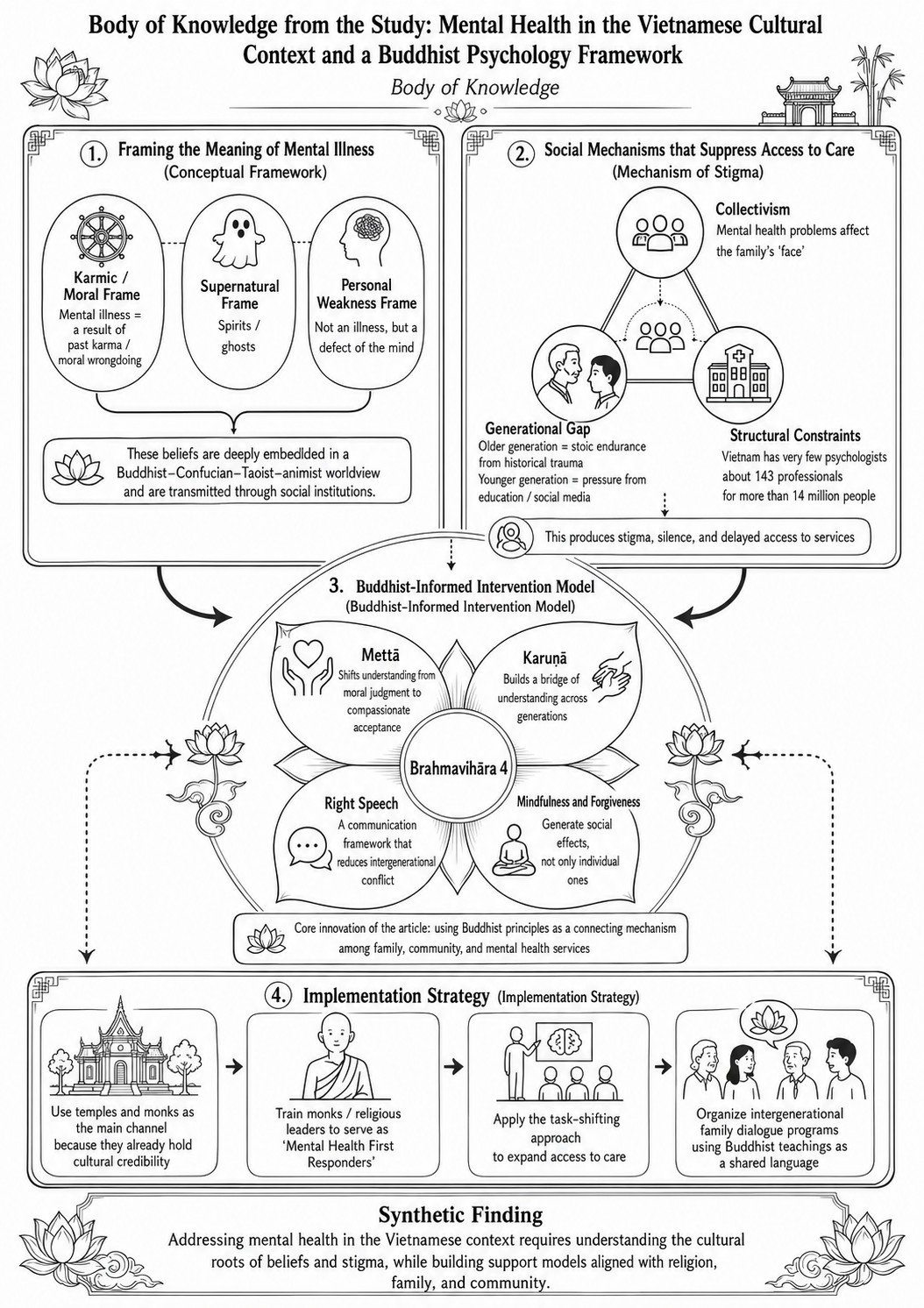
Mental health within the Vietnamese community, encompassing both local citizens and Vietnamese immigrants residing in the United States, remains significantly stigmatized due to deeply rooted cultural beliefs, traditional belief systems, and significant intergenerational disparities in mental health literacy and acceptance. This article examines the anthropological, cultural, and psychological dimensions of these barriers, exploring how mental illness is often mischaracterized as a sign of personal weakness, moral failure, severe insanity, or the karmic consequence of past wrongdoing. Older generations, driven by collectivist imperatives to preserve family honor and a pervasive fear of community judgment, routinely dismiss psychological distress and actively resist professional psychological treatment. Younger generations, shaped by contemporary education and greater exposure to global mental health discourse, demonstrate considerably greater openness toward acknowledging and addressing mental health difficulties, yet remain constrained by familial expectations, intergenerational conflict, and the emotional invalidation of their struggles by elders. These cultural and generational disparities create significant barriers to accessing necessary psychological care, resulting in widespread silent suffering that exacerbates individual distress and undermines community well-being. To bridge this divide effectively, this article argues for the integration of Buddhist psychological principles particularly the Brahmavihara of loving-kindness (Metta) and compassion (Karuna) into culturally competent mental health practice. By framing psychological intervention within Buddhist contemplative traditions that are already deeply embedded in Vietnamese cultural identity, practitioners can destigmatize treatment, cultivate empathic understanding across generations, and encourage help-seeking behaviors among vulnerable populations. Furthermore, the synergistic application of mindfulness and forgiveness practices is examined as a mechanism for fostering social cohesion in multicultural environments, with evidence drawn from research conducted in Binh Duong province, Vietnam. The article concludes that culturally sensitive, Buddhist-informed interventions offer a viable and transformative pathway toward healing individual trauma, repairing intergenerational relationships, and building resilient, harmonious communities.
References
Beck, A. T., Rush, A. J., Shaw, B. F., & Emery, G. (1979). Cognitive therapy of depression. Guilford Press.
Bernal, G., & Domenech Rodriguez, M. (2012). Cultural adaptations: Tools for evidence-based practice with diverse populations. American Psychological Association.
Bodhi, B. (1993). A comprehensive manual of Abhidhamma. Buddhist Publication Society.
Bodhi, B. (1994). The noble eightfold path: Way to the end of suffering. Buddhist Publication Society.
Do, M., McCleary, J., Nguyen, D., & Winfrey, K. (2020). Mental illness public stigma and generational differences among Vietnamese Americans. Community Mental Health Journal, 56(1), 1–10.
Duc, T. M. (2025). Mindfulness and forgiveness as catalysts for stress reduction and social cohesion: A mixed-methods study in multicultural Binh Duong, Vietnam. The Open Psychology Journal, 18(1), 1–15.
Enright, R. D., & Fitzgibbons, R. P. (2015). Forgiveness therapy: An empirical guide for resolving anger and restoring hope. American Psychological Association.
Harvey, P. (2013). An introduction to Buddhism: Teachings, history and practices (2nd ed.). Cambridge University Press.
Le, V. T. (2026). Buddhist psychology model of problem-solving for depression among youths in Ho Chi Minh City, Viet Nam [Doctoral dissertation]. Mahachulalongkornrajavidyalaya University.
Nguyen, A., & Bui, T. (2021). Mental health workforce report. Health Policy Institute.
Nguyen-Luu, M. L. (2024). Attitudes and perceptions of mental health in the Vietnamese community: A comprehensive analysis [Honors Undergraduate Thesis]. University of Central Florida.
Pham, T. T. (2022). Help-seeking behavior among Vietnamese adolescents. Youth Psychology Center.
Salzberg, S. (1995). Loving-kindness: The revolutionary art of happiness. Shambhala Publications.
Segal, Z. V., Williams, J. M. G., & Teasdale, J. D. (2013). Mindfulness-based cognitive therapy for depression (2nd ed.). Guilford Press.
Sue, S., Zane, N., Hall, G. C. N., & Berger, L. K. (2009). The case for cultural competency in psychotherapeutic interventions. Annual Review of Psychology, 60, 525–548.
Vu, N. H., & Doan, T. T. H. (2019). Family structures in contemporary Vietnam. Social Sciences Publishing House.
Zeng, X., Chiu, C. P. K., Wang, R., Oei, T. P. S., & Leung, F. Y. K. (2015). The effect of loving-kindness meditation on positive emotions: A meta-analytic review. Frontiers in Psychology, 6, 1693.
Downloads
Published
How to Cite
Issue
Section
License
Copyright (c) 2026 Journal of Contemporary Buddhist Society = JCBS

This work is licensed under a Creative Commons Attribution-NonCommercial-NoDerivatives 4.0 International License.



