
DEVELOPMENT OF ENGLISH WRITING SKILLS THROUGH MIND MAPPING AMONG FIRST-YEAR B.Ed. ENGLISH PROGRAM STUDENTS, FACULTY OF EDUCATION, MAHACHULALONGKORNRAJAVIDYALAYA UNIVERSITY, THAILAND
Abstract
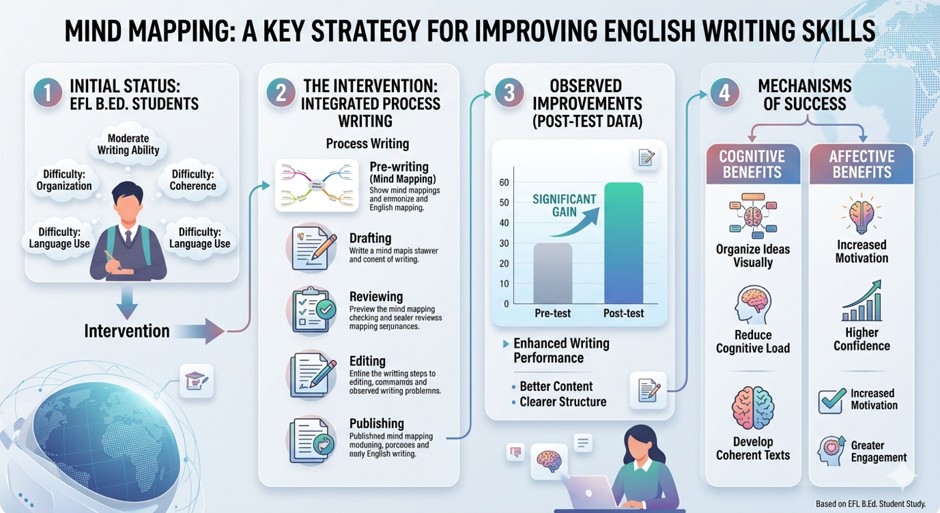
The objectives of this study were: (1) To study the general English writing skills of first-year B.Ed. English Program students, Faculty of Education, Mahachulalongkorn rajavidyalaya University, Thailand. (2) To develop and implement mind mapping for improving English writing skills among first-year B.Ed. English Program students, Faculty of Education, Mahachulalongkornrajavidyalaya University, Thailand. (3) To evaluate the effects of mind mapping on the English writing skills of first-year B.Ed. English Program students, Faculty of Education, Mahachulalongkornrajavidyalaya University, Thailand. (4) To investigate the perceptions and satisfaction among first-year B.Ed. English Program students, Faculty of Education, Mahachulalongkornrajavidyalaya University, Thailand. This study employed a Research and Development (R&D) methodology consisting of four phases. The sample group consisted of 20 first-year B.Ed. English Program students selected by purposive sampling. The research instruments included an English writing pretest and posttest, a mind mapping instructional manual, lesson plans, and a perception and satisfaction questionnaire. The instruments were validated by five experts, with IOC values ranging from 0.80 to 1.00.
The findings revealed that students’ English writing skills before the experiment were at a fair level, with a mean score of 52.40 and a standard deviation of 9.85. After learning through mind mapping, students’ writing skills improved to a good level, with a mean score of 68.75 and a standard deviation of 8.10. The paired-sample t-test showed a statistically significant difference between the pretest and posttest scores, with t = 6.98 and p = .000. In addition, students’ perceptions and satisfaction toward learning English writing through mind mapping were at a very high level, with a mean score of 4.36 and a standard deviation of 0.58. Therefore, the study concluded that mind mapping is an effective instructional technique for improving English writing skills, especially in idea generation, organization, paragraph development, grammar use, vocabulary use, confidence, and learning motivation.
References
Anderson, L. W., & Krathwohl, D. R. (2001). A taxonomy for learning, teaching, and assessing: A revision of Bloom’s taxonomy of educational objectives. New York: Longman.
Al-Jarf, R. (2009). Enhancing freshman students’ writing skills with a mind-mapping software. Conference Proceedings of eLearning and Software for Education, 1, 347–351.
Buzan, T. (2006). The mind map book: Unlock your creativity, boost your memory, change your life. London: BBC Active.
Badger, R., & White, G. (2000). A process genre approach to teaching writing. ELT Journal, 54(2), 153–160.
Brown, H. D. (2001). Teaching by principles: An interactive approach to language pedagogy (2nd ed.). White Plains, NY: Longman.
Creswell, J. W., & Creswell, J. D. (2018). Research Design: Qualitative, Quantitative, and Mixed Methods Approaches (5th ed.). Sage Publications.
Davies, M. (2011). Concept mapping, mind mapping and argument mapping: What are the differences and do they matter? Higher Education, 62(3), 279–301.
https://doi.org/10.1007/s10734-010-9387-6.
Dörnyei, Z. (2007). Research Methods in Applied Linguistics. Oxford University Press.
Flower, L., & Hayes, J. R. (1981). A cognitive process theory of writing. College Composition and Communication, 32(4), 365–387.
Field, A. (2018). Discovering Statistics Using IBM SPSS Statistics (5th ed.). London: Sage Publications.Rovinelli,
R. J., & Hambleton, R. K. (1977). On the use of content specialists in the assessment of criterion-referenced test item validity. Dutch Journal of Educational Research, 2, 49–60.
Fadlelmula, F. K. (2010). The effectiveness of using mind mapping strategy in developing writing skills among university students. Journal of Educational and Psychological Studies, 4(1), 55–72.
Graham, S., & Perin, D. (2007). Writing next: Effective strategies to improve writing of adolescents in middle and high schools. New York: Carnegie Corporation of New York.
Harmer, J. (2004). How to teach writing. Essex: Pearson Education Limited.
Hyland, K. (2003). Second language writing. Cambridge: Cambridge University Press.
Hayes, J. R. (1996). A new framework for understanding cognition and affect in writing. In C. M. Levy & S. Ransdell (Eds.), The science of writing: Theories, methods, individual differences, and applications (pp. 1–27). Lawrence Erlbaum Associates.
Jensen, Eric. (2008). Brain-Based Learning: The New Paradigm of Teaching. California: Corwin Press.
Kroll, B. (2003). Exploring the dynamics of second language writing. Cambridge University Press.
Leki, I. (1992). Understanding ESL writers: A guide for teachers. Portsmouth, NH: Boynton/Cook.
Downloads
Published
How to Cite
Issue
Section
License
Copyright (c) 2026 Journal of Contemporary Buddhist Society = JCBS

This work is licensed under a Creative Commons Attribution-NonCommercial-NoDerivatives 4.0 International License.



