PROBLEM-SOLVING FOR DEPRESSION AMONG YOUTHS: A BUDDHIST PSYCHOLOGY APPROACH
Keywords:
Buddhist psychology, youth depression, Noble Eightfold Path, Cognitive Behavioral Therapy, Mindfulness and Loving-kindness, Vietnamese adolescentsAbstract
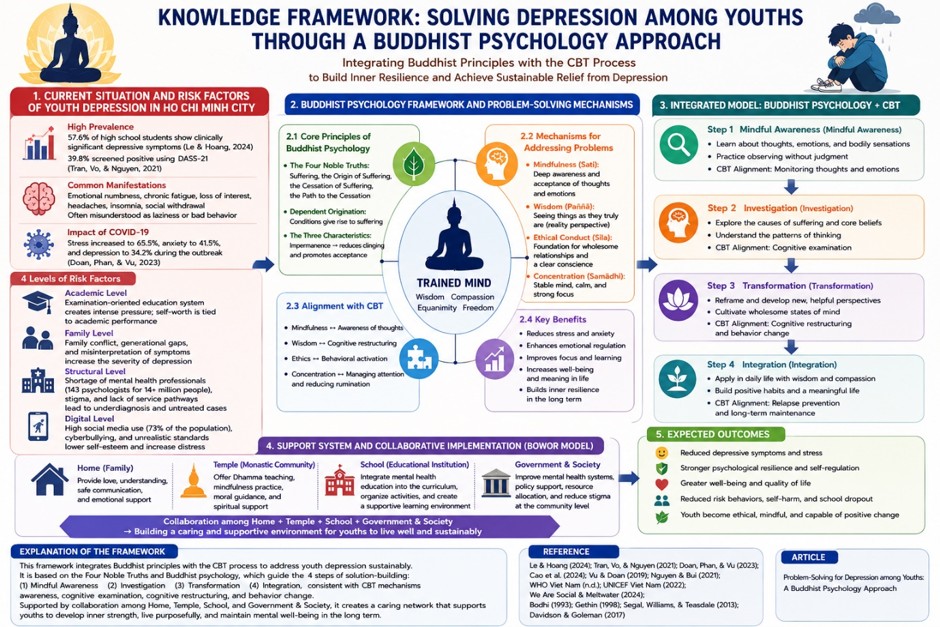
Depression among youths has become an escalating public health crisis in Ho Chi Minh City, Vietnam, with empirical evidence indicating that 57.6 percent of high school students exhibit clinically significant depressive symptoms. This academic article pursues three objectives: (1) to analyze the current conditions and risk factors of youth depression, (2) to examine Buddhist psychological principles for addressing mental suffering, and (3) to propose an integrated model combining Buddhist psychology with Cognitive Behavioral Therapy (CBT) to promote youth mental well-being.
The analysis reveals that youth depression is a multidimensional phenomenon rooted in academic pressure, intergenerational communication gaps, digital social comparison, and loss of existential meaning. The Four Noble Truths function as a comprehensive diagnostic system, while the Noble Eightfold Path provides a multidimensional treatment protocol encompassing the domains of wisdom, ethical conduct, and mental discipline. The core mechanisms of the integrated model include Right View paired with cognitive restructuring, Right Mindfulness paired with mindfulness-based cognitive therapy, loving-kindness and compassion paired with compassion-focused therapy, and Right Action paired with behavioral activation.
The proposed model is distinguished by two characteristics: scientific universality supported by empirical evidence, and cultural congruence with Vietnamese Buddhist heritage. This integration establishes a pathway for developing responsive mental health systems across school, family, and community contexts. Ultimately, the model aims not to create morally perfect youth, but to empower young people to liberate themselves from cycles of unrealistic expectations, cultivate stable inner refuge, and foster sustainable well-being autonomously.
References
Analayo. (2003). Satipaṭṭhāna: The direct path to realization. Windhorse Publications.
Bodhi, B. (1993). A comprehensive manual of Abhidhamma. Buddhist Publication Society.
Bodhi, B. (1994). The noble eightfold path: Way to the end of suffering. Buddhist Publication Society.
Cao, L. X., Le, C. M., Tran, D. T. T., Nguyen, V. H. A., & Tran-Chi, V. L. (2024). Prevalence and factors associated with depression among high school students in Ho Chi Minh City, Vietnam. DOAJ Record.
Davidson, R. J., & Goleman, D. (2017). Altered traits: Science reveals how meditation changes your mind, brain, and body. Avery.
Doan, H., Phan, T., & Vu, L. (2023). Psychological impacts of COVID-19 on Vietnamese adolescents. National University Press.
Gethin, R. (1998). The foundations of Buddhism. Oxford University Press.
Harvey, P. (2013). An introduction to Buddhism: Teachings, history and practices (2nd ed.). Cambridge University Press.
Kumar, S. M. (2002). An introduction to Buddhism for the cognitive-behavioral therapist. Cognitive and Behavioral Practice, 9(1), 40–45.
Lazar, S. W., Kerr, C. E., Wasserman, R. H., Gray, J. R., Greve, D. N., Treadway, M. T., McGarvey, M., Quinn, B. T., Dusek, J. A., Benson, H., Rauch, S. L., Moore, C. I., & Fischl, B. (2005). Meditation experience is associated with increased cortical thickness. NeuroReport, 16(17), 1893–1897.
Le, T., & Hoang, P. (2024). School mental health survey in HCMC. Department of Education Publishing.
Le, V. T. (2026). Buddhist psychology model of problem-solving for depression among youths in Ho Chi Minh City, Viet Nam [Doctoral dissertation]. Mahachulalongkorn rajavidyalaya University.
Martell, C. R., Dimidjian, S., & Herman-Dunn, R. (2010). Behavioral activation for depression. Guilford Press.
Neff, K. (2011). Self-compassion: The proven power of being kind to yourself. William Morrow.
Nguyen, A., & Bui, T. (2021). Mental health workforce report. Health Policy Institute.
Pham, T. T. (2022). Help-seeking behavior among Vietnamese adolescents. Youth Psychology Center.
Segal, Z. V., Williams, J. M. G., & Teasdale, J. D. (2013). Mindfulness-based cognitive therapy for depression (2nd ed.). Guilford Press.
Teasdale, J. D., Segal, Z. V., Williams, J. M. G., Ridgeway, V. A., Soulsby, J. M., & Lau, M. A. (2000). Prevention of relapse/recurrence in major depression by mindfulness-based cognitive therapy. Journal of Consulting and Clinical Psychology, 68(4), 615–623.
Tran, M. Q., Vo, K., & Nguyen, D. (2021). Adolescent psychological health in Ho Chi Minh City. University of Education Press.
UNICEF Viet Nam. (2022). Child and adolescent mental health report. UNICEF.
Vu, N. H., & Doan, T. T. H. (2019). Family structures in contemporary Vietnam. Social Sciences Publishing House.
We Are Social & Meltwater. (2024). Digital 2024: Vietnam report. We Are Social.
WHO Viet Nam. (n.d.). Mental health profile. WHO Country Office.
Downloads
Published
How to Cite
Issue
Section
License
Copyright (c) 2026 Journal of Contemporary Buddhist Society = JCBS

This work is licensed under a Creative Commons Attribution-NonCommercial-NoDerivatives 4.0 International License.



