
DEVELOPING ORGANIZATIONAL STRATEGY BASED ON BUDDHIST PRINCIPLES
Keywords:
Organizational Strategy, Buddhist Principles, Integration, AdministrationAbstract
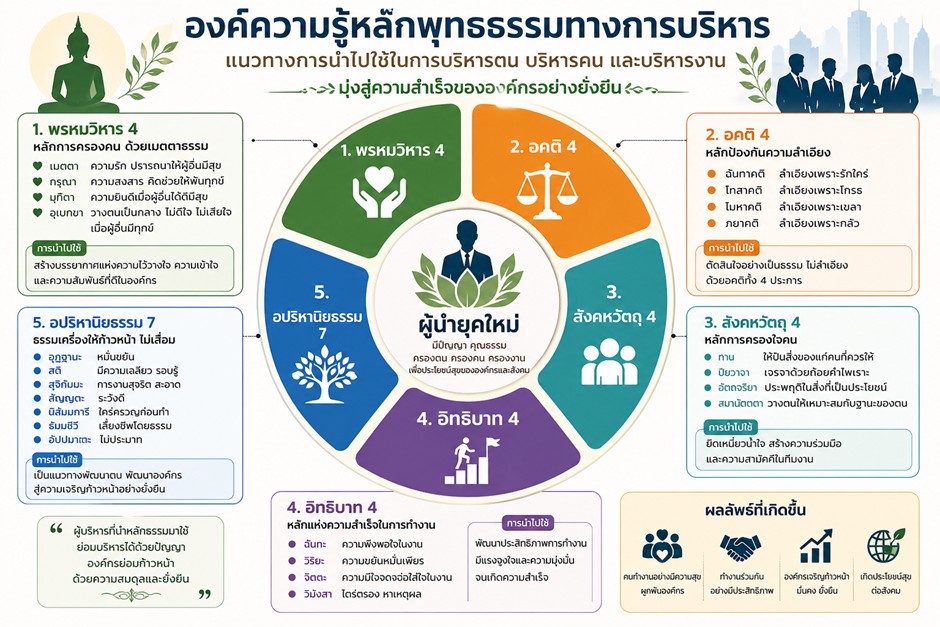
This article aims to study the application of Buddhist principles in corporate strategy development. It aims to analyze the integration of key principles, namely Temple 4, Party 4, Social 4, Patent 4, and Ethics 7 into the strategic management process, which consists of environmental analysis. Setting the vision and goals, planning the strategy and putting the strategy into practice. The study found that Buddhist principles can be applied as a conceptual framework for the proper management of the organization. Mother Temple 4 helps to promote ethical leadership and build good relationships in the organization. Perspective 4 helps to prevent decision-making bias. Objective 4 strengthens employee collaboration and engagement. Impact 4 promotes motivation and performance and ethics. Ethics 7 promotes stability, solidarity and progress for the organization. Integrating ethics into strategic management is an important guide to enhancing operational efficiency. Along with corporate ethics, ethics and sustainability, leading to stable and balanced long-term development of the organization.
References
กวินพัฒน์ เลิศพงษ์มณี. (2566). การจัดการเชิงกลยุทธ์. พิษณุุโลก : การพิมพ์ดอทคอม,
จตุรวัฒน์ ธนิษฐ์นันท์. (2565). การจัดการเชิงกลยุุทธ์ Strategic Management ฉบับคัมภีร์นักบริหาร. (ฉบับปรับปรุงครั้งที่ 3). กรุงเทพมหานคร: โรงพิมพ์ ทริปเบิ้ลเอ.
ไพโรจน์ ปิยะวงศ์วัฒน์. (2555). การจัดการเชิงกลยุทธ์ : เทคโนโลยีและนวัตกรรม. กรุงเทพมหานคร:จุฬาลงกรณ์มหาวิทยาลัย.
มหาจุฬาลงกรณราชวิทยาลัย. (2539). พระไตรปิฎกภาษาไทย ฉบับมหาจุฬาลงกรณราชวิทยาลัย. กรุงเทพมหานคร: โรงพิมพ์มหาจุฬาลงกรณราชวิทยาลัย.
สมยศ นาวีการ. (2539). การบริหารเชิงกลยุทธ์. กรุงเทพมหานคร: ดอกหญ้า.
อำพล นววงศ์เสถียร. (2562). ตำราการจัดการเชิงกลยุทธ์การแสวงหาความได้เปรียบในการแข่งขัน. (ฉบับปรับปรุงครั้งที่่ 5). กรุงเทพมหานคร: วิทยาลัยเซาธ์อีสท์บางกอก.
Dess, Gregory G. and Miller, Alex. (1993). Strategic Management. New York: McGraw-Hill, Inc.
Von Rosing, Mark, Henrik von Scheel, and August-Wilhelm Scheer. (2014). The Complete Business Process Handbook: Body of Knowledge from Process Modeling to BPM, Volume 1. Morgan Kaufmann.
Schermerhorn, John R. (2002). Management. 7th ed. New York: John Wiley & Sons, Inc.
Thompson, A., Margarat A. Peteraf, John E Gamble, and A.J. Strickland III. (2014). Crafting and Executing Strategy: The Quest for Competitive Advantage. 19th ed. McGraw-Hill Education.Inc.
Downloads
Published
How to Cite
Issue
Section
License
Copyright (c) 2026 Journal of Contemporary Buddhist Society = JCBS

This work is licensed under a Creative Commons Attribution-NonCommercial-NoDerivatives 4.0 International License.



