
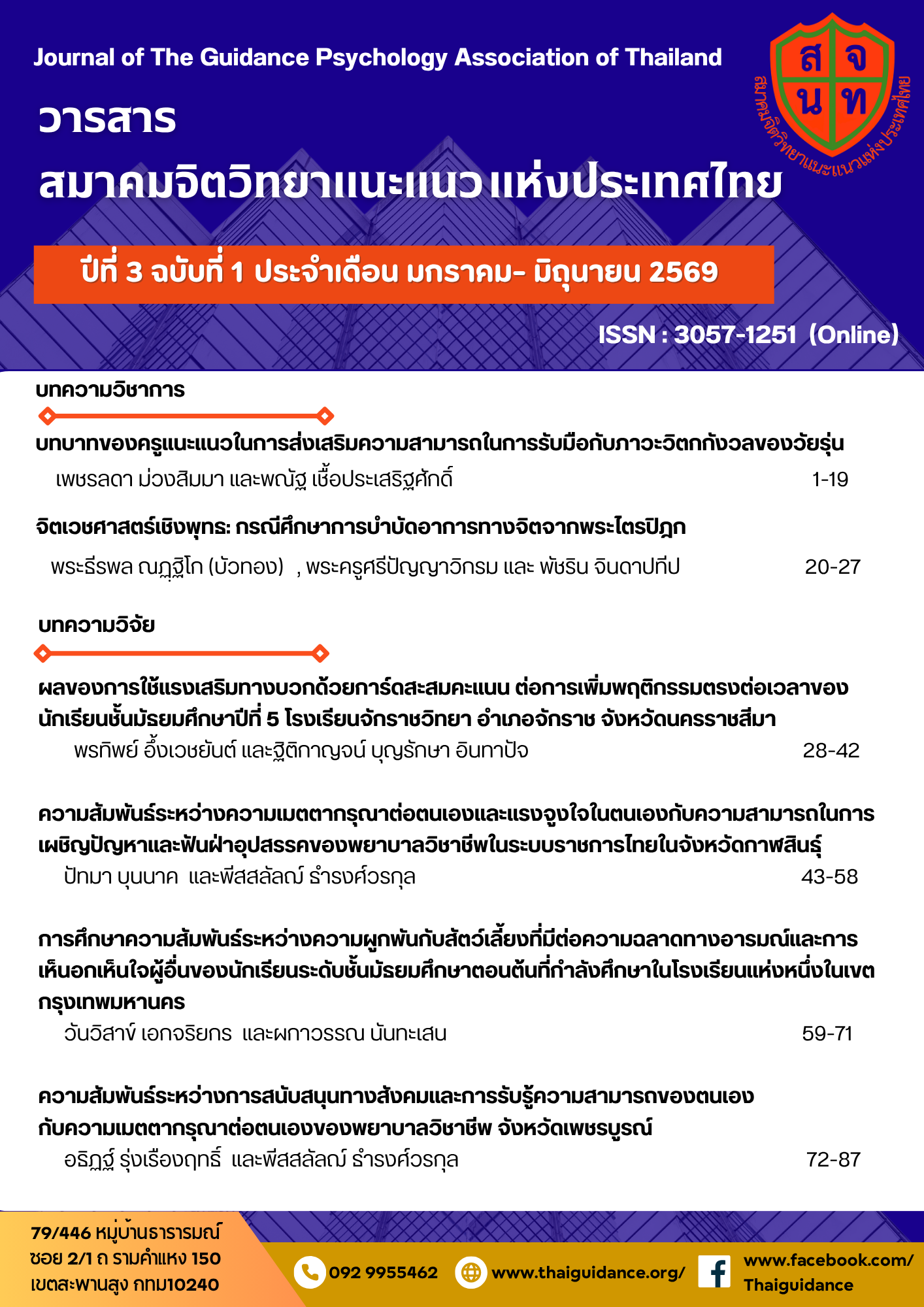
The Role of Guidance Teachers to Support Adolescents' Ability to Cope with Anxiety
Keywords:
Anxiety, Coping with Anxiety, Role of Guidance Teachers, AdolescentsAbstract
This academic article aims to: (1) study the role of guidance teachers in supporting adolescents coping with anxiety, and (2) propose approaches to help adolescents cope with anxiety. The study found that the causes of anxiety can be categorized into 3 main factors: 1) Biological factors 2)Psychological factors and 3) Environmental factors. These factors lead adolescents to exhibit behaviors such as social withdrawal, mood swings, or avoidance of various activities. Guidance teachers play a crucial role in supporting adolescent mental health, which includes 5 key roles: 1) Providing counseling and guidance Screening 2)monitoring mental health issues 3) Developing programs and activities to promote mental health 4) Creating a school environment conducive to mental health and 5) Collaborating with parents and other professionals to provide comprehensive mental health support for students. The study recommends 7 strategies to help adolescents cope with anxiety: 1) Mindfulness training 2) Meditation 3) Yoga 4) Stress management programs 5) Emotional regulation 6) Emotional freedom techniques or EFT and 7) Dance. By integrating these strategies into guidance classes and mental health promotion activities, schools can create a safe and emotionally supportive environment for students. This also helps to build self-confidence, enabling students to effectively cope with anxiety and achieve long-term mental well-being. The researchers further recommend that relevant agencies utilize the findings to develop and implement broader practices in the future.
References
กชวรรณ พลอยทับทิม และคณะ. (2564). ความชุกและปัจจัยที่เกี่ยวข้องกับภาวะวิตกกังวลและซึมเศร้าในครูโรงเรียนเอกชนหญิงล้วน. วารสารสมาคมจิตแพทย์แห่งประเทศไทย, 66(1), 25–38.
กิจจ์ศรัณย์ จันทร์โป๊. (2556). ผลของการสวดมนต์ตามแนวพุทธศาสนา และการทำสมาธิแบบอานาปานสติที่มีต่อความเครียดของนิสิตจุฬาลงกรณ์มหาวิทยาลัย (วิทยานิพนธ์ปริญญา วิทยาศาสตรมหาบัณฑิตสาขาวิทยาศาสตรการกีฬา). จุฬาลงกรณ์มหาวิทยาลัย.
ชลมาศ คูหารัตนากร. (2557). ผลของการให้ข้อมูลผ่านการ์ตูนแอนิเมชั่นต่อความวิตกกังวลและความร่วมมือของเด็กชายวัยเรียนที่เข้ารับการขยายท่อปัสสาวะ (วิทยานิพนธ์ปริญญามหาบัณฑิต).จุฬาลงกรณ์มหาวิทยาลัย.
ณัชพล เติมพรเลิศ และปัญจภรณ์ วาลีประโคน. (2563). ผลของวีดีทัศน์สื่อความรู้ต่อการลดความวิตกกังวลในการรักษาทางจิตเวชด้วยไฟฟ้า. วารสารสมาคมจิตแพทย์แห่งประเทศไทย, 65(2): 153-166.
ดาราวรรณ ต๊ะปินตา. (2563). ผลของโปรแกรมการบำบัดด้วยการแก้ปัญหาต่อภาวะซึมเศร้าในผู้ป่วยโรคไตวายเรื้อรังระยะสุดท้ายที่ได้รับการฟอกเลือดด้วยเครื่องไตเทียม (วิทยานิพนธ์พยาบาลศาสตรมหาบัณฑิต). มหาวิทยาลัยเชียงใหม่.
ธารทิพย์ นรังศิยา. (2558). แนวทางการชี้แนะและการเป็นพี่เลี้ยงครู: บทเรียนจากการศึกษาเชิงปริมาณและเชิงคุณภาพ (วิทยานิพนธ์ปริญญา ครุศาสตรมหาบัณฑิต). จุฬาลงกรณ์มหาวิทยาลัย.
นันทกา สุปรียาพร. (2566). สุขภาพจิตโรงเรียน: แนวทางการส่งเสริมสุขภาพจิตวัยรุ่น. วารสารครุศาสตร์ จุฬาลงกรณ์มหาวิทยาลัย, 51(1), 1-13.
พระมหาสุวัฒน์ กิตฺติเมธี (คงยืน) และ สมควร นามสีฐาน. (2565). บทบาทของครูที่ปรึกษาในการส่งเสริมคุณลักษณะอันพึงประสงค์ของนักเรียนในสถานศึกษา. วารสารศึกษาศาสตร์ มหาวิทยาลัยขอนแก่น,45(2), 123–137.
มาโนช หล่อตระกูล. (2563). ความวิตกกังวล: อาการและการรักษา. โรงพยาบาลรามาธิบดี. สืบค้นเมื่อ 24 มกราคม 2568, จาก https://www.rama.mahidol.ac.th
รัตนา สายพาณิชย์ และธนิตา หิรัญเทพ. (2558). ชีวภาพและกรรมพันธุ์: ปัจจัยที่เกี่ยวข้องกับความวิตกกังวล. วารสารสุขภาพจิตไทย, 23(2), 67-80.
ลมุล วิสีปัตย์. (2563). ผลการใช้ชุดกิจกรรมแนะแนวเพื่อเสริมสร้างความฉลาดทางอารมณ์ของนักเรียนชั้นมัธยมศึกษาปีที่ 1 โรงเรียนอรัญประเทศ จังหวัดสระแก้ว (วิทยานิพนธ์ปริญญา ศึกษาศาสตรมหาบัณฑิต) มหาวิทยาลัยสุโขทัยธรรมาธิราช.
วิไลรัตน์ แสงศรี. (2543). ปัญหาของนักศึกษาและความต้องการบริการแนะแนวในสถาบันเทคโนโลยีราชมงคลวิทยาลัยเขตพายัพ. การค้นความแบบอิสระศึกษาศาสตร์มหาบัณฑิต มหาวิทยาลัยเชียงใหม่.
สมาคมจิตแพทย์แห่งประเทศไทย. (2563). แนวทางการดูแลผู้ป่วยภาวะวิตกกังวลในระบบสุขภาพจิตไทย. วารสารสุขภาพจิตไทย, 28(2), 85-97.
สายฝน เอกวรางกูร. (2559). แนวทางการดูแลภาวะวิตกกังวลในผู้ป่วยวัยรุ่น. วารสารพยาบาลศาสตร์,28(3), 120-135.
สาลี่ สุภาภรณ์. (2564). การฝึกโยคะและการใช้ลมหายใจเพื่อเสริมสร้างสุขภาพจิตและร่างกาย. กรุงเทพฯ: สำนักพิมพ์จุฬาลงกรณ์มหาวิทยาลัย.
สำนักงานคณะกรรมการการศึกษาขั้นพื้นฐาน. (2559). การให้คําปรึกษา. กรุงเทพฯ: ชุมนุมสหกรณ์การเกษตรแห่งประเทศไทย.
สำนักยุทธศาสตร์กระทรวงสาธารณสุข. (2560). รายงานสถิติการมารับบริการด้านจิตเวช: ปี พ.ศ. 2558 และ 2559. สืบค้นเมื่อ 23 มกราคม 2568, จาก https://spd.moph.go.th
American Psychiatric Association. (2021). Diagnostic and Statistical Manual of Mental Disorders (5th ed., Text Revision). Washington, DC: APA.
Anyan, F., & Hiemdal, G. (2016). Anxiety in adolescence and its relationship with long-term mental health issues. Psychiatry Research, 238, 75-81.
Balkin, R. S., & Schilling, T. L. (2019). The experiences of school counselors who collaborate with clinical mental health counselors. Journal of School Counseling, 17(1), 1-25.
Beesdo, K., et al. (2009). Long-term consequences of anxiety disorders in adolescence. of Clinical Psychiatry, 70(8), 1071-1078.
Birdee G. S., Legedza A. T., Saper R. B., Bertisch S. M., Eisenberg D. M., Phillips R. S. (2008). Characteristics of yoga users: Results of a national survey. Journal of General Internal Medicine, 23(10), 1653-1658.
Breedvelt, J. J. F., et al. (2019). Mindfulness-based interventions for mental health and well-being. Cochrane Database of Systematic Reviews, 2019(12).
Cattell, R. B. (1965). The scientific analysis of personality. Hafner Publishing.
Clerk, P. (1990). Cognitive theory and emotional disorders: Understanding anxiety. Journal of Psychological Research, 12(3), 102-115.
Copeland, W. E., Angold, A., Shanahan, L., & Costello, E. J. (2014). Long-term outcomes of anxiety disorders in adolescence. Archives of General Psychiatry, 71(12), 1317-1324.
Craig, G. (2010). The Emotional Freedom Techniques (EFT): A new method for stress reduction and emotional healing. In L. Patterson (Ed.), The Emotional FreedomTechniques (EFT): A therapeutic approach to stress and anxiety reduction.
Creswell, J. D. (2017). Mindfulness Interventions. Annual Review of Psychology, 68, 491–516.
Goldberger, L. (1892). The effects of anxiety on biological systems. Journal of Psychosomatic Research, 11(2), 234-245.
González-Rodríguez, M., & García, R. (2015). The role of guidance counselors in using psychological tools for screening and monitoring students’ mental health issues. Journal of Educational Psychology, 34(2), 134-145.
Lader, M., & Marks, I. (1971). Fears, phobias and rituals: Panic, anxiety, and their disorders. Oxford University Press.
Jafar, H., et al. (2016). Stress Management and Coping Strategies for Students. Journal of Education and Practice, 7(2), 57–61.
Larsen, R. J., & Buss, D. M. (2014). Personality psychology: Domains of knowledge about human nature (6th ed.). McGraw-Hill Education.
Linn, M. W. (1980). The relationship between physical health and stress-related anxiety disorders. Journal of Health and Social Behavior, 21(3), 234-245.
Lopez-Rodriguez, M. D., et al. (2017). Biodanza as a therapeutic approach for stress reduction. Journal of Alternative and Complementary Medicine, 23(10), 793-800.
McKee, B. R., & Atkinson, L. D. (2014). The role of school environment in promoting mental health. Journal of Educational Psychology, 106(2), 267-276.
Paterson, M., & McKee, R. (2017). Teacher-student relationships and their impact on students’ mental health. Journal of School Health, 87(3), 203-209.
Raknes, R., et al. (2017). The impact of anxiety on the quality of life in adolescents: A longitudinal study. Journal of Adolescent Health, 60(3), 315-323.
Riley D. (2004). Hatha yoga and the treatment of illness. Alternat Therapies in Health and Medicine, 10(2), 20-21.
Rosenbaum, M. R. (2019). Reducing academic stress through assessment reform. Educational Psychology Review, 31(4), 695-710.
Spielberger, C. D., Gorsuch, R.L., & Lushene, R.E. (1970). Manual for the State-Trait Anxiety Inventory (Self Evaluation Questionnaire). CA: Consulting Psychologists Press.
Starr, L. R., Stroud, C. B., & Li, S. (2016). Anxiety and depression in adolescents: Predictors of later mental health issues. Journal of Abnormal Psychology, 125(2), 247-255.
Taylor, S. (1953). The symptoms of anxiety. Journal of Abnormal and Social Psychology, 48(3), 401-409.
Twomey, C., & O’Reilly, G. (2017). MoodGYM and its effectiveness in reducing emotional distress. Journal of Affective Disorders, 213, 155–161.
Vallance, J. K., & Fernandez, M. (2016). The impact of anxiety on adolescent emotional, cognitive, physical, and behavioral responses. Journal of Adolescent Health, 58(2),153-160.
WHO. (2016). Depression and other common Mental Disorders: Global Health Estimates. Geneva: WHO Document Production Services.
Downloads
Published
How to Cite
Issue
Section
License
Copyright (c) 2026 (The Guidance Psychology Association of Thailand

This work is licensed under a Creative Commons Attribution-NonCommercial-NoDerivatives 4.0 International License.
บทความที่ได้รับการตีพิมพ์เป็นลิขสิทธิ์ของ สมาคมจิตวิทยาแนะแนวแห่งประเทศไทย
ข้อความที่ปรากฏในบทความแต่ละเรื่องในวารสารวิชาการเล่มนี้เป็นความคิดเห็นส่วนตัวของผู้เขียนแต่ละท่านไม่เกี่ยวข้องกับสมาคมจิตวิทยาแนะแนวแห่งประเทศไทย และบุคลากรท่านอื่น ๆ ใน สมาคมฯ แต่อย่างใด ความรับผิดชอบองค์ประกอบทั้งหมดของบทความแต่ละเรื่องเป็นของผู้เขียนแต่ละท่าน หากมีความผิดพลาดใดๆ ผู้เขียนแต่ละท่านจะรับผิดชอบบทความของตนเองแต่ผู้เดียว


