
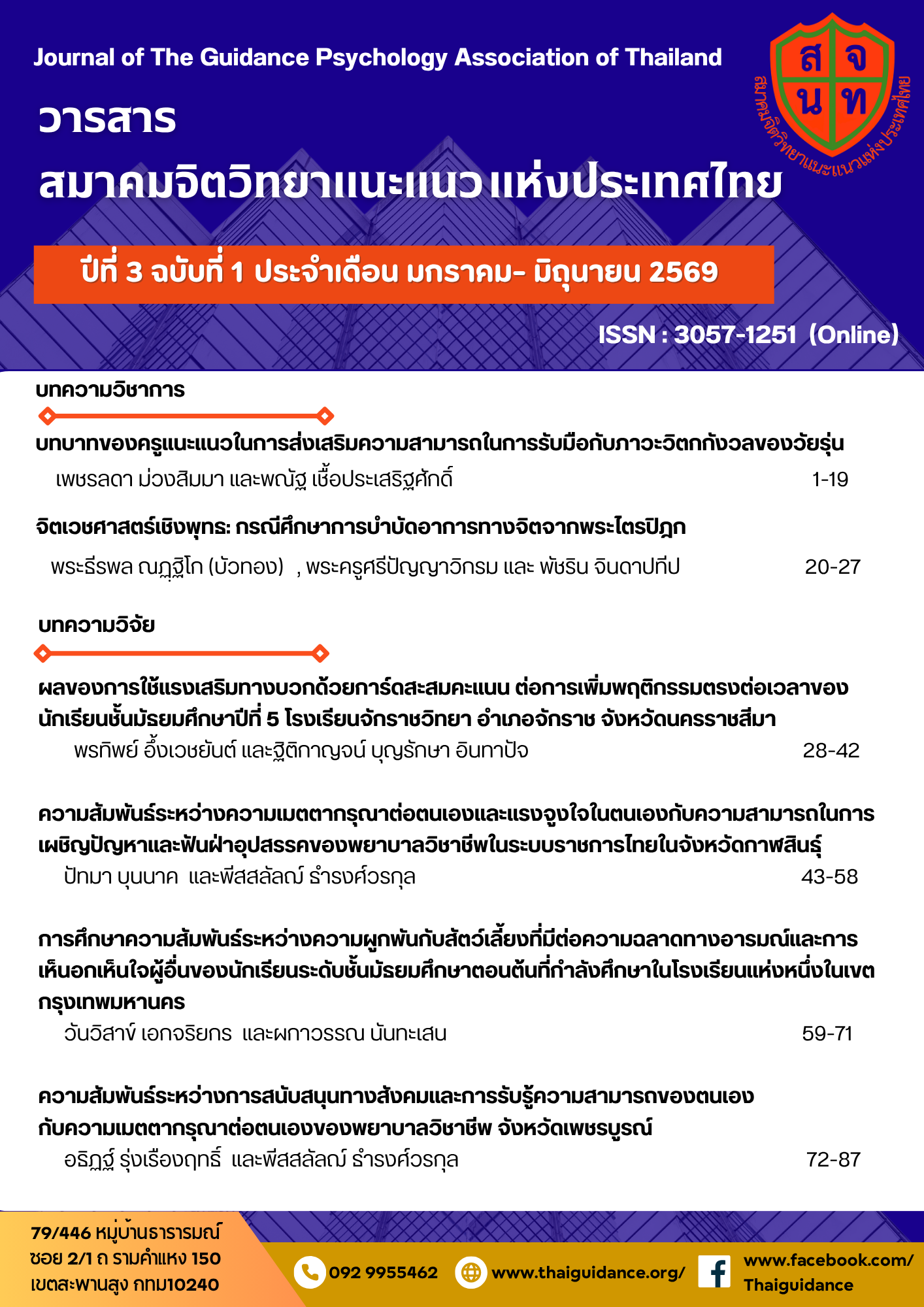
การศึกษาความสัมพันธ์ระหว่างความผูกพันกับสัตว์เลี้ยงที่มีต่อความฉลาดทางอารมณ์ และการเห็นอกเห็นใจผู้อื่นของนักเรียนระดับชั้นมัธยมศึกษาตอนต้น ที่กำลังศึกษาในโรงเรียนแห่งหนึ่งในเขตกรุงเทพมหานคร
Keywords:
ความผูกพันกับสัตว์เลี้ยง, ความฉลาดทางอารมณ์, การเห็นอกเห็นใจผู้อื่นAbstract
The purpose of this research are study 1) The level of Pet attachment, Emotional quotient, and Empathy 2) The relationship between Pet attachment and Emotional quotient 3) The relationship between Pet attachment and Empathy among junior high school students who enrolled in a secondary school in Bangkok 4) The relationship between Emotional quotient and Empathy. The sample consisted of 250 students selected through stratified random sampling. The research instruments included General information questionnaire, Pet attachment scale, Emotional quotient scale, and Empathy scale. Data were analyzed using statistics including percentage mean standard deviation and Pearson’s correlation coefficient.
The research findings revealed that: 1) The Pet attachment level was relatively high ( = 2.61, SD = 0.76), the overall level of Emotional quotient was relatively high ( = 2.75, SD = 0.30), and the overall level of Empathy was relatively high ( = 3.68, SD = 0.74); 2) There was a significant positive correlation between overall level of pet attachment and emotional quotient (r = .174, p < .01) 3) The relationship between pet attachment and overall empathy was statistically significant positive correlation (r = .315, p < .01) 4) Overall emotional quotient was positively and significantly correlated with the overall empathy (r = .539, p < .01)
References
กรมสุขภาพจิต. (2550). อีคิว: ความฉลาดทางอารมณ์ (ฉบับปรับปรุง). สำนักพัฒนาสุขภาพจิต.
กรมสุขภาพจิต กระทรวงสาธารณสุข. (2563). คู่มือความฉลาดทางอารมณ์วัยรุ่น (อายุ 12-17 ปี) ฉบับปรับปรุงใหม่. สำนักงานกิจการโรงพิมพ์องค์การสงเคราะห์ทหารผ่านศึก.
จุลมณฑล, พ. (2562). ความสัมพันธ์ระหว่างความผูกพันกับสัตว์เลี้ยงและความเหงาในวัยรุ่นโดยมีการสนับสนุนทางสังคมด้านอารมณ์เป็นตัวแปรส่งผ่าน [วิทยานิพนธ์ปริญญามหาบัณฑิต, จุฬาลงกรณ์มหาวิทยาลัย].
Angela, J. M., Brodie, C. S., & Montgomery, D. D. (2020). The effects of animal-assisted interventions on anxiety and depression. Journal of Mental Health Counseling, 42(1), 34–47. https://doi.org/10.1176/ps.49.6.797
Bao, K. J., & Schreer, G. (2016). Pets and happiness: Examining the association between pet ownership and wellbeing. Anthrozoös, 29(2), 283–296. https://doi.org/10.1080/08927936.2016.1152721
Bowlby, J. (1969). Attachment and loss: Vol. 1. Attachment. Basic Books.
Cooper, R. K., & Sawaf, A. (1997). Executive EQ: Emotional intelligence in leadership and organizations. Grosset/Putnam.
Courtney, A., Veenema, A. H., & Portnoy, G. A. (2021). The impact of human–animal interaction on resilience. Frontiers in Psychology, 12, Article 656636. https://doi.org/10.3389/fpsyg.2021.656636
Daly, B., & Morton, L. L. (2009). Empathic differences in adults as a function of childhood and adult pet ownership and pet type. Anthrozoös, 22(4), 371–382. https://doi.org/10.2752/089279309X12538695316383
Davis, M. H. (1983). Measuring individual differences in empathy: Evidence for a multidimensional approach. Journal of Personality and Social Psychology, 44(1), 113–126. https://doi.org/10.1037/0022-3514.44.1.113
Eisenberg, N., & Fabes, R. A. (1998). Prosocial development. In W. Damon (Ed.), Handbook of child psychology (5th ed., Vol. 3, pp. 701–778). Wiley.
Esposito, L., McCune, S., Griffin, J. A., & Maholmes, V. (2011). Directions in human-animal interaction research: Child development, health, and therapeutic interventions. Child Development Perspectives, 5(3), 205–211. https://doi.org/10.1111/j.1750-8606.2011.00175.x
Goleman, D. (1995). Emotional intelligence: Why it can matter more than IQ. Bantam Books.
Goleman, D. (1998). Working with emotional intelligence. Bantam Books.
Gómez-Leal, R., Megías-Robles, A., Gutiérrez-Cobo, M. J., Cabello, R., & Fernández-Berrocal, P. (2021). Exploring the role of empathy as a dual mediator in the relationship between human–pet attachment and quality of life. International Journal of Environmental Research and Public Health, 18(4), Article 1851. https://doi.org/10.3390/ani13132220
Göncz, L. (2017). Teacher personality: A review of psychological research and guidelines for a more comprehensive theory in educational psychology. Open Review of Educational Research, 4(1), 75–95. https://doi.org/10.1080/23265507.2017.1339572
Krejcie, R. V., & Morgan, D. W. (1970). Determining sample size for research activities. Educational and Psychological Measurement, 30(3), 607–610. https://doi.org/10.1177/001316447003000308
Kurdek, L. A. (2008). Pet dogs as attachment figures for adult owners. Journal of Family Psychology, 22(4), 439–446. https://doi.org/10.1037/a0014979
Payne, E., Bennett, P. C., & McGreevy, P. D. (2016). Current perspectives on attachment and bonding in the dog–human dyad. Psychology Research and Behavior Management, 9, 71–79. https://doi.org/10.2147/PRBM.S74972
Poresky, R. H., Hendrix, C., Mosier, J. E., & Samuelson, M. L. (1987). The Companion Animal Bonding Scale: Internal reliability and construct validity. Psychological Reports, 60(3), 743–746. https://doi.org/10.2466/pr0.1987.60.3.743
Poresky, R. H. (1989). The young children's empathy measure: Reliability, validity and factor structure. Journal of Genetic Psychology, 150(3), 355–365. https://doi.org/10.1080/00221325.1989.9914600
Rey, L., Extremera, N., & Pena, M. (2019). Emotional competence relating to perceived stress and academic performance in adolescents: A meta-analytic review. Educational Psychology, 39(10), 1223–1243. https://doi.org/10.7717/peerj.2087
Sable, P. (2013). The pet connection: An attachment perspective. Clinical Social Work Journal, 41, 93–99. https://doi.org/10.1007/s10615-012-0405-2
Serpell, J. (2004). Factors influencing human attitudes to animals and their welfare. Animal Welfare, 13(S1), S145–S151. https://doi.org/10.1017/S0962728600014500
Usán Supervía, P., Salavera Bordás, C., Quílez Robres, A., Lozano Blasco, R., & Latorre Cosculluela, C. (2023). Empathy, self-esteem and satisfaction with life in adolescent. Children and Youth Services Review, 144, Article 106755. https://doi.org/10.1016/j.childyouth.2022.106755
Zilcha-Mano, S., Mikulincer, M., & Shaver, P. R. (2011). Pet in the therapy room: An attachment perspective on animal-assisted therapy. Attachment & Human Development, 13(6), 541–561. https://doi.org/10.1080/14616734.2011.608987
Downloads
Published
How to Cite
Issue
Section
License
Copyright (c) 2026 (The Guidance Psychology Association of Thailand

This work is licensed under a Creative Commons Attribution-NonCommercial-NoDerivatives 4.0 International License.
บทความที่ได้รับการตีพิมพ์เป็นลิขสิทธิ์ของ สมาคมจิตวิทยาแนะแนวแห่งประเทศไทย
ข้อความที่ปรากฏในบทความแต่ละเรื่องในวารสารวิชาการเล่มนี้เป็นความคิดเห็นส่วนตัวของผู้เขียนแต่ละท่านไม่เกี่ยวข้องกับสมาคมจิตวิทยาแนะแนวแห่งประเทศไทย และบุคลากรท่านอื่น ๆ ใน สมาคมฯ แต่อย่างใด ความรับผิดชอบองค์ประกอบทั้งหมดของบทความแต่ละเรื่องเป็นของผู้เขียนแต่ละท่าน หากมีความผิดพลาดใดๆ ผู้เขียนแต่ละท่านจะรับผิดชอบบทความของตนเองแต่ผู้เดียว


