
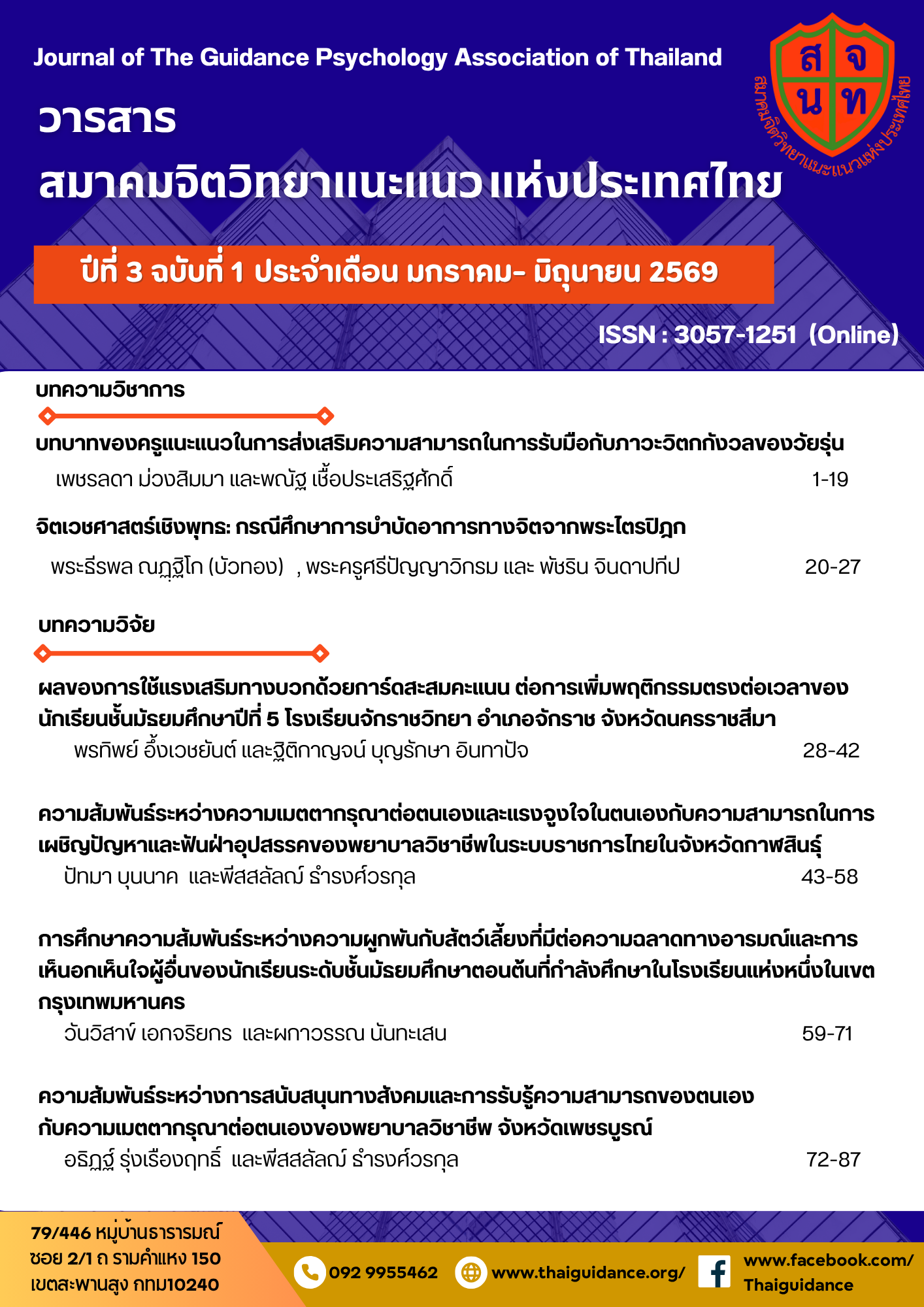
Relationship Study Between Self-Compassion, Self-Motivation and Adversity Quotient among Registered Nurses of The Thai Bureaucracy in Kalasin Province
Keywords:
ความเมตตากรุณาต่อตนเอง, แรงจูงใจในตนเอง, การเผชิญปัญหา, พยาบาลวิชาชีพAbstract
This study aimed to 1) study level of self-compassion, self-motivation, and the Adversity Quotient of Registered Nurses in the Thai Bureaucracy in Kalasin Province; and 2) study relationship between self-compassion, self-motivation, and the Adversity Quotient of Registered Nurses in the Thai Bureaucracy in Kalasin Province. The sample comprised 325 registered nurses from in the Thai Bureaucracy in Kalasin Province, selected using cluster random samplingThe research instruments used in this study were a self-compassion scale, self-motivation scale, and adversity quotient scale. Data were analyzed using descriptive statistics—including frequency, percentage, mean, and standard deviation—and Pearson’s correlation coefficient
was employed to test the study hypotheses.
The results of this study revealed that 1) registered nurses in the Thai Bureaucracy in Kalasin Province exhibited high overall average scores for self-compassion ( = 4.00, SD = 0.44), self-motivation (= 4.08, SD = 0.43), and adversity quotient (= 3.92, SD = 0.45). 2) Self-compassion and self-motivation were positively correlated with the adversity quotient of these registered nurses, with the relationships being statistically significant at the .01 level.
References
สำนักงานสาธารณสุขจังหวัดกาฬสินธุ์. (2567). รายงานสถานการณ์บุคลากรพยาบาลในระบบราชการ. กาฬสินธุ์: สำนักสาธารณสุขจังหวัด.
อรพินทร์ ชูชม, อัจฉรา สุขารมณ์ และ วิลาสลักษณ์ ชัววัลลี. (2542). การพัฒนาแบบวัดแรงจูงใจภายใน. กรุงเทพฯ: สถาบันวิจัยพฤติกรรมศาสตร์ มหาวิทยาลัยศรีนครินทรวิโรฒ.
อุ่นทรพันธ์ อ., & ธำรงวรกุล พ. (2025). ความสัมพันธ์ระหว่างการสนับสนุนทางสังคมและการปรับตัวกับความเมตตาต่อตนเอง ของผู้สูงอายุในอำเภอเมือง จังหวัดกาฬสินธุ์. วารสารสมาคมจิตวิทยาแนะแนวแห่งประเทศไทย (Online), 2(1), 15–28.
Alshagrawi, S. (2023). Coping during the COVID-19 pandemic: A qualitative study of healthcare workers in Saudi Arabia. Illness, Crisis & Loss, 32(4), 700-720.
Azizkhani, R., Nasr-Esfahani, M., Gholipour, Z., Azarkhavarani, M.G., & Kabirian, M. (2023). Multiple Correlations of Resilience with Self-Compassion, Self-Control, and Problem-Solving Styles in Emergency Medical Services (EMS) Workers in Isfahan, Iran. Hosp Pract Res., 8(3), 304–309.
Best, J. W., & Kahn, J. V. (1983). Research in education (4th ed.). Englewood Cliffs, NJ: Prentice-Hall.
Fredrickson, B.L. (2001). The Role of Positive Emotions in Positive Psychology: The Broaden-and-Build Theory of Positive Emotions. American Psychologist, 56(3), 218–226. doi.org/10.1037/0003-066X.56.3.218.
Gilbert, P. (2009). The Compassionate Mind: A New Approach to Life Challenges. London: Constable and Robinson Ltd.
Kabat-Zinn, J. (1990). Full Catastrophe Living: Using the Wisdom of Your Body and Mind to Face Stress, Pain and Illness. New York: Delacorte.
Kusurkar, R.A., Ten Cate, T.J., Vos, C.M., Westers, P., & Croiset, G. (2013). How Motivation Affects Academic Performance: A Structural Equation Modelling Analysis. Adv Health Sci Educ Theory Pract, 18(1): 57–69. doi: 10.1007/s10459-012-9354-3.
Laschinger, H.K.S., Finegan, J., & Wilk, P. (2009). Context Matters: The Impact of Unit Leadership and Empowerment on Nurses’ Organizational Commitment. Journal of Nursing Administration, 39(5), 228-235.
Leary, M.R., Tate, E.B., Adams, C.E., Batts Allen, A., & Hancock, J. (2007). Self-Compassion and Reactions to Unpleasant Self-Relevant Events: The Implications of Treating Oneself Kindly. Journal of Personality and Social Psychology, 92(5), 887–904. doi.org/10.1037/0022-3514.92.5.887.
MacBeth, A., & Gumley, A. (2012). Exploring Compassion: A Meta-Analysis of the Association between Self-Compassion and Psychopathology. Clinical Psychology Review, 32, 545–552. doi.org/10.1016/j.cpr.2012.06.003.
McHugh, M.D., Kutney-Lee, A., Cimiotti, J.P., Sloane, D.M., & Aiken, L.H. (2011). Nurses’ Widespread Job Dissatisfaction, Burnout, and Frustration with Health Benefits Signal Problems for Patient Care. Health Affairs, 30(2), 202–210.
Neff, K.D. (2003a). The Development and Validation of a Scale to Measure Self-Compassion. Self and Identity, 2, 223–250.
Neff, K.D. (2003b). Self-Compassion: An Alternative Conceptualization of a Healthy Attitude toward Oneself. Self and Identity, 2, 85–101.
Ryan, R.M., & Deci, E.L. (2000). Self-Determination Theory and the Facilitation of Intrinsic Motivation, Social Development, and Well-Being. American Psychologist, 55(1), 68–78.
Shapiro, S.L., Carlson, L.E., Astin, J.A., Freedman, B. (2006). Mechanisms of mindfulness. J. Clin. Psychol, 62(3), 373–386.
Sirois, F.M., Molnar, D.S., & Hirsch, J.K. (2014). Self-Compassion, Stress and Coping in the Context of Chronic Illness. Self and Identity, 14(3), 1–31.
Stoltz, P.G. (1997). Adversity Quotient: Turning Obstacles into Opportunities. New Jersey: Wiley.
Stoltz, P.G. (2000). Adversity quotient @ work. New York: Harper Business.
Stoltz, P.G. (2005). Adversity Quotient. Jakarta, Indonesia: Grasindo.
Vroom, V. (1964). Work and Motivation. New York: Wiley and Sons.
Woo, H. Y., & Song, J. H. (2015). The factors affecting the adversity quotient of nurses and office workers. International Journal of Bio-Science and Bio-Technology, 7(5), 1-10.
Yamane, T. (1967). Statistics: An introductory analysis (2nd ed.). New York, NY: Harper and Row.
Downloads
Published
How to Cite
Issue
Section
License
Copyright (c) 2026 (The Guidance Psychology Association of Thailand

This work is licensed under a Creative Commons Attribution-NonCommercial-NoDerivatives 4.0 International License.
บทความที่ได้รับการตีพิมพ์เป็นลิขสิทธิ์ของ สมาคมจิตวิทยาแนะแนวแห่งประเทศไทย
ข้อความที่ปรากฏในบทความแต่ละเรื่องในวารสารวิชาการเล่มนี้เป็นความคิดเห็นส่วนตัวของผู้เขียนแต่ละท่านไม่เกี่ยวข้องกับสมาคมจิตวิทยาแนะแนวแห่งประเทศไทย และบุคลากรท่านอื่น ๆ ใน สมาคมฯ แต่อย่างใด ความรับผิดชอบองค์ประกอบทั้งหมดของบทความแต่ละเรื่องเป็นของผู้เขียนแต่ละท่าน หากมีความผิดพลาดใดๆ ผู้เขียนแต่ละท่านจะรับผิดชอบบทความของตนเองแต่ผู้เดียว


