
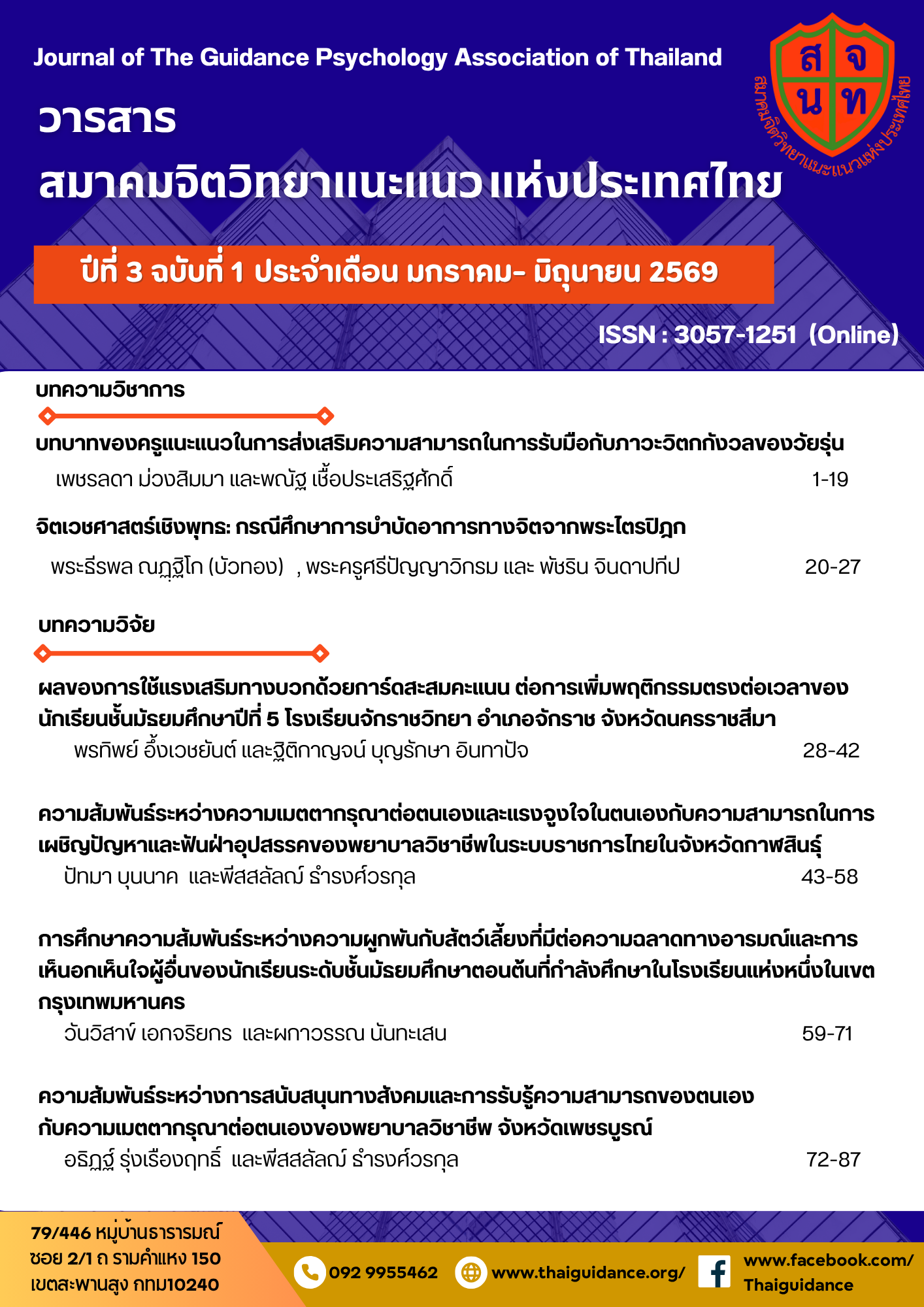
การศึกษาความสัมพันธ์ระหว่างความผูกพันกับสัตว์เลี้ยงที่มีต่อความฉลาดทางอารมณ์ และการเห็นอกเห็นใจผู้อื่นของนักเรียนระดับชั้นมัธยมศึกษาตอนต้น ที่กำลังศึกษาในโรงเรียนแห่งหนึ่งในเขตกรุงเทพมหานคร
คำสำคัญ:
ความผูกพันกับสัตว์เลี้ยง, ความฉลาดทางอารมณ์, การเห็นอกเห็นใจผู้อื่นบทคัดย่อ
การศึกษาครั้งนี้เพื่อศึกษา 1) ระดับความผูกพันกับสัตว์เลี้ยง ความฉลาดทางอารมณ์ และการเห็นอกเห็นใจผู้อื่น 2) ความสัมพันธ์ระหว่างความผูกพันกับสัตว์เลี้ยงกับความฉลาดทางอารมณ์ 3) ความสัมพันธ์ระหว่างความผูกพันกับสัตว์เลี้ยงกับการเห็นอกเห็นใจผู้อื่น 4) ความสัมพันธ์ระหว่างความฉลาดทางอารมณ์กับการเห็นอกเห็นใจผู้อื่น กลุ่มตัวอย่างเป็นนักเรียนระดับชั้นมัธยมศึกษาตอนต้นที่ศึกษาในโรงเรียนแห่งหนึ่ง ในจังหวัดกรุงเทพมหานคร จำนวน 250 คน โดยเครื่องมือในการวิจัย ได้แก่ แบบสอบถามปัจจัยส่วนบุคคล แบบวัดความผูกพันกับสัตว์เลี้ยง แบบวัดความฉลาดทางอารมณ์ และแบบวัดการเห็นอกเห็นใจผู้อื่น ผู้วิจัยวิเคราะห์ข้อมูลโดยใช้สถิติ ได้แก่ ร้อยละ ค่าเฉลี่ย ส่วนเบี่ยงเบนมาตรฐาน และค่าสัมประสิทธิ์สหสัมพันธ์ของเพียร์สัน
ผลการศึกษาพบว่า 1) นักเรียนมีระดับความผูกพันกับสัตว์เลี้ยงค่อนข้างสูง (x̄ = 2.61, SD = 0.76) มีระดับความฉลาดทางอารมณ์โดยรวมค่อนข้างสูง (x̄ = 2.75, SD = 0.30) และมีระดับการเห็นอกเห็นใจผู้อื่นโดยรวมค่อนข้างสูง (x̄ = 3.68, SD = 0.74) 2) ความผูกพันกับสัตว์เลี้ยงมีความสัมพันธ์ทางบวกกับความฉลาดทางอารมณ์ (r = .174) 3) ความผูกพันกับสัตว์เลี้ยงมีความสัมพันธ์ทางบวกกับการเห็นอกเห็นใจผู้อื่น (r = .315) 4) ความฉลาดทางอารมณ์มีความสัมพันธ์ทางบวกกับการเห็นอกเห็นใจผู้อื่น (r = .539)
เอกสารอ้างอิง
กรมสุขภาพจิต. (2550). อีคิว: ความฉลาดทางอารมณ์ (ฉบับปรับปรุง). สำนักพัฒนาสุขภาพจิต.
กรมสุขภาพจิต กระทรวงสาธารณสุข. (2563). คู่มือความฉลาดทางอารมณ์วัยรุ่น (อายุ 12-17 ปี) ฉบับปรับปรุงใหม่. สำนักงานกิจการโรงพิมพ์องค์การสงเคราะห์ทหารผ่านศึก.
จุลมณฑล, พ. (2562). ความสัมพันธ์ระหว่างความผูกพันกับสัตว์เลี้ยงและความเหงาในวัยรุ่นโดยมีการสนับสนุนทางสังคมด้านอารมณ์เป็นตัวแปรส่งผ่าน [วิทยานิพนธ์ปริญญามหาบัณฑิต, จุฬาลงกรณ์มหาวิทยาลัย].
Angela, J. M., Brodie, C. S., & Montgomery, D. D. (2020). The effects of animal-assisted interventions on anxiety and depression. Journal of Mental Health Counseling, 42(1), 34–47. https://doi.org/10.1176/ps.49.6.797
Bao, K. J., & Schreer, G. (2016). Pets and happiness: Examining the association between pet ownership and wellbeing. Anthrozoös, 29(2), 283–296. https://doi.org/10.1080/08927936.2016.1152721
Bowlby, J. (1969). Attachment and loss: Vol. 1. Attachment. Basic Books.
Cooper, R. K., & Sawaf, A. (1997). Executive EQ: Emotional intelligence in leadership and organizations. Grosset/Putnam.
Courtney, A., Veenema, A. H., & Portnoy, G. A. (2021). The impact of human–animal interaction on resilience. Frontiers in Psychology, 12, Article 656636. https://doi.org/10.3389/fpsyg.2021.656636
Daly, B., & Morton, L. L. (2009). Empathic differences in adults as a function of childhood and adult pet ownership and pet type. Anthrozoös, 22(4), 371–382. https://doi.org/10.2752/089279309X12538695316383
Davis, M. H. (1983). Measuring individual differences in empathy: Evidence for a multidimensional approach. Journal of Personality and Social Psychology, 44(1), 113–126. https://doi.org/10.1037/0022-3514.44.1.113
Eisenberg, N., & Fabes, R. A. (1998). Prosocial development. In W. Damon (Ed.), Handbook of child psychology (5th ed., Vol. 3, pp. 701–778). Wiley.
Esposito, L., McCune, S., Griffin, J. A., & Maholmes, V. (2011). Directions in human-animal interaction research: Child development, health, and therapeutic interventions. Child Development Perspectives, 5(3), 205–211. https://doi.org/10.1111/j.1750-8606.2011.00175.x
Goleman, D. (1995). Emotional intelligence: Why it can matter more than IQ. Bantam Books.
Goleman, D. (1998). Working with emotional intelligence. Bantam Books.
Gómez-Leal, R., Megías-Robles, A., Gutiérrez-Cobo, M. J., Cabello, R., & Fernández-Berrocal, P. (2021). Exploring the role of empathy as a dual mediator in the relationship between human–pet attachment and quality of life. International Journal of Environmental Research and Public Health, 18(4), Article 1851. https://doi.org/10.3390/ani13132220
Göncz, L. (2017). Teacher personality: A review of psychological research and guidelines for a more comprehensive theory in educational psychology. Open Review of Educational Research, 4(1), 75–95. https://doi.org/10.1080/23265507.2017.1339572
Krejcie, R. V., & Morgan, D. W. (1970). Determining sample size for research activities. Educational and Psychological Measurement, 30(3), 607–610. https://doi.org/10.1177/001316447003000308
Kurdek, L. A. (2008). Pet dogs as attachment figures for adult owners. Journal of Family Psychology, 22(4), 439–446. https://doi.org/10.1037/a0014979
Payne, E., Bennett, P. C., & McGreevy, P. D. (2016). Current perspectives on attachment and bonding in the dog–human dyad. Psychology Research and Behavior Management, 9, 71–79. https://doi.org/10.2147/PRBM.S74972
Poresky, R. H., Hendrix, C., Mosier, J. E., & Samuelson, M. L. (1987). The Companion Animal Bonding Scale: Internal reliability and construct validity. Psychological Reports, 60(3), 743–746. https://doi.org/10.2466/pr0.1987.60.3.743
Poresky, R. H. (1989). The young children's empathy measure: Reliability, validity and factor structure. Journal of Genetic Psychology, 150(3), 355–365. https://doi.org/10.1080/00221325.1989.9914600
Rey, L., Extremera, N., & Pena, M. (2019). Emotional competence relating to perceived stress and academic performance in adolescents: A meta-analytic review. Educational Psychology, 39(10), 1223–1243. https://doi.org/10.7717/peerj.2087
Sable, P. (2013). The pet connection: An attachment perspective. Clinical Social Work Journal, 41, 93–99. https://doi.org/10.1007/s10615-012-0405-2
Serpell, J. (2004). Factors influencing human attitudes to animals and their welfare. Animal Welfare, 13(S1), S145–S151. https://doi.org/10.1017/S0962728600014500
Usán Supervía, P., Salavera Bordás, C., Quílez Robres, A., Lozano Blasco, R., & Latorre Cosculluela, C. (2023). Empathy, self-esteem and satisfaction with life in adolescent. Children and Youth Services Review, 144, Article 106755. https://doi.org/10.1016/j.childyouth.2022.106755
Zilcha-Mano, S., Mikulincer, M., & Shaver, P. R. (2011). Pet in the therapy room: An attachment perspective on animal-assisted therapy. Attachment & Human Development, 13(6), 541–561. https://doi.org/10.1080/14616734.2011.608987
ดาวน์โหลด
เผยแพร่แล้ว
รูปแบบการอ้างอิง
ฉบับ
ประเภทบทความ
สัญญาอนุญาต
ลิขสิทธิ์ (c) 2026 สมาคมจิตวิทยาแนะแนวแห่งประเทศไทย

อนุญาตภายใต้เงื่อนไข Creative Commons Attribution-NonCommercial-NoDerivatives 4.0 International License.
บทความที่ได้รับการตีพิมพ์เป็นลิขสิทธิ์ของ สมาคมจิตวิทยาแนะแนวแห่งประเทศไทย
ข้อความที่ปรากฏในบทความแต่ละเรื่องในวารสารวิชาการเล่มนี้เป็นความคิดเห็นส่วนตัวของผู้เขียนแต่ละท่านไม่เกี่ยวข้องกับสมาคมจิตวิทยาแนะแนวแห่งประเทศไทย และบุคลากรท่านอื่น ๆ ใน สมาคมฯ แต่อย่างใด ความรับผิดชอบองค์ประกอบทั้งหมดของบทความแต่ละเรื่องเป็นของผู้เขียนแต่ละท่าน หากมีความผิดพลาดใดๆ ผู้เขียนแต่ละท่านจะรับผิดชอบบทความของตนเองแต่ผู้เดียว


